
Resources
Explore a wide range of valuable resources on GCED to deepen your understanding and enhance your research, advocacy, teaching, and learning.
684 Results found
 Recomendación sobre la educación para la paz, los derechos humanos y el desarrollo sostenible: guía de implementación Year of publication: 2026 Corporate author: UNESCO Sin educación no hay paz. Una educación transformadora, orientada a la construcción y el mantenimiento de la paz es más urgente que nunca, dado el aumento de los conflictos en diversos frentes.La Recomendación sobre la Educación para la Paz y los Derechos Humanos, la Comprensión Internacional, la Cooperación, las Libertades Fundamentales, la Ciudadanía Mundial y el Desarrollo Sostenible, que fue adoptada por los 194 Estados Miembros de la UNESCO en 2023, articula la visión humanista y transformadora de la educación que ayuda a abordar los actuales y futuros agravios a la paz. Estos desafíos abarcan desde el resurgimiento de conflictos impulsados por desigualdades e injusticias sistémicas, el auge y la propagación del discurso de odio, el racismo y la discriminación—especialmente en línea—, hasta los efectos adversos de las tecnologías digitales y la amenaza existencial del cambio climático.La UNESCO ha elaborado esta Guía como la primera de varias herramientas que ayudarán a los Estados miembro a comprender e implementar plenamente la Recomendación de 2023. Su contenido ha sido desarrollado integrando la perspectiva transdisciplinaria para conectar conceptos y cuestiones clave de la Recomendación de 2023. Además, proporciona ideas concretas y recursos seleccionados para la acción en distintos niveles y tipos de educación. Asimismo, promueve un enfoque multisectorial que parte de las iniciativas positivas ya en marcha y busca la inclusión de todas las personas.Esta Guía es una incorporación oportuna al conjunto de recursos colectivos disponibles para implementar plenamente la Recomendación de 2023 y promover así una educación transformadora para un mundo justo y pacífico.
  The Role of Kuwaiti Satellite Channels in Promotion of Citizenship among Kuwaiti Youth Year of publication: 2012 Author: Hassan Al Gharbi Corporate author: Middle East University The focus of the problem that the research dealt with was on the following question: Have public and private Kuwaiti satellite channels contributed to enhancing the concept of citizenship among young Kuwaitis? The researcher adopted a definition of the concept of citizenship among the multiple definitions of this concept, which was tainted by some uncertainty and disagreement. Citizenship in this study "is the awareness of belonging to a geographical area of a specific political and social goals and shared one common culture and political system." دور الفضائيات الكويتية الرسمية و الخاصة في تعزيز المواطنة لدى الشباب الكويتي Year of publication: 2012 Author: Hassan Al Gharbi Corporate author: Middle East University تركزت المشكلة التي تناولها البحث على التساؤل التالي: هل ساهمت القنوات الفضائية الكويتية العامة والخاصة في تعزيز مفهوم المواطنة بين الشباب الكويتي؟ واعتمدت الباحثة تعريفاً لمفهوم المواطنة من بين التعاريف المتعددة لهذا المفهوم ، والذي شابه بعض عدم اليقين والاختلاف. المواطنة في هذه الدراسة "هي الوعي بالانتماء إلى منطقة جغرافية لأهداف سياسية واجتماعية محددة ومشتركة في ثقافة ونظام سياسي واحد".
  How Digital is Transforming the Lives of Young People in Small Island Developing States Year of publication: 2024 Corporate author: United Nations Development Programme (UNDP) Young people represent a sizeable and vital population in Small Island Developing States (SIDS). For them, digital technologies are more than just tools; they are gateways to new horizons. Digital is creating fresh opportunities, opening doors to unconventional careers, and redefining how knowledge is acquired and shared. Young people are using digital to start new businesses, explore new opportunities, learn new knowledge and skills, and to build global connections. However, young people are also cautious about digital – and they recognise risks and issues posed by digital channels, tools, and technologies. ‘How Digital is Transforming the Lives of Young People in SIDS’ explores these opportunities and challenges by hearing from young people – in their own words. Through a bespoke survey chatbot, running on messaging platforms most used by young people living in SIDS, more than 5,000 respondents from over 30 countries discuss how they’re using digital to transform their lives and livelihoods. And the barriers and challenges that they are facing on their digital journeys.
  Learning to live together Year of publication: 2014 Corporate author: UNESCO Bangkok The importance of LTLT has increased in recent years. Indeed, relevant competencies appear to be gaining focus in international frameworks and educational initiatives across countries. This is all the more necessary as Voogt and Roblin (2012) argue, given the demands of our increasingly knowledge-based society in which “ideas and knowledge function as commodities” (p. 299 –300) and to which effective social and emotional skills are critical. It is perhaps all the more critical given the multivariate global challenges in the 21st Century and the need for unified global commitment to effectively combat these challenges. In this context, the significance of LTLT is reflected in both the rise of and growing interest in Global Citizenship Education (GCE), Education for Sustainable Development (ESD), Education for International Understanding (EIU) as well as peace and human rights education. The UN Secretary-General’s Global Education First Initiative, which lists ‘Fostering Global Citizenship’ as one of its three global priorities, also implicitly recognizes the significance of LTLT as a precursor to the building of a more peaceful society, one in which discrimination is intolerable and common challenges such as climate change and abject poverty are tackled together.Yet despite the significance of LTLT in the 21st Century, and despite numerous international initiatives to foster LTLT competencies, there is a large gap of evidence identifying how this supposition is translated into effective policy and curricula, and eventually into the reality of schools, teachers and learners. This report is a response to this gap, and attempts to understand how ten selected countries in the Asia-Pacific region – Afghanistan, Australia, Indonesia, Malaysia, Myanmar, Nepal, The Philippines, Republic of Korea, Sri Lanka and Thailand – have reflected and integrated LTLT into their education policies and initiatives. This variety of countries aims to reflect their diverse experiences in terms of reflecting LTLT through their education systems. By exploring a number of areas, namely policy, curricula, teachers and assessment, this study aims to identify what has so far been achieved in education systems of the Asia-Pacific region in the area of LTLT.This report is therefore targeted predominantly at education policy makers, researchers, academics as well as education practitioners of the Asia-Pacific region. Given its connection to Global Citizenship Education and other relevant international initiatives around sustainability and peace education, this report is also relevant to UNESCO’s partner organizations and the broader educational development community.This report will first present the research framework for the study, before exploring the social and economic contexts in the ten selected countries and wider regional factors in the Asia-Pacific in relation to global challenges in Chapter Two. Chapter Three will then examine national policy frameworks, including the vision of those policies in defining LTLT in education. Chapter Four focuses on the national curriculum in selected countries and the extent to which they incorporate learning objectives, subjects, and extra-curricular activities reflecting the concept of LTLT and related skills and competencies. In Chapter Five, teaching practices are examined, including the role of teachers and teacher education, as well as teaching methods and application of media and information literacy (MIL) in the classroom. Chapter Six then looks at assessment, and how far countries have attempted to develop assessment frameworks that measure the skills and competencies related to LTLT. Finally, Chapter Seven provides reflections and conclusions based on the main findings of the study, while also identifying trends across policy domains, shortcomings and some policy considerations.
  International Conference on Artificial Intelligence and Education, Planning Education in the AI Era: Lead the Leap; Final Report Year of publication: 2019 Corporate author: UNESCO The current report is an exhaustive account of the discussion and debate at the International Conference on Artificial Intelligence and Education (hereafter referred to as ‘the conference’) held in Beijing from 16 to 18 May 2019. Under the overarching theme of ‘Planning Education in the AI Era: Lead the Leap’, the conference was structured into seven plenary sessions and 16 breakout sessions complemented by a live exhibition and study tours to facilitate forwardlooking debates, share cutting-edge knowledge and AI solutions, and deliberate on sector-wide strategies.
 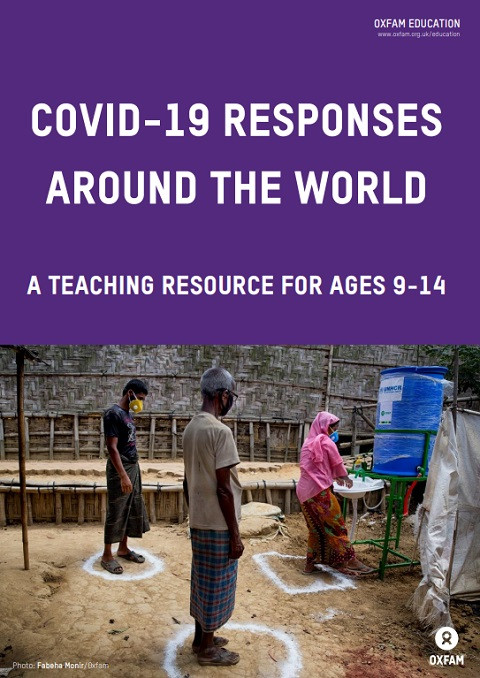 COVID-19 Responses Around the World: A Teaching Resource for Ages 9-14 Year of publication: 2021 Corporate author: Oxfam GB This resource helps learners to discuss their thoughts and feelings about the pandemic with others. Learners will also find out about ways to stop the current ‘infodemic’ – the rapid spread of misinformation and disinformation about COVID-19.This material will help learners to:discuss their thoughts and feelings about COVID-19.investigate some of the incredible ways in which people have been responding to this crisis.understand the difference between information, disinformation and misinformation.consider their own responses to the pandemic and possible actions that they might take to manage their own wellbeing and support others.
 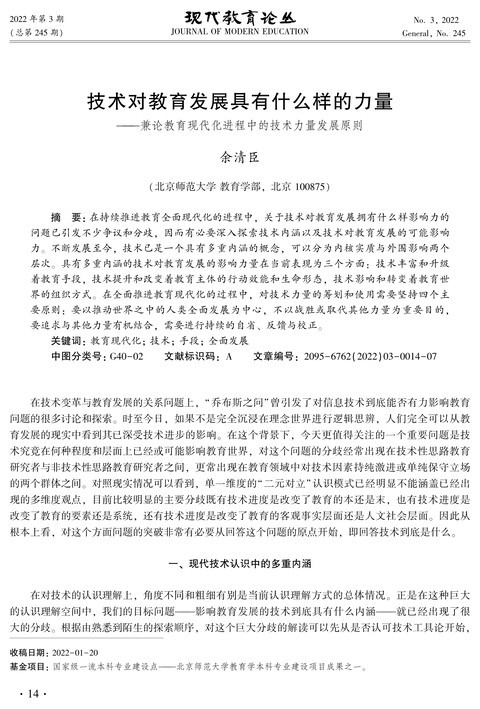 What Kind of Power Does Technology Have on the Development of Education: On the Development Principle of Technical Force in the Process of Educational Modernization (Modern Education Review; No.3, 2022) Year of publication: 2022 Author: 余清臣 In the process of continuously promoting the comprehensive modernization of education, the issue of what influence technology has on the development of education has caused many debates and disputes. Therefore, it is necessary to deeply explore the connotation of technology and the possible influence of technology on the development of education. Up to now, technology has been a concept with multiple connotations, which can be divided into two levels:core essence and peripheral influence. At present, the influence of technology with multiple connotations on educational development is manifested in three aspects:technology enriches and upgrades educational means, promotes and changes the action efficiency and life form of educational subjects, and influences and changes the way the educational world is organized. In the process of comprehensively promoting the modernization of education, the planning and application of technological forces in education should focus on promoting the all-round development of mankind in the world, not on defeating or replacing other forces, and pursue the organic combination with other forces. In addition, continuous introspection, feedback and correction are also very important. 技术对教育发展具有什么样的力量: 兼论教育现代化进程中的技术力量发展原则 (现代教育论丛; No.3, 2022) Year of publication: 2022 Author: 余清臣 在持续推进教育全面现代化的进程中,关于技术对教育发展拥有什么样影响力的问题已引发不少争议和分歧,因而有必要深入探索技术内涵以及技术对教育发展的可能影响力。不断发展至今,技术已是一个具有多重内涵的概念,可以分为内核实质与外围影响两个层次。具有多重内涵的技术对教育发展的影响力量在当前表现为三个方面:技术丰富和升级着教育手段,技术提升和改变着教育主体的行动效能和生命形态,技术影响和转变着教育世界的组织方式。在全面推进教育现代化的过程中,对技术力量的筹划和使用需要坚持四个主要原则:要以推动世界之中的人类全面发展为中心,不以战胜或取代其他力量为重要目的,要追求与其他力量有机结合,需要进行持续的自省、反馈与校正。
 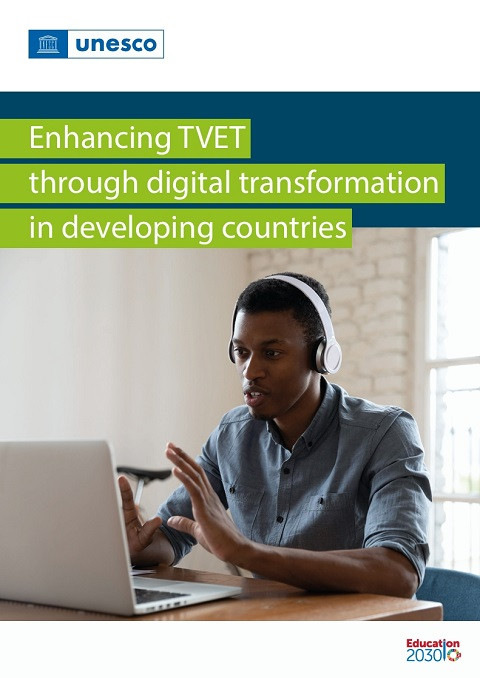 Enhancing TVET through Digital Transformation in Developing Countries Year of publication: 2023 Corporate author: UNESCO Technological advancements and digitalization are profoundly reshaping our work and lifestyle, business models and operations, and government policy choices. Digital transformation in technical and vocational education and training (TVET) is the planned and structured introduction of automated and streamlined processes within institutions and national technical and vocational education and training (TVET) systems through digital technology, with the goal of enhancing their scope, scale, efficiency and effectiveness and ultimately, driving their more sustainable development. This document provides overall perspective and five country case studies on digital transformation in TVET. Most countries studied face similar enabling factors: the digital infrastructure available; legal and policy frameworks; focused institutional change to improve the acquisition of digital skills; and the promotion of equality and inclusivity. To understand how digital transformation in TVET is occurring, the report analyses it at four levels: technical and technological development; curriculum and qualifications; teaching and learning using technology; and its contribution to the sustainability and resilience of societies.