
Resources
Explore a wide range of valuable resources on GCED to deepen your understanding and enhance your research, advocacy, teaching, and learning.
1,448 Results found
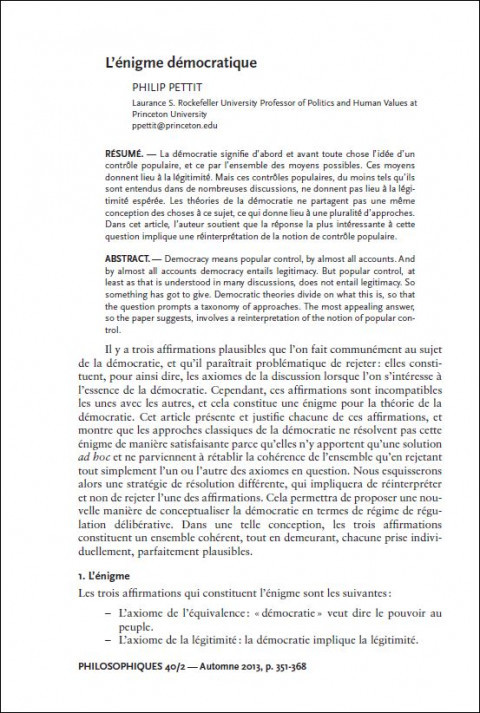 The Democratic Enigma Year of publication: 2014 Author: Philip Pettit Corporate author: Philosophiques Democracy means popular control, by almost all accounts. And by almost all accounts democracy entails legitimacy. But popular control, at least as that is understood in many discussions, does not entail legitimacy. So something has got to give. Democratic theories divide on what this is, so that the question prompts a taxonomy of approaches. The most appealing answer, so the paper suggests, involves a reinterpretation of the notion of popular control. L’énigme démocratique Year of publication: 2014 Author: Philip Pettit Corporate author: Philosophiques La démocratie signifie d’abord et avant toute chose l’idée d’un contrôle populaire, et ce par l’ensemble des moyens possibles. Ces moyens donnent lieu à la légitimité. Mais ces contrôles populaires, du moins tels qu’ils sont entendus dans de nombreuses discussions, ne donnent pas lieu à la légitimité espérée. Les théories de la démocratie ne partagent pas une même conception des choses à ce sujet, ce qui donne lieu à une pluralité d’approches. Dans cet article, l’auteur soutient que la réponse la plus intéressante à cette question implique une réinterprétation de la notion de contrôle populaire.
 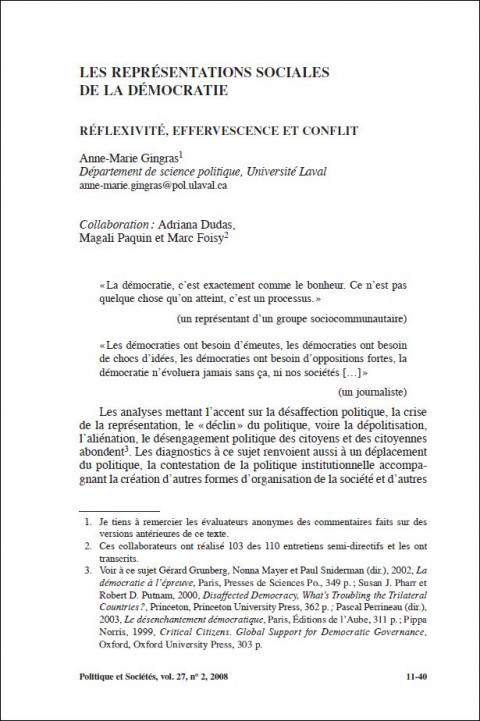 The Social Representations of Democracy: Reflexivity, Efferevescence and Conflict Year of publication: 2008 Author: Anne-Marie Gingras | Adriana Dudas | Magali Paquin | Marc Foisy Corporate author: Politique et Sociétés (Canada) This paper deals with “democracy within society” that appears predominantly in our research on social representations of democracy. We have interviewed 110 persons who have a regular access to the public sphere to perceive their understanding of democracy, its many dimensions, and its main stakes. Democracy within society, or democracy as a state of society, is opposed to institutional democracy (that is, political practices and Rule of law) toward which critics abound. Democracy within society is twofold: on the one hand, emphasis on effervescence and reflexivity that crystallize in collective organisations and in debate and communication and, on the other hand, assimilation of democracy to conflict, considered in terms of normality and processes. Moreover, democracy within society needs an actor, the citizen, who does not respond to the call of democracy, as shown in the many social sciences studies of the last decades. Les représentations sociales de la démocratie: réflexivité, effervescence et conflit Year of publication: 2008 Author: Anne-Marie Gingras | Adriana Dudas | Magali Paquin | Marc Foisy Corporate author: Politique et Sociétés (Canada) Cet article porte sur la « démocratie sociale », un concept qui ressort avec force dans notre recherche sur les représentations sociales sur la démocratie. Nous avons interviewé 110 personnes ayant accès à l’espace public dans le but de saisir leur compréhension de la démocratie, de ses diverses dimensions et des principaux enjeux qui l’affectent. La démocratie sociale, ou démocratie comme état de société, s’oppose à la démocratie institutionnelle (pratiques politiques institutionnelles et État de droit) à l’égard de laquelle les critiques abondent. La démocratie sociale comporte deux volets : d’une part, l’insistance sur l’effervescence et la réflexivité qui s’incarnent dans l’organisation collective et dans le débat et la communication et, d’autre part, l’assimilation de la démocratie au conflit qui est pensé en termes de normalité et de processus. Cependant, la démocratie sociale a besoin d’un acteur, le citoyen, qui, comme le montrent les travaux en sciences sociales depuis des décennies, ne répond pas à l’appel de la construction de la démocratie.
 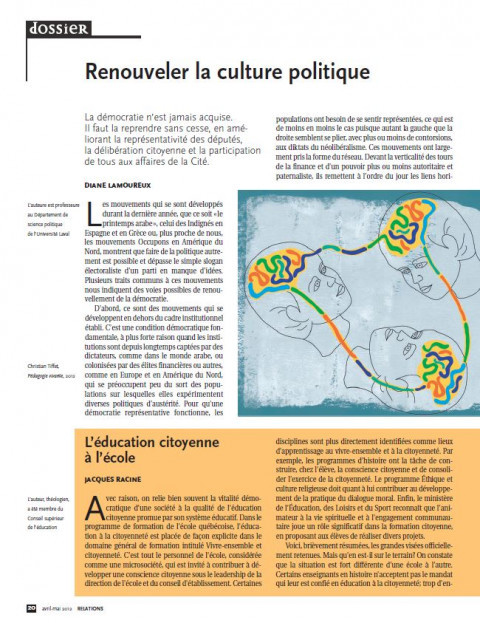 Citizenship Education at School Year of publication: 2012 Author: Jacques Racine Corporate author: Relations Special Issue of Relations intitled "Our democracy (23 articles) L’éducation citoyenne à l’école Year of publication: 2012 Author: Jacques Racine Corporate author: Relations Numéro spécial de la revue Relations intitulé "Notre démocratie : fiction ou réalité ?" (23 articles)
 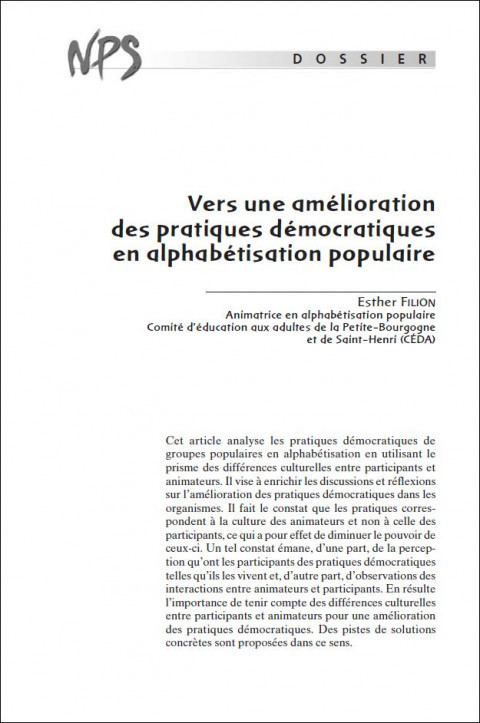 Aiming to Improve Democractic Practices in Relation to Literacy Year of publication: 2011 Author: Esther Filion Corporate author: Nouvelles pratiques sociales The article analyses the democratic practices in place within community literacy groups, through the prism of cultural differences existing between participants and facilitators. Its objective is to enrich discussions and research relative to the improvement of democratic practices within such organizations. It states that the practices are usually modeled on the facilitators’ own culture rather than on that of the participants, thus reducing their power. This assessment is based on the participants’ perception of their group’s democratic practices, and on the interactions observed between facilitators and participants. It is therefore essential to take into account cultural differences residing between facilitators and participants to ensure the improvement of democratic practices in place. Several practical solutions are also put forward. Vers une amélioration des pratiques démocratiques en alphabétisation populaire Year of publication: 2011 Author: Esther Filion Corporate author: Nouvelles pratiques sociales Cet article analyse les pratiques démocratiques de groupes populaires en alphabétisation en utilisant le prisme des différences culturelles entre participants et animateurs. Il vise à enrichir les discussions et réflexions sur l’amélioration des pratiques démocratiques dans les organismes. Il fait le constat que les pratiques correspondent à la culture des animateurs et non à celle des participants, ce qui a pour effet de diminuer le pouvoir de ceux-ci. Un tel constat émane, d’une part, de la perception qu’ont les participants des pratiques démocratiques telles qu’ils les vivent et, d’autre part, d’observations des interactions entre animateurs et participants. En résulte l’importance de tenir compte des différences culturelles entre participants et animateurs pour une amélioration des pratiques démocratiques. Des pistes de solutions concrètes sont proposées dans ce sens.
  École et culture : une analyse des justifications des partenariats éducatifs à caractère culturel Year of publication: 2010 Author: Héloïse Côté Corporate author: Revue des sciences de l’éducation Les gouvernements légifèrent afin de favoriser les partenariats éducatifs à caractère culturel. Quel sens les textes officiels et les acteurs donnent-ils à ces partenariats ? Nous avons analysé le contenu des textes officiels québécois et d’entretiens semi-dirigés effectués avec douze acteurs (n = 12) sous l’angle des justifications présentées. Un pourcentage de 30,9 % des textes officiels et un de 28,4 % du discours des acteurs justifient ces partenariats au nom des activités d’exploration de réseaux et d’établissement de projets. Néanmoins, comme d’autres justifications pertinentes sont également évoquées, les partenariats éducatifs à caractère culturel découlent d’un compromis entre des justifications multiples.
  Constructing Environmental Citizenship through Socio-professional Insertion Programs for Youth with Severe Learning and Adaptation Difficulties Year of publication: 2009 Author: Marc Boutet | Ghislain Samson | Julie Myre Bisaillon Corporate author: Revue des sciences de l’éducation This article is about the importance of environmental citizenship as a factor of socio-professional insertion for students who terminate their schooling without a secondary or professional training diploma, in order to prevent that their school exclusion leads to a social exclusion. Results of a research on a socio-professional insertion program for youth that integrates environmental and sustainable development issues and the Corporate Training and Recuperation Centres Network (CFER) are presented and discussed. Those results tend to demonstrate that the students’ involvement in an environmental cause increases their empowerment towards complex social issues.