
Resources
Explore a wide range of valuable resources on GCED to deepen your understanding and enhance your research, advocacy, teaching, and learning.
2,772 Results found
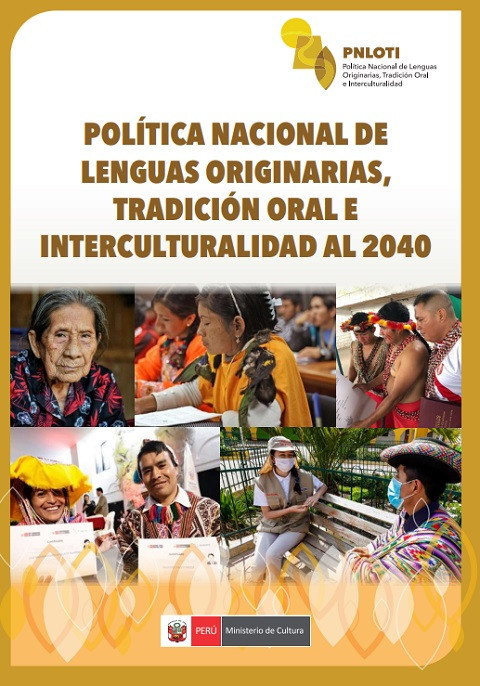 National Policy on Native Languages, Oral Tradition and Interculturality by 2040 Year of publication: 2021 Corporate author: Ministry of Culture of Peru The Ministry of Culture, in coordination with the different sectors of the State, has carried out the process of updating the National Policy on Native Languages, Oral Tradition and Interculturality by 2040 (PNLOTI), which will be the main instrument of guidance and attention in subject of indigenous languages. Seeking to guarantee the participation of citizens in public decisions, the Ministry of Culture makes the PNLOTI proposal for 2040 available to them, with the aim that they can access it and learn about the 41 services declared in charge of the different sectors. In this way, the PNLOTI ensures the full exercise of the linguistic rights of the more than 4 million citizens who speak one of the 48 indigenous or native languages of the country. Política nacional de lenguas originarias, tradición oral e interculturalidad al 2040 Year of publication: 2021 Corporate author: Ministry of Culture of Peru El Ministerio de Cultura, en coordinación con los diferentes sectores del Estado, han llevado a cabo el proceso de actualización de la Política Nacional de Lenguas Originarias, Tradición Oral e Interculturalidad al 2040 (PNLOTI), que será el principal instrumento de orientación y atención en materia de lenguas indígenas. Buscando garantizar la participación de la ciudadanía en las decisiones públicas, el Ministerio de Cultura pone a su disposición la propuesta de la PNLOTI al 2040, con el objetivo de que puedan acceder a él y conocer los 41 servicios declarados a cargo de los diferentes sectores. De esta manera, la PNLOTI asegura el ejercicio pleno de los derechos lingüísticos de los más de 4 millones de ciudadanos y ciudadanas hablantes de alguna de las 48 lenguas indígenas u originarias del país.
 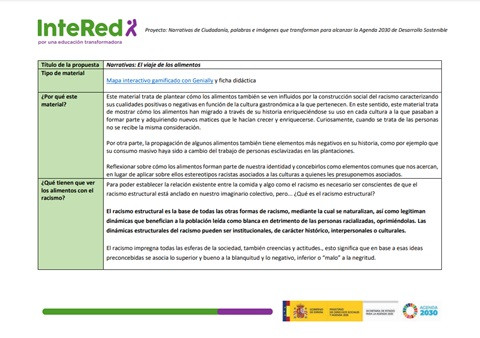 Narratives: The Journey of Food Year of publication: 2024 Corporate author: InteRed This is an interactive game that raises the question of how food is also influenced by the social construction of racism, characterising its positive or negative qualities, depending on the gastronomic culture to which it belongs. In this sense, this material tries to show how food has migrated throughout history, enriching its use in each culture it became part of and acquiring new nuances that made it grow and become richer. Curiously, when it comes to people, the same consideration is not given. On the other hand, the spread of some foods also has more negative elements in their history, such as the fact that their mass consumption has been in exchange for the work of enslaved people on plantations. Narrativas: El viaje de los alimentos Year of publication: 2024 Corporate author: InteRed Este es un juego interactivo que plantea cómo los alimentos también se ven influidos por la construcción social del racismo caracterizando sus cualidades positivas o negativas, en función de la cultura gastronómica a la que pertenecen. En este sentido, este material trata de mostrar cómo los alimentos han migrado a través de su historia enriqueciéndose su uso en cada cultura de la que pasaban a formar parte y adquiriendo nuevos matices que les hacían crecer y enriquecerse. Curiosamente, cuando se trata de las personas, no se recibe la misma consideración. Por otra parte, la propagación de algunos alimentos también tiene elementos más negativos en su historia, como por ejemplo que su consumo masivo haya sido a cambio del trabajo de personas esclavizadas en las plantaciones.
 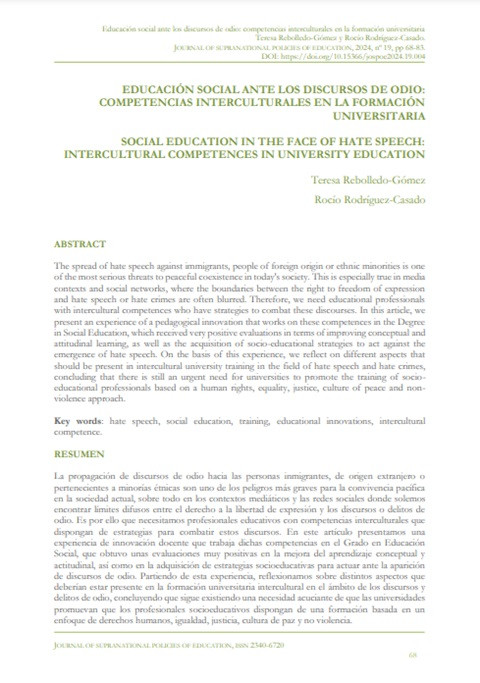 Social Education in the Face of Hate Speech: Intercultural Competences in University Education (Journal of Supranational Policies of Education; Vol. 1, No. 19) Year of publication: 2024 Author: Teresa Rebolledo Gámez | Rocío Rodríguez-Casado Corporate author: Autonomous University of Madrid The spread of hate speech against immigrants, people of foreign origin or ethnic minorities is one of the most serious threats to peaceful coexistence in today's society. This is especially true in media contexts and social networks, where the boundaries between the right to freedom of expression and hate speech or hate crimes are often blurred. Therefore, we need educational professionals with intercultural competences whohave strategies to combat these discourses. In this article, we present an experience of a pedagogical innovation that works on these competences in the Degree in Social Education, which received very positive evaluations in terms of improving conceptual and attitudinal learning, as well as the acquisition of socio-educational strategies to act against the emergence of hate speech. On the basis of this experience, we reflect on different aspects that should be present in intercultural university training in the field of hate speech and hate crimes, concluding that there is still an urgent need for universities to promote the training of socio-educational professionals based on a human rights, equality, justice, culture of peace and non-violence approach. Educación social ante los discursos de odio: Competencias interculturales en la formación universitaria (Journal of Supranational Policies of Education; Vol. 1, Núm. 19) Year of publication: 2024 Author: Teresa Rebolledo Gámez | Rocío Rodríguez-Casado Corporate author: Autonomous University of Madrid La propagación de discursos de odio hacia las personas inmigrantes, de origen extranjero o pertenecientes a minorías étnicas son uno de los peligros más graves para la convivencia pacífica en la sociedad actual. Existe una gran preocupación sobre las consecuencias discriminatorias e incluso delictivas que generan la propagación de los discursos de odio. Las normas legales establecen cuándo se traspasa la línea que convierte estas expresiones en actos condenables como delito, si bien en el ámbito de las redes sociales y los medios de comunicación, a veces, encontramos límites difusos entre el derecho a la libertad de expresión y los discursos o delitos de odio. Es por ello que necesitamos profesionales educativos con competencias interculturales que dispongan de estrategias para combatir estas situaciones. A partir de una experiencia de innovación docente en el Grado en Educación Social, en este trabajo reflexionamos sobre distintos aspectos que deberían estar presente en la formación universitaria intercultural en el ámbito de los discursos y delitos de odio, concluyendo que sigue existiendo una necesidad acuciante de que los profesionales del ámbito socioeducativo estén preparados para abordar esta realidad.
  Migrations and Displacements: Racism and Discrimination Year of publication: 2021 Corporate author: Argentina. Ministry of Education This video describes the phenomenon of migration within the framework of global citizenship. It was produced within the framework of the Seguimos Educando Program, which during 2020 and 2021 allowed, through different means, students to remain in contact with school. The proposed activities and content are guided by the Priority Learning Cores common to the entire country. Migraciones y desplazamientos: Racismo y discrimanción Year of publication: 2021 Corporate author: Argentina. Ministry of Education Este video describe el fenómeno de las migraciones en el marco de una ciudadanía global. Fue elaborado en el marco del Programa Seguimos Educando, que durante 2020 y 2021 permitió, a través de distintos medios, que las y los estudiantes siguieran en contacto con la escuela. Las actividades y contenidos propuestos están orientados por los Núcleos de Aprendizajes Prioritarios comunes para todo el país.
  A Tree to Bloom Year of publication: 2023 Corporate author: Center for Memory, Peace and Reconciliation The Camino a Casa room of the Memory, Peace and Reconciliation Center is committed to memory processes that recognize children as active subjects with the full capacity to reflect and dialogue about the recent past of violence and struggles for the construction of democracy and peace. This document is written under the metaphor of a tree: it is proposed that change and movement become a possibility for continued growth, therefore the role of adults is related to being the nutrients of the tree. In so far as their daily work can contribute to other axes, which would be the branches. And finally, children play the role of caretakers of memory - they are the tree - based on their authenticity and creativity. Un árbol para florecer Year of publication: 2023 Corporate author: Center for Memory, Peace and Reconciliation La sala Camino a Casa del Centro de Memoria, Paz y Reconciliación apuesta por procesos de memoria que reconozcan en los niños y las niñas sujetos activos con capacidad plena para reflexionar y dialogar en torno al pasado reciente de violencias y luchas por la construcción de democracia y paz. Este documento está escrito bajo la metáfora de un árbol: se propone que el cambio y el movimiento se convierta en una posibilidad para que siga creciendo, por ello el papel de las personas adultas está relacionado con ser los nutrientes del árbol. En tanto su labor cotidiana pueden aportar a otros ejes, que vendrían siendo las ramas. Y por último, los niños y niñas cumplen el rol de cuidadores de la memoria -ellos son el árbol- a partir de su autenticidad y creatividad.