
Resources
Explore a wide range of valuable resources on GCED to deepen your understanding and enhance your research, advocacy, teaching, and learning.
1,180 Results found
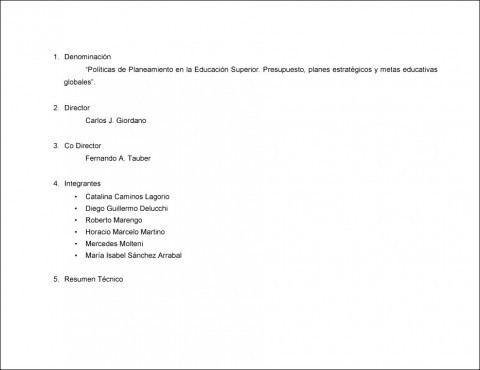 Políticas de Planeamiento en la Educación Superior: presupuesto, planes estratégicos y metas educativas globales Year of publication: 2016 Author: Carlos José Giordano | Fernando Tauber | Catalina Caminos Lagorio | Diego Guillermo Delucchi | Roberto Marengo | Horacio Marcelo Martino | Mercedes Molteni | María Isabel Sánchez Arrabal El documento es un reporte realizado por la Universidad Nacional de la Plata (UNLP), Argentina, que intenta explicar el desarrollo de políticas el desarrollo de políticas de planeamiento en la Educación Superior desde el análisis de los presupuestos y los planes estratégicos en función de metas educativas globales que han sido consensuadas y aceptadas para constituirse como guías macroinstitucional del sistema. El trabajo intenta poner en circulación una reflexión compleja acerca del lugar de la UNLP en el sistema de Educación Superior argentino y la discusión por los modelos de desarrollo integrales de las políticas públicas en el contexto de las intencionalidades internacionalistas, globalizadoras y cooperativo-interinstitucionalistas.
 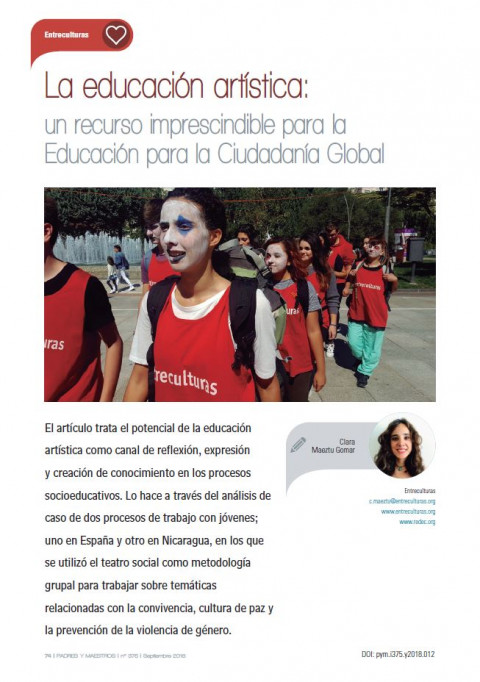 Artistic Education: An Essential Resource for Global Education Year of publication: 2018 Author: Clara Maeztu Gomar The article is about the potential of artistic education as a means of reflection, expression and production of knowledge in socioeducative processes. It details a case study were two working processes with youth are explained: one in Spain and the other one in Nicaragua. In both cases social theatre was used as a group methodology to work on thematics related with coexistence, culture of peace, and prevention of gender violence. La educación artística: un recurso imprescindible para la Educación para la Ciudadanía Global Year of publication: 2018 Author: Clara Maeztu Gomar El artículo trata el potencial de la educación artística como canal de reflexión, expresión y creación de conocimiento en los procesos socioeducativos. Lo hace a través del análisis de caso de dos procesos de trabajo con jóvenes; uno en España y otro en Nicaragua, en los que se utilizó el teatro social como metodología grupal para trabajar sobre temáticas relacionadas con la convivencia, cultura de paz y la prevención de la violencia de género.
  The Meaning of Citizenship in Social Inequality Contexts: Guidelines for a Comprehensive Education Year of publication: 2016 Author: Alma A Ramírez Iñiguez This article analyses the sense of citizenship education currently regarding the social inequality in the global era. For this, a conceptual framework about citizenship meaning is stablished and the need of a conceptual change is highlighted taking into account the social transformations, the increase of inequality in the worldwide and the neoliberal model hegemony in last decades. Based on this, some relevant Ibero American educational experiences in citizenship education are analyzed and their results are discussed. From this, some key elements involved in education for inclusive citizenship are pointed out as well as their contribution for social inequality decrease. El significado de la ciudadanía en contextos de desigualdad social: pautas para una educación incluyente Year of publication: 2016 Author: Alma A Ramírez Iñiguez El presente artículo tiene el propósito de analizar el sentido de la educación para la ciudadanía en la actualidad, tomando en cuenta la desigualdad social existente en la era global. Para ello, se realiza una revisión conceptual sobre el significado de la ciudadanía en nuestros días, destacando la necesidad de un cambio de perspectiva para entender este concepto y considerando las transformaciones sociales de las últimas décadas, así como el predominio del modelo económico neoliberal, el cual ha tenido como consecuencia el incremento de la desigualdad social a nivel mundial. Con base en dicha revisión, se realiza un análisis documental de algunas experiencias educativas iberoamericanas relevantes por su propósito de crear ciudadanía a través de propuestas inclusivas. A partir de este análisis, se discuten los resultados de dichas experiencias, los elementos clave que propician una ciudadanía incluyente desde la educación y sus implicaciones en la reducción de la desigualdad social.
  What is Education for Development? Year of publication: 2019 Corporate author: UNAQUÍ The blog of Unaquí informs that the Aragones Federation of Solidarity understands that Education for Development (ED) is a process which fosters critical and active global citizenship, that promotes more just, equal and cooperative societies. The blog also informs that the organizations that are part of the FAS believe that they are responsible of the education in order to transform societies, therefore, they created this space, called UNAQUÍ, to promote Education for Development and contribute to the promotion of citizenship.The blog provides information about different projects that are carried out. Qué es Educación para el Desarrollo Year of publication: 2019 Corporate author: UNAQUÍ El blog de Unaquí informa que desde la Federación Aragonesa de Solidaridad se entiende a la Educación para el Desarrollo (EpD) como un proceso encaminado a generar una ciudadanía global, crítica y activa que esté comprometida en la construcción de una sociedad solidaria, justa y equitativa. También informa que las organizaciones integrantes de la FAS se sienten corresponsables en la tarea de educar para transformar por lo que crearon ese espacio de Educación para el Desarrollo llamado UNAQUÍ para contribuir a la formación integral de la ciudadanía como clave para el Desarrollo. En el blog colocan información sobre distintos proyectos que son llevados a cabo.
 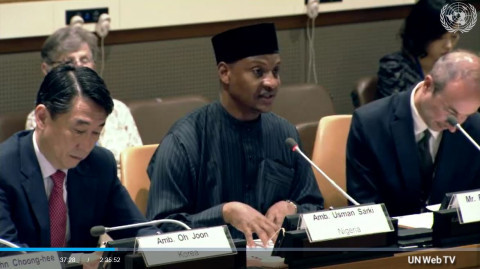 [Video] Global Citizenship Education for a just, peaceful, inclusive and sustainable world: a conceptual framework and its application in the field Year of publication: 2015 Corporate author: United Nations (UN) The Seminar held at UN HQs entitled, "Global Citizenship Education for a Just, Peaceful, Inclusive, and Sustainable world: A Conceptual Framework and its Application in the Field" was co-organized by the Permanent Missions of France, Nigeria, Qatar and the Republic of Korea, the United States Mission and the United Nations Educational, Scientific and Cultural Organization (UNESCO), in support of the Secretary-General’s Global Education First Initiative (GEFI).The panel discussion was moderated by H.E. Ambassador Hahn Choong‐hee of Korea. Some of the speakers for this event included H.E. Ambassador Richard Erdman, Acting Representative to ECOSOC of the Permanent Mission of the United States of America to the United Nations; H.E. Ambassador Usman Sarki, Deputy Permanent Representative of the Permanent Mission of the Federal Republic of Nigeria to the United Nations; Yousef Laram, Deputy Permanent Representative of the State of Qatar to the United Nations; Mr. Francois Gave, Counsellor at the Permanent Mission of France to the United Nations; and Christopher Castle, Chief of UNESCO’s Section of Global Citizenship Education.This event was divided into two segments. In the first, GCED was discussed at the level of concept. How can it strengthen the three pillars of the United Nations and the three pillars of sustainable development in furtherance of a just, peaceful, inclusive and sustainable world. In the second, examples from the field – the local, national and international levels – were presented and discussed as were certain opportunities going forward including the important role of media. [vidéo] Éducation à la Citoyenneté mondiale pour un monde juste, pacifique, inclusive et durable: un cadre conceptuel et son application dans le domaine Year of publication: 2015 Corporate author: United Nations (UN) Le séminaire a eu lieu au Siège de l'ONU intitulé «Éducation Mondiale Citoyenneté pour un monde juste, paisible, inclusive et durable: un cadre conceptuel et son application sur le terrain» a été co-organisée par les Missions permanentes de la France, le Nigeria, le Qatar et les République de Corée, la Mission des États-Unis et l'Organisation de l’ONU pour l'éducation, la science et la culture (UNESCO), à l'appui de First Éducation Mondiale Initiative du Secrétaire général (GEFI).Le débat a été animé par S.E. Ambassadeur Hahn Choong-hee de Corée. Certains des orateurs pour cet événement inclus S.E. Ambassadeur Richard Erdman, représentant par intérim à l'ECOSOC de la Mission permanente des États-Unis d'Amérique auprès de l'Organisation de l’ONU; IL. Ambassadeur Usman Sarki, Représentant permanent adjoint de la Mission permanente de la République fédérale du Nigéria auprès de l’ONU; Yousef LARAM, Représentant permanent adjoint de l'Etat du Qatar auprès de l'Organisation de l’ONU; M. François Gave, Conseiller à la Mission permanente de la France auprès de l’ONU; et Christopher Castle, la Section de l'éducation à la citoyenneté mondiale chef de l'UNESCO. Cet événement a été divisé en deux segments. Dans le premier, ECM a été discuté au niveau du concept. Comment peut-on renforcer les trois piliers de l'Organisation de l’ONU et les trois piliers du développement durable dans la poursuite d'un monde juste, pacifique, inclusif et durable. Dans le second, des exemples sur le terrain - aux niveaux local, national et international - ont été présentées et discutées de même que certaines opportunités à l'avenir, y compris le rôle important des médias.
  Responding to Covid-19: Online Classes in Korea - A Challenge Toward the Future of Education Year of publication: 2020 Corporate author: Korea R. Ministry of Education Korea is effectively responding to the outbreak of COVID-19 by adopting a whole-of-government approach, under the leadership of the Central Disaster and Safety Countermeasures Headquarters to prevent and contain the pandemic with the principle of “openness, transparency and democratic process.” The nationwide introduction of the online classes to respond to COVID-19 was a huge challenge and a path that we have never trodden before. The Ministry of Education of the Republic of Korea introduced Korean education with the world in response to COVID-19 and shared experiences and challenges of distance learning and online education. COVID-19 is a universal challenge which requires joint response, and the global community should be committed to strong solidarity and close cooperation to overcome this crisis and take a leap forward to a brighter future.