
Resources
Explore a wide range of valuable resources on GCED to deepen your understanding and enhance your research, advocacy, teaching, and learning.
3,378 Results found
 The Story of the Woodcutter and the Weaver's Daughter Year of publication: 2021 Corporate author: Alma3rifabook The video is a purposeful story represented in some Arab values and noble morals. It is said, in the old days, that there was a young woodcutter named Nasir who was newly married and lived with his wife on the outskirts of a quiet rural village. He would go out to work every morning to cut wood and gather it from the nearby forest, and would not return home until after midday. One afternoon, he went out with his wife to the market, and there they met a young girl named Salwa who was selling hand-woven rugs.
 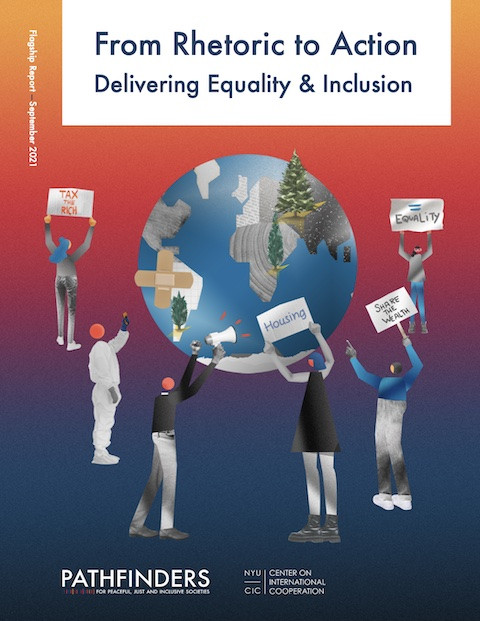 From Rhetoric to Action: Delivering Equality & Inclusion Year of publication: 2021 Author: Faiza Shaheen | Alexander Bossakov | Avner Cohen | Amanda Lenhardt | Nendirmwa Noel | Paula Sevilla Núñez | Paul von Chamier Corporate author: Pathfinders for Peaceful, Just and Inclusive Societies, NYU. Center on International Cooperation This flagship report of the Pathfinders Grand Challenge on Inequality and Exclusion is about the solutions that will deliver equality and inclusion.The report constructs a bridge between the rhetoric of “build back better” and action: a bridge between promise and progress. It underlines the need for renewed social contracts between citizens, civil society, the private sector, and governments, as well as between high and low- and middle-income countries. These social contracts must be built to serve future generations, to guard against climate breakdown and pandemics while delivering respect, opportunity, and justice for all.This report should serve as a practical handbook for policymakers and influencers; as a source of possibility for the public; and, as a call to all political leaders to act.
  ARC8 Outlook Report 2030: Inclusive and Diverse Higher Education in Asia and Europe Year of publication: 2021 Corporate author: Asia-Europe Foundation (ASEF) The ARC8 Outlook Report 2030 on ʻInclusive and Diverse Higher Education in Asia and Europe’ was initiated with the objective of better understanding the current state, policies and practices of inclusion in higher education and identifying actions that could accelerate greater inclusion in a post-pandemic era.The ARC8 Outlook Report outlines emerging issues that could grow into major challenges and/ or opportunities in the coming 10 years related to inclusion in higher education. Inputs for the report came from an in-depth consultation process and from previous research done by Asian and European stakeholders. The Report consists of 4 chapters which analyse the future of inclusion from different perspectives: Inclusive Learning and Teaching in a Digital World Inclusive and Flexible Lifelong Learning Pathways Inclusive International Mobility of People and Knowledge Equitable Access and Success in Higher Education
 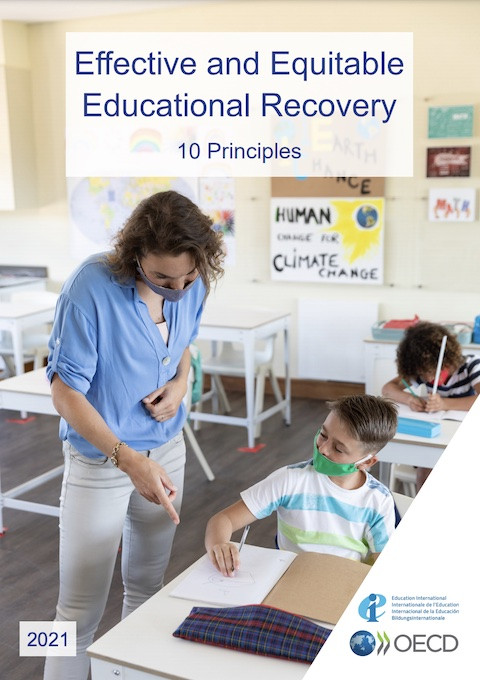 Effective and Equitable Educational Recovery: 10 Principles Year of publication: 2021 Corporate author: Education International (EI) | Organisation for Economic Co-operation and Development (OECD) The COVID-19 pandemic has led to the frequent closure of school buildings in most countries in the world and has interrupted the school attendance of at least 1.2 billion students in 2020 and 2021. Although many education systems have been able to adapt in varying degrees, the pandemic has shown that countries’ current learning infrastructures are highly vulnerable to external shocks.While schools have shown great resilience in trying to compensate for the crisis, they need to be better prepared for similar challenges. Education systems must ensure the continuity of learning which must be the centrepiece of all considerations.Acknowledging the disruption that the health crisis has brought about and its likely impact on educational quality and equity, the OECD Secretariat and Education International have, based on their respective work during the pandemic, jointly established 10 principles that can facilitate the collaboration of education authorities, the teaching profession and their organisations to navigate the crisis effectively and reshape education systems after the pandemic to reach greater levels of educational quality and equity.Education systems around the world have been facing similar challenges but generated diverse approaches and experiences. The intention is also for these principles to contribute to a framework for international cooperation and peer learning.
  Education at a Glance 2021: OECD Indicator Year of publication: 2021 Corporate author: Organisation for Economic Co-operation and Development (OECD) Education at a Glance is the authoritative source for information on the state of education around the world. It provides data on the structure, finances and performance of education systems across OECD countries and a number of partner economies. More than 100 charts and tables in this publication – as well as links to much more available on the educational database – provide key information on the output of educational institutions; the impact of learning across countries; access, participation and progression in education; the financial resources invested in education; and teachers, the learning environment and the organisation of schools.The 2021 edition includes a focus on equity, investigating how progress through education and the associated learning and labour market outcomes are impacted by dimensions such as gender, socio‐economic status, country of birth and regional location. A specific chapter is dedicated to Target 4.5 of the Sustainable Development Goal 4 on equity in education, providing an assessment of where OECD and partner countries stand in providing equal access to quality education at all levels. Two new indicators on the mechanisms and formulas used to allocate public funding to schools and on teacher attrition rate complement this year’s edition. Regards sur l’éducation 2021: Les indicateurs de l’OCDE Year of publication: 2021 Corporate author: Organisation for Economic Co-operation and Development (OECD) Regards sur l’éducation est le rapport de référence sur l’état de l’éducation dans le monde. Ce rapport étudie la structure, le financement et la performance des systèmes d’éducation des pays de l’OCDE et d’un certain nombre de pays partenaires. Avec plus d’une centaine de tableaux et graphiques – et de nombreux liens vers la base de données de l’OCDE sur l’éducation – Regards sur l’éducation foisonne d’informations sur les résultats des établissements d’enseignement ; l’impact de l’apprentissage ; l’accès à l’éducation, les taux de scolarisation et les parcours scolaires ; les investissements dans l’éducation ; et les enseignants, l’environnement d’apprentissage et l’organisation de l’enseignement.L’édition 2021 s’intéresse à la question de l’équité : elle étudie dans quelle mesure le sexe, le milieu socio-économique, le pays d’origine ou encore la situation géographique influencent le parcours éducatif des élèves et étudiants, et ont un impact sur les résultats en termes d’apprentissage et d’emploi. Un chapitre spécifique est consacré à la cible 4.5 de l’objectif de développement durable 4 sur l’équité dans l’éducation. Il situe les pays membres et partenaires de l’OCDE par rapport aux objectifs en matière d’égalité d’accès à une éducation de qualité à tous les niveaux d’enseignement. Deux nouveaux indicateurs sur les mécanismes et les formules utilisés pour allouer les fonds publics aux établissements et sur le taux d’attrition des enseignants complètent l’édition 2021.
  المواطنة Year of publication: 2020 Author: Zeyad Alawana Corporate author: Ministry of Political and Parliamentary Affairs يهدف الكتيب إلى تعميق ثقافة المواطنة الصالحة والفعّالة لدى الشباب، وتعريفهم بحقوقهم وواجباتهم الواردة في الدستور الاردني، وتعريفهم أيضاً بقيم المواطنة الصالحة الي تقوم على أساس سيادة القانون، واحرام المساواة، والتسامح وتقبّل الآخر، وتقبل التعددية والتنوع في المجتمع. وبشكل أكثر تفصيلاً، يحتوي الكتيب على موضوعات ومعارف وأسئلة وخبرات تهدف إلى ما يلي:•أولاً، التعريف بمفهوم المواطنة والحقوق والواجبات والتمييز بين المواطن الصالح وغير الصالح.•ثانياً، التعريف بمبادئ المواطنة الصالحة ، كالحرية والمشاركة الفاعلة والمساواةوتكافؤ الفرص والتضامن والمحافظة على الممتلكات العامة.•ثالثاً، التعريف بأهداف المواطنة، كالالتزام بمبادئ الديمقراطية، والتحرر من التعصب والتميز، والايمان بالأخوّة الإنسانية والمنهج العلمي في التفك وسيادة القانون، والالزام بالدستور، والمشاركة السياسية الفاعلة، واحرام كرامة الانسان، واكتساب قيم المواطنة الحقة.
  Fifteen Analytical Keys to Strengthen the Education 2030 Agenda Year of publication: 2017 Author: Renato Opertti Corporate author: UNESCO International Bureau of Education (IBE) The joint review of the goals of the Education 2030 agenda and global change accentuated by the emergence of a fourth industrial revolution highlights the need to rethink the concepts that have influenced education over the past forty years. This necessity is accompanied by a major challenge: that of giving a new meaning to these concepts, in the same way education systems, in a transformational and united perspective. The present document proposes a global reflection based on fifteen keys of analysis, in order to help define a vision of education and learning that is in line with the Education 2030 agenda examines the following aspects: 1) education as a reflection of the type of society targeted; 2) the state as guarantor of the right to education; 3) education as a cultural, social and economic ; 4) the characteristics and roles of education systems; 5) learning throughout life long; 6) education according to age groups; 7) inclusion as a basis for education systems; 8) education for global and local citizenship; 9) education for sustainable development ; 10) STEM training to build sustainable societies; 11) the relevance of the gender issue at a time of the democratization of society and education; 12) computer programming as a new challenge in the teaching of ICT; 13) the evolution of the relationship between training and work; 14) the trio formed by curricula, educational establishments and pedagogy; and 15) teachers as decision-makers. Quinze clés d’analyse pour renforcer l’agenda Éducation 2030 Year of publication: 2017 Author: Renato Opertti Corporate author: UNESCO International Bureau of Education (IBE) L’examen conjoint des objectifs de l’agenda Éducation 2030 et des changements planétaires accentués par l’émergence d’une quatrième révolution industrielle met en évidence la nécessité de repenser les concepts qui ont influencé l’éducation au cours des quarante dernières années. Cette nécessité s’accompagne d’un défi de taille : celui de donner un sens nouveau à ces concepts, de même qu’aux systèmes éducatifs, dans une perspective transformationnelle et unie. Le présent document propose une réflexion globale reposant sur quinze clés d’analyse, en vue de contribuer à définir une vision de l’éducation et de l’apprentissage qui soit en adéquation avec l’agenda Éducation 2030. Il se penche ainsi sur les aspects suivants : 1) l’éducation en tant que reflet du type de société visé ; 2) l’État en tant que garant du droit à l’éducation ; 3) l’éducation en tant que politique culturelle, sociale et économique ; 4) les caractéristiques et les rôles des systèmes éducatifs ; 5) l’apprentissage tout au long de la vie ; 6) l’éducation en fonction de groupes d’âge ; 7) l’inclusion en tant que fondement des systèmes éducatifs ; 8) l’éducation à la citoyenneté mondiale et locale ; 9) l’éducation pour le développement durable ; 10) la formation aux STEM en vue de bâtir des sociétés durables ; 11) la pertinence de la problématique hommes-femmes à l’heure de la démocratisation de la société et de l’éducation ; 12) la programmation informatique en tant que nouveau défi dans l’enseignement des TIC ; 13) l’évolution de la relation entre la formation et le travail ; 14) le trio formé par les curricula, les établissements éducatifs et la pédagogie ; et 15) les enseignants en tant que décideurs.
  L'éducation au service du développement: La vision de la Banque mondiale, de l'OCDE et de l'UNESCO (L’Education en débats: analyse comparée; no. 8) Year of publication: 2016 Author: Thibaut Lauwerier Corporate author: Université de Genève Dans ce présent article, nous nous intéressons aux liens entre éducation et développement du point de vue de la Banque mondiale, l’OCDE et l’UNESCO, organisations internationales majeures dans le secteur éducatif au niveau mondial. Après avoir présenté le contexte de la recherche, à savoir les caractéristiques majeures des trois organisations étudiées et la méthodologie utilisée, nous montrons comment le concept du développement est perçu par ces institutions. Ensuite, nous traitons des implications de ces visions du développement pour l’éducation. En conclusion, tout en analysant les récentes évolutions des discours des organisations internationales, nous discutons de la nécessité d’aller au-delà d’une vision étriquée du développement et donc de l’éducation.