
Resources
Explore a wide range of valuable resources on GCED to deepen your understanding and enhance your research, advocacy, teaching, and learning.
730 Results found
 Une Vie meilleure, un avenir meilleur: partenariat mondial de l'UNESCO pour l'éducation des filles et des femmes Year of publication: 2015 Corporate author: UNESCO Since its inception, UNESCO has been a strong advocate, promoter and defender of the right to quality education for all, especially for girls and women. Gender equality and education are fundamental human rights, which stand at the core of UNESCO’s mandate. UNESCO launched the Global Partnership for Girls’ and Women’s Education in 2011, guided by the conviction that by educating girls and women, we can break persistent cycles of poverty and in turn foster greater social justice. The Partnership aims to increase learning opportunities for adolescent girls and women and to find solutions to some of the biggest challenges and obstacles to their education. The partnership addresses two weakest links which are secondery education and literacy.
 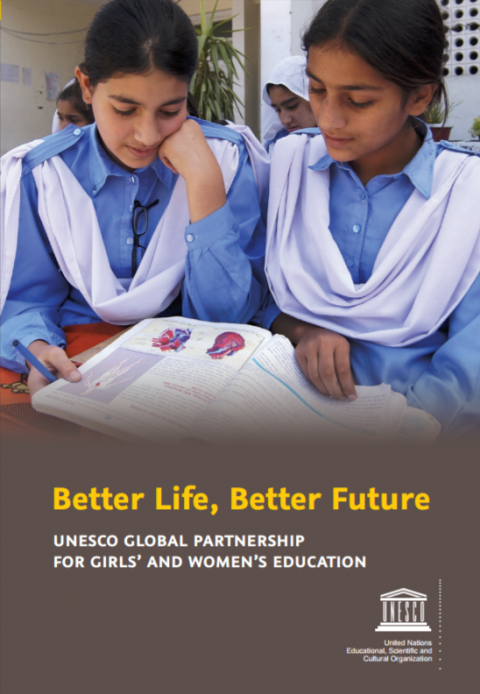 Better Life, Better Future: UNESCO Global Partnership for Girls' and Women's Education Year of publication: 2014 Corporate author: UNESCO Since its creation, UNESCO has been advocating for, promoting and defending the right to quality education for all, especially for girls and women. As fundamental human rights, gender equality and education stand at the core of UNESCO’s mandate. UNESCO launched the Global Partnership for Girls’ and Women’s Education in 2011 guided by the conviction that educating girls and women can break the cycle of poverty and foster greater social justice. The Partnership seeks to increase learning opportunities for adolescent girls and women and to find solutions to some of the biggest challenges and obstacles to their education. The Partnership addresses two main areas which require increased attention: secondary education and literacy.
  Values Education through Sport Year of publication: 2016 Corporate author: UNESCO Innovative education for developmentEducation in the 21st century increasingly recognizes the role of values and social skills in tackling global challenges, such as inactivity, obesity, unemployment, and conflict. This approach is at the core of the Sustainable Development Goal 4 on quality education, which advocates for inclusive lifelong learning opportunities and innovative content delivery. Dynamic forms of values-based education using sport can be introduced in schools to support teachers deliver curricula actively and cooperatively.What are sport values?Sport can teach values such as fairness, teambuilding, equality, discipline, inclusion, perseverance and respect. Sport has the power to provide a universal framework for learning values, thus contributing to the development of soft skills needed for responsible citizenship.What can Values Education through Sport offer?Values Education through Sport (VETS) programmes support active learning, complement cognitive skills and give students increasing amounts of responsibility, and enhance their level of concentration and participation. VETS programmes are flexible and have a strong cross-curricular potential: they can reinforce existing curricula and can be streamed across different subjects, including physical education, civic and moral education, nutrition, biology, arts. Ultimately, these programmes help students to transfer and put values into action outside the school environment, by getting engaged in their communities, making informed decisions, being sensitive and respecting the others and the environment. VETS contributes to the development of self-confidence, active and healthy lifestyle choices, and an understanding of rights, supporting the delicate transition to the independence of adulthood. Éducation aux Valeurs par le Sport Year of publication: 2016 Corporate author: UNESCO Éducation innovante pour le développementL'éducation au 21e siècle reconnaît de plus en plus le rôle des valeurs et des compétences sociales pour relever les défis mondiaux, tels que l'inactivité, l'obésité, le chômage et les conflits. Cette approche est au cœur de l'objectif de développement durable 4 sur l'éducation de qualité, qui milite pour des possibilités d'apprentissage inclusifs et la livraison de contenu innovant. Les formulaires dynamiques de l'éducation fondée sur les valeurs en utilisant le sport peuvent être introduits dans les écoles pour aider les enseignants offrent des programmes activement et en collaboration.Quelles sont les valeurs du sport?Le sport peut enseigner des valeurs telles que l'équité, teambuilding, l'égalité, la discipline, l'inclusion, la persévérance et le respect. Le sport a le pouvoir de fournir un cadre universel pour les valeurs d'apprentissage, contribuant ainsi au développement des compétences générales nécessaires à la citoyenneté responsable. Que peut l'éducation aux valeurs par offre de Sport?Valeurs éducation par le sport (VEPS) programmes appuient l'apprentissage actif, compléter les compétences cognitives et donner aux étudiants les montants de responsabilité de plus en plus, et d'améliorer leur niveau de concentration et de participation. programmes VEPS sont flexibles et ont un fort potentiel transdisciplinaire: ils peuvent renforcer les programmes existants et peuvent être écoutés sur différents sujets, y compris l'éducation physique, l'éducation civique et morale, la nutrition, la biologie, les arts. En fin de compte, ces programmes aident les élèves à transférer et de mettre les valeurs en action en dehors du milieu scolaire, en s'engagés dans leurs communautés, prendre des décisions éclairées, étant sensible et en respectant les autres et l'environnement. VEPS contribue au développement de la confiance en soi, des choix de vie sains et actifs, et une compréhension des droits, soutenir la transition délicate à l'indépendance de l'âge adulte.
  [Video] Learning to live together in peace through Global Citizenship Education Year of publication: 2016 Corporate author: UNESCO The UNESCO video on “Learning to live together in peace through Global Citizenship Education” explains the importance of Global Citizenship Education (GCED) in a globalized and increasingly interconnected and interdependent world. GCED is key to understand the interconnections between the local and the global and nurture a sense of belonging to a common humanity. It builds motivation to assume active roles to contribute to a more just, peaceful, tolerant and sustainable world. The video also illustrates how GCED can be delivered in and outside of schools. [Vidéo] Apprendre à vivre ensemble dans la paix par l’éducation à la citoyenneté mondiale Year of publication: 2016 Corporate author: UNESCO La vidéo de l'UNESCO sur le thème "Apprendre à vivre ensemble dans la paix par l’Éducation à la Citoyenneté Mondiale", explique l'importance de l'Éducation à la Citoyenneté Mondiale (ECM) dans un monde globalisé et de plus en plus interconnecté et interdépendant. ECM est essentiel de comprendre les interconnexions entre le local et le global et à favoriser un sentiment d'appartenance à une humanité commune. Il construit la motivation à assumer un rôle actif pour contribuer à un monde plus juste, pacifique, tolérante et durable. La vidéo montre également comment ECM peut être livré dans et à l'extérieur des écoles.
 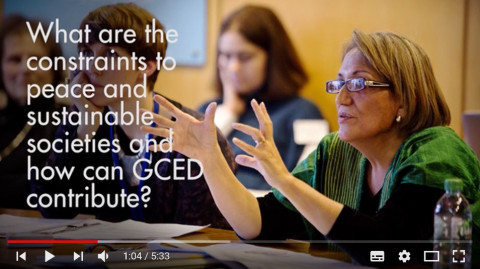 [Video] Second UNESCO Forum on Global Citizenship Education Year of publication: 2015 Corporate author: UNESCO Highlights of the Second UNESCO Forum on Global Citizenship Education (GCED) Building peaceful and sustainable societies: preparing for post-2015 (28-30 January 2015,UNESCO HQ, Paris). The Forum was organized by the Division for Teaching, Learning and Content, Education Sector, UNESCO, with the support of Austria, the Sultanate of Oman and the Republic of Korea, and the UN Secretary-General’s Global Education First Initiative (GEFI).
 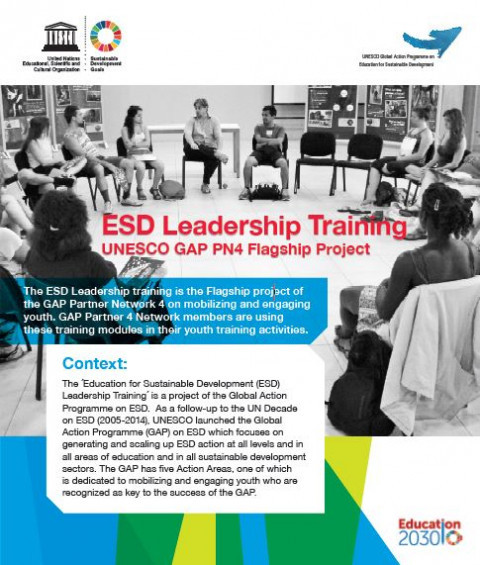 ESD Leadership Training: UNESCO GAP PN4 Flagship Project Year of publication: 2017 Corporate author: UNESCO The ESD Leadership training is the Flagship project of the GAP Partner Network 4 on mobilizing and engaging youth. GAP Partner 4 Network members are using these training modules in their youth training activities. Formation au Leadership pour l'EDD: Projet phare GAP PN4 de l'UNESCO Year of publication: 2017 Corporate author: UNESCO La formation au leadership pour l’EDD est le projet phare du réseau de partenaires 4 (PN4) mis en place pour le Programme d’action global en vue d’autonomiser et de mobiliser les jeunes. Les membres de ce réseau utilisent ces modules pour leurs activités de formation des jeunes.
  Education for Sustainable Development: Children speak up! Year of publication: 2017 Corporate author: UNESCO Children from around the world share their message on sustainability.