
Resources
Explore a wide range of valuable resources on GCED to deepen your understanding and enhance your research, advocacy, teaching, and learning.
1,407 Results found
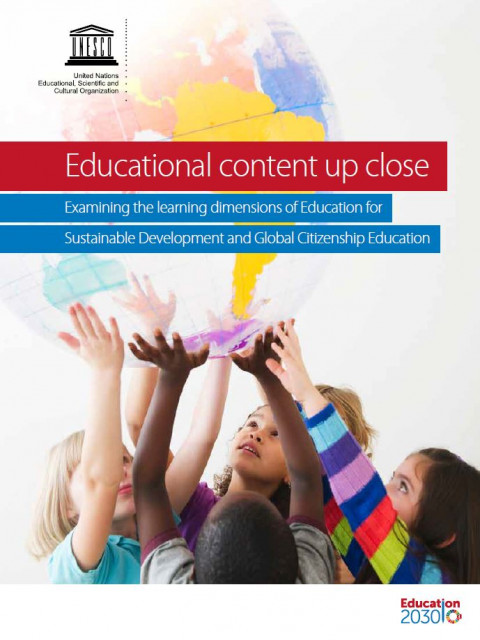 Educational Content up Close Examining the Learning Dimensions of Education for Sustainable Development and Global Citizenship Education Year of publication: 2019 Corporate author: UNESCO In taking ESD and GCED forward, UNESCO seeks to advance a holistic approach to education that emphasizes three inter-related dimensions of learning – the cognitive, social and emotional and behavioural.This publication summarizes the findings of a study commissioned by UNESCO to examine if and how these three dimensions of learning and teaching of ESD and GCED are reflected in pre-primary, primary and secondary educational content (ie. national laws, policies and the intended curriculum) in Costa Rica, Japan, Kenya, Lebanon, Mexico, Morocco, Portugal, Republic of Korea, Rwanda and Sweden. The outcome of this work shows a major pattern of commitment to the three learning dimensions in the selected countries and across the four education levels, with noteworthy nuances between ESD and GCED. 지속가능발전교육 및 세계시민교육의 학습 영역 연구: 국가별 교육 과정 분석을 중심으로 Year of publication: 2019 Corporate author: 유네스코 이 보고서는 유네스코가 의뢰한 연구 결과를 요약한 것으로, ESD 및 GCED의 교수·학습에 있어서 이 세 가지 영역이 취학전교육, 초등교육, 중등교육의 내용 (예: 국가법, 정책 및 의도된 교육과정)에 반영되고 있는지 여부와 어떻게 반영되고 있는지를 검토하고 있다. 연구 대상 국가로는 코스타리카, 일본, 케냐, 레바논, 멕시코, 모로코, 포르투갈, 한국, 르완다, 스웨덴 등 10개국이다. 이 연구결과는 선정 국가별, 교육단계별로 나타나는 세 가지 학습 영역에 대한 주요 양상을 보여주고 있으며, ESD와 GCED 사이의 미묘한 차이는 주목할 만하다.
 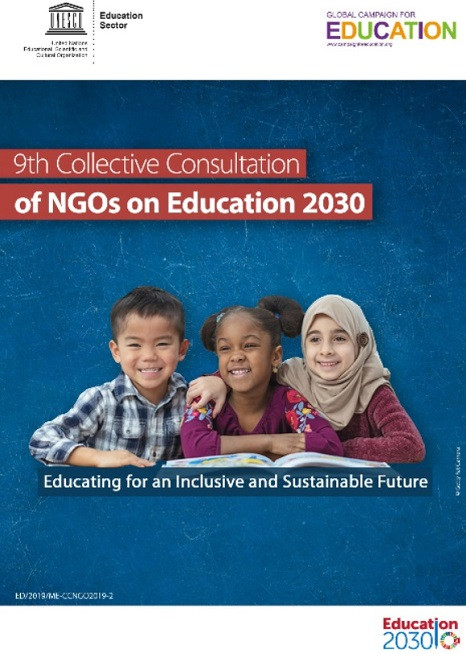 9th Collective Consultation of NGOs on Education 2030: Educating for an Inclusive and Sustainable Future Year of publication: 2020 Corporate author: UNESCO | Global Campaign for Education (GCE) This includes proceedings and key messages of the 9th Global meeting of the Collective Consultation of NGOs on Education 2030 (CCNGO 2019) organized by UNESCO from 2-5 December 2019 in Hammamet, Tunisia and generously hosted by the Global Campaign for Education (GCE), alongside the Arab Campaign for Education for All (ACEA) and the National Association of the Right to Education (ANDET). The CCNGO 2019 aimed to build on CSOs(Civil Society Organisations) experiences and strong commitments to strengthen collective initiatives towards the realisation of the SDGs and education related targets. The focus and major theme of the Meeting was the role and engagement of civil society organizations in supporting equity and inclusion in the implementation of SDG4-Education 2030 at national, regional and global level. 9e Consultation collective des ONG sur l’Éducation 2030: Éduquer pour un avenir inclusif et durable Year of publication: 2020 Corporate author: Organisation des Nations Unies pour l'éducation, la science et la culture (UNESCO) | Global Campaign for Education (GCE) Cela comprend les actes et les messages clés de la 9eRéunion mondialede la Consultation collective des ONG sur l’Éducation 2030(CCONG2019) a été organisée par l’UNESCO du 2 au 5 décembre2019 à Hammamet, Tunisie,où elle a été généreusement accueillie par la Campagne mondiale pour l’éducation(CME), la Campagne arabe pour l’éducation pour tous(ACEA) et l’Association nationale du droit à l’éducation(ANDET). La Réunion mondialede la CCONG2019 avait pour but derenforcer les initiatives collectives visant à la mise en œuvre des ODD et des cibles relatives à l’éducation ens’appuyantsur l’expérience des OSC et leur forte mobilisation. La réunion avait pour thèmecentral l’action et l’engagement des organisations de la société civile en faveur de l’équité et de l’inclusion dans le cadre dela mise en œuvre de l’ODD 4 –Éducation 2030aux niveaux national, régional et mondial.
 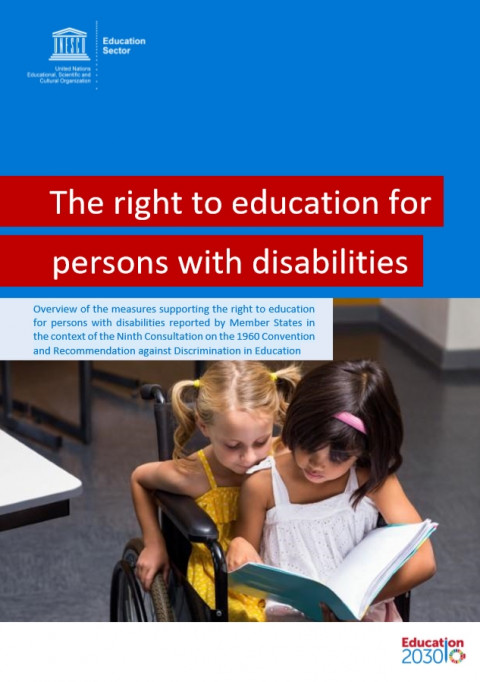 The Right to Education for Persons with Disabilities Year of publication: 2019 Corporate author: UNESCO Persons with disabilities are often excluded from the education system, whether out-of-school entirely, educated in separate institutions or participating in a mainstream system which is not adapted to their needs and abilities. The 2030 Agenda commitment to ‘leave no one behind’ has reinforced the global discourse towards inclusive, equitable education. As part of its mandate, UNESCO monitors the implementation of the 1960 Convention and Recommendation against Discrimination in Education. During the Ninth Consultation on the implementation of this instrument, almost all Member States reported upon measures that they have taken in relation to the right to education for persons with disabilities. This document compiles practical examples extracted from these reports for information sharing and advocacy.
 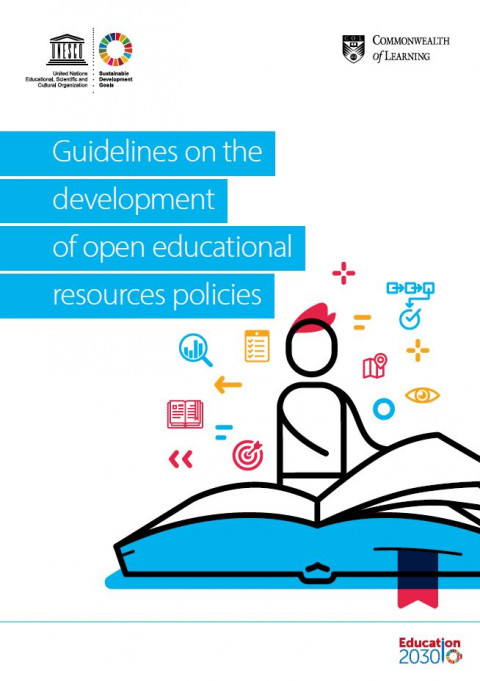 Guidelines on the Development of Open Educational Resources Policies Year of publication: 2019 Corporate author: UNESCO | Commonwealth of Learning Open educational resources (OER) – and to a greater extent, OER policies – can increase the quality and accessibility of teaching and learning as well as foster knowledge creation within a country.This publication provides detailed guidelines on how to develop systematic and effective policies on OER. Such policies are important to coordinate, strengthen and drive initiatives in a country; they involve government and institution actors on various levels working together to leverage OER toward achieving common goals under a national educational framework. OER policy provisions can be a part of a dedicated national masterplan, be under the framework of an overall education programme, or be elements incorporated into various strategies across multiple sectors.These guidelines lay out steps to review, analyse, develop, implement and monitor a context-relevant OER policy. They guide, but do not determine, what involved actors should do in a specific set of circumstances, providing a comprehensive framework for governments and institutions to set out vision and the scope of their policy.Each chapter introduces the purpose of the phase, provides background information and references practical examples for illustration. At the end of each chapter, specific tasks are set for the policy designer, which will help with the formulation of the final OER policy.
 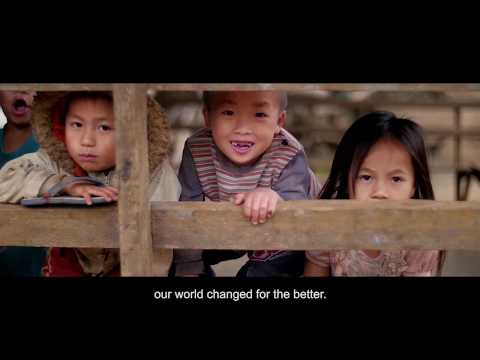 Education Transforms Lives Year of publication: 2019 Corporate author: UNESCO Education transforms lives every day and in every corner of society. This video explores the power of education and UNESCO’s role in leading and coordinating the Education 2030 Agenda, which is part of a global movement to eradicate poverty through 17 Sustainable Development Goals by 2030. Education is the right of every woman, man and child.Together, we’re shaping the global citizens of tomorrow, empowered on the path of education to build a more sustainable future. UNESCO – Building peace in the minds of men and women. www.unesco.org/education
 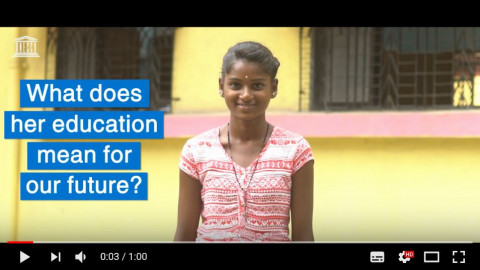 Her Education, Our Future Year of publication: 2019 Corporate author: UNESCO Too many girls and women are still held back by social norms and traditional school practices influencing their educational right and opportunities. But we know that their education is the most powerful investment to make for our collective future. Her education, our future is UNESCO’s new drive to accelerate action for girls’ and women’s education by leveraging political and financial commitments, as well as leadership for women and girls.Join #HerEducationOurFuture and be a part of our collective movement to advance girls’ and women’s education. Learn more: http://on.unesco.org/HerEducation
 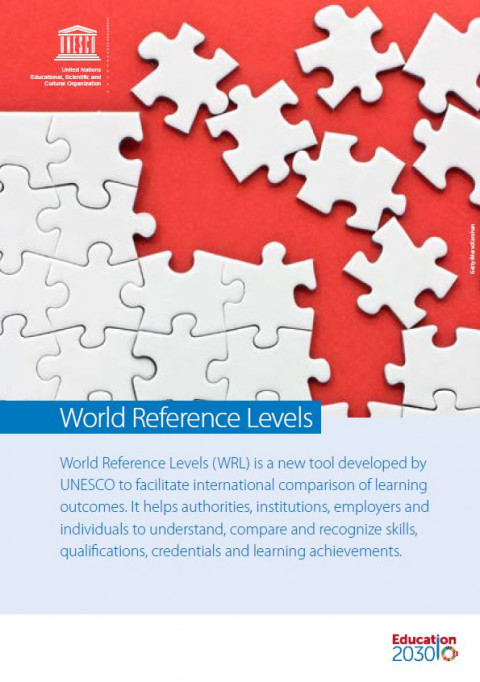 World Reference Levels Year of publication: 2019 Corporate author: UNESCO World Reference Levels (WRL) is a tool that facilitates the comparison of qualifications and skills.It helps those with a stake in the outcomes of learning - authorities, institutions, employers and individuals - to understand, compare and recognize skills, qualifications, other kinds of credential and learning achievements, both on a national level and across borders.The WRL is developed by UNESCO in collaboration with experts, international partners and regional organizations that oversee regional qualification frameworks. The tool is based on research of level descriptors in a wide range of qualification frameworks and job evaluation programmes, and was designed to complement and work together with other systems of managing and recognizing qualifications and outcomes.
 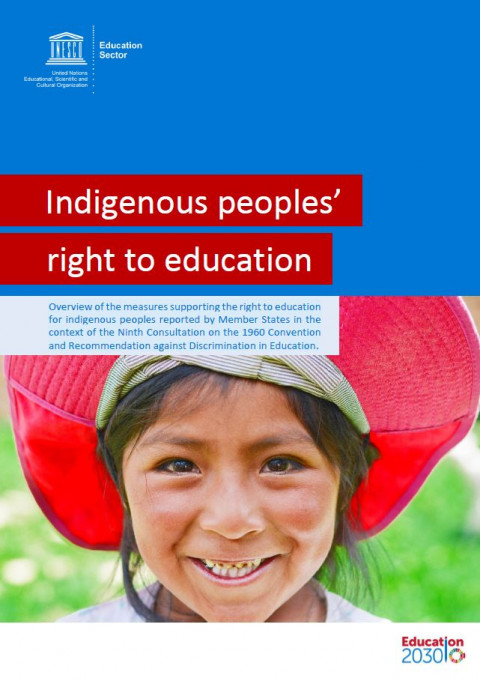 Indigenous Peoples’ Right to Education Year of publication: 2019 Corporate author: UNESCO Among the many inequalities that indigenous peoples face, the lack of access to quality education is particularly blatant. The 2030 Agenda commitment to ‘leave no one behind’, brings new impetus to ensure that indigenous peoples’ priorities are heard. In 2017, UNESCO adopted the Policy on engaging with indigenous peoples. Concurrently, as part of its mandate, UNESCO monitors the implementation of the 1960 Convention and Recommendation against Discrimination in Education. During the Ninth Consultation on the implementation of this instrument, several Member States reported upon measures they have taken in relation to the right to education for indigenous peoples. This document (Indigenous Peoples’ Right to Education: Overview of the Measures Supporting the Right to Education for Indigenous Peoples Reported by Member States in the Context of the Ninth Consultation on the 1960 Convention and Recommendation against Discrimination in Education) compiles practical examples extracted from these reports for information sharing and advocacy.