
Resources
Explore a wide range of valuable resources on GCED to deepen your understanding and enhance your research, advocacy, teaching, and learning.
3,229 Results found
 Global Citizenship and Liberation History in Secondary Curricula in Southern Africa: Summary Report on the Findings of a Desk Review Year of publication: 2021 Corporate author: UNESCO Harare This report presents key findings of a desk study on the extent of integration of Global Citizenship Education (GCED) and Southern Africa Liberation History (SALH) educationin the secondary schools curricula in Angola, Democratic Republic of Congo, Eswatini, Lesotho, Malawi, Mauritius, Mozambique, Namibia, South Africa, Seychelles, United Republic of Tanzania, Zambia and Zimbabwe. Citoyenneté mondiale et histoire de la libération dans les programmes des établissements secondaires en Afrique australe: Rapport de synthèse sur les résultats d'une étude documentaire Year of publication: 2021 Corporate author: UNESCO Harare This report presents key findings of a desk study on the extent of integration of Global Citizenship Education (GCED) and Southern Africa Liberation History (SALH) educationin the secondary schools curricula in Angola, Democratic Republic of Congo, Eswatini, Lesotho, Malawi, Mauritius, Mozambique, Namibia, South Africa, Seychelles, United Republic of Tanzania, Zambia and Zimbabwe.
  Taking Stock of Progress Towards Gender Equality in the Water Domain: Where Do We Stand 25 Years After the Beijing Declaration? Year of publication: 2021 Corporate author: UNESCO World Water Assessment Programme (WWAP) Women are not only the main persons responsible for water collection in many parts of the world, but they also possess invaluable knowledge with regard to water resources and play a key role in water and sanitation management at the local and community levels. Accordingly, women must be able to enjoy equal access to water and also have an equal say in the management and governance of water resources. Twenty-five years after the Beijing Declaration and Platform for Action, progress towards gender equality through the fulfilment of the basic right to water and sanitation is clearly off track.Despite advances at the policy level in acknowledging the need to progress towards gender equality in the water sector – and the resulting benefits – large gender inequalities persist in practice. Women are generally under-represented in terms of participation at all levels: from institutional bodies that manage national or transboundary waters, to water-related institutions such as governmental water agencies and water utilities, to local water management institutions.This report provides a detailed overview of the existing and emerging challenges to gender equality in the water domain with a particular focus on: access to water, sanitation and hygiene (WASH), health, employment,climate change management, water governance, education and training, and data collection and funding. Systematic and sustained efforts to eliminate these inequalities are essential to achieve meaningful and lasting gender equality in the water sector, and to promote sustainable development in general.Governments, international organizations, professionals and policy-makers in the water sector, academia and NGOs are invited to join forces to accelerate the achievement of gender equality in water for a more just, sustainable and peaceful future.
  Achieving SDG4 Through a Human Rights Based Approach to Education: World Development Report 2018 Background Paper Year of publication: 2018 Author: Kate Moriarty Corporate author: World Bank Quality education is a critical dimension for the achievement of sustainable development. The renewed political commitment set out in sustainable development goal 4 (SDG4) is an opportunity to ensure strong coherence between education policy and the right to education first articulated more than 70 years ago. This paper presents the results of a desk-based study on a human rights-based approach to education (HRBAE) in the context of SDG4. It explores the ways in which such an approach can guide policy, planning, and the delivery of education in observance with agreed international frameworks providing for the right to education. The paper argues that the human rights conventions on the right to education are not passive instruments designed to remain only at the level of discourse but, as legal obligations, require action from the state and should be central in the development of education services, including in the context of large scale displacement and crisis. This paper outlines the legally binding commitments of the right to education. It considers how these can be applied practically through a HRBA-E to address the continuing barriers to access and completion of quality education and learning.
  10 Myths About... Inequality Worldwide: Sorting Facts From Fiction Year of publication: 2021 Author: Colm Regan Corporate author: Irish Aid | DevelopmentEducation.ie This material explores 10 common myths about market economics, women’s empowerment and the technology divide. This pocket-size booklet includes: Why does thinking about inequality matters 10 short myths about the economics, gender equality and the role of technological solutions to inequalities Links to the Sustainable Development Goals References per each myth following a fact/fiction and explainer approach
 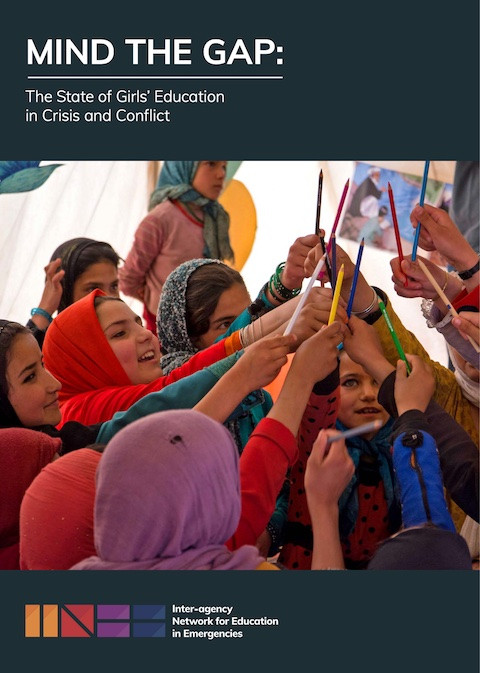 Mind the Gap: The State of Girls’ Education in Crisis and Conflict Year of publication: 2021 Corporate author: Inter-agency Network for Education in Emergencies (INEE) This report summarizes progress, gaps, challenges and opportunities in improving education and training for girls and women affected by conflict and crisis. The report aims to support the Charlevoix Declaration on Quality Education’s commitment to enhance the evidence base and monitor progress toward gender-equitable education in crises. The report draws from data on 44 crisis-affected countries, from recent research, and from a set of case studies of interventions in a range of crisis-affected contexts.
  Municipalities and Regions Take Action on Global Citizenship Education: The Road Towards 2030 Year of publication: 2021 Author: Aurèle Destrée | Tereza Čajková Corporate author: PLATFORMA | European Union (EU) Development Education and Awareness Raising (DEAR)/Global Citizenship Education (GCE) can cultivate the spirit of the 2030 Agenda because it helps acquiring missing knowledge on global interconnections and creates spaces for enquiries.Whilst old constraints still remain and new challenges are appearing, local and regional governments continue to innovate, experiment and work hand in hand with key partners, including with their peers across the globe, to find new solutions and achieve their ambitions.Discover in this publication how local and regional governments are active in supporting learning and fostering changes in a context of socio-economic recovery plans. Actions des municipalités et des régions en faveur de l'éducation à la citoyenneté mondiale: En route vers 2030 Year of publication: 2021 Author: Aurèle Destrée | Tereza Čajková Corporate author: PLATFORMA | EU L’éducation au développement et la sensibilisation (DEAR) et l’éducation à la citoyenneté mondiale (ECM) soutiennent et alimentent l’esprit de l’Agenda 2030 car elles permettent d’acquérir les connaissances manquantes sur les interconnexions mondiales et de créer des espaces de recherche.Alors que d’anciennes contraintes subsistent et que de nouveaux défis apparaissent, les gouvernements locaux et régionaux continuent d’innover, d’expérimenter et de travailler de concert avec des partenaires clés, notamment avec leurs homologues du monde entier, pour trouver de nouvelles solutions et concrétiser leurs ambitions.Découvrez dans la présente publication comment les gouvernements locaux et régionaux s’emploient à soutenir l’apprentissage et à favoriser les changements dans un contexte de plans de relance socio-économique.
 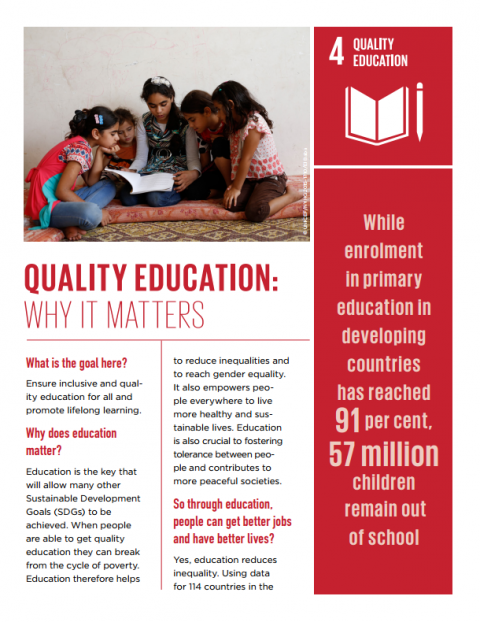 Quality Education: Why It Matters Corporate author: United Nations Children's Fund (UNICEF) Education is the key that will allow many other Sustainable Development Goals (SDGs) to be achieved. When people are able to get quality education they can break from the cycle of poverty. Education therefore helps to reduce inequalities and to reach gender equality. It also empowers people everywhere to live more healthy and sustainable lives. Education is also crucial to fostering tolerance between people and contributes to more peaceful societies.
  On Education & Democracy: 25 Lessons from the Teaching Profession Year of publication: 2019 Author: Susan Hopgood | Fred van Leeuwen Corporate author: Education International (EI) On the occasion of the 25th anniversary of Education International, the authors have selected 25 lessons which educators and their organizations have learnt throughout history on education and democracy.These lessons serve as a set of recommendations to every classroom teacher working at all levels in education systems and in their education unions. These lessons are an invitation to take a stand in favour of democracy and its institutions and to consider contributions that teachers, schools, universities and representative organizations can make to solidify and progress democratic life.