
Resources
Explore a wide range of valuable resources on GCED to deepen your understanding and enhance your research, advocacy, teaching, and learning.
1,727 Results found
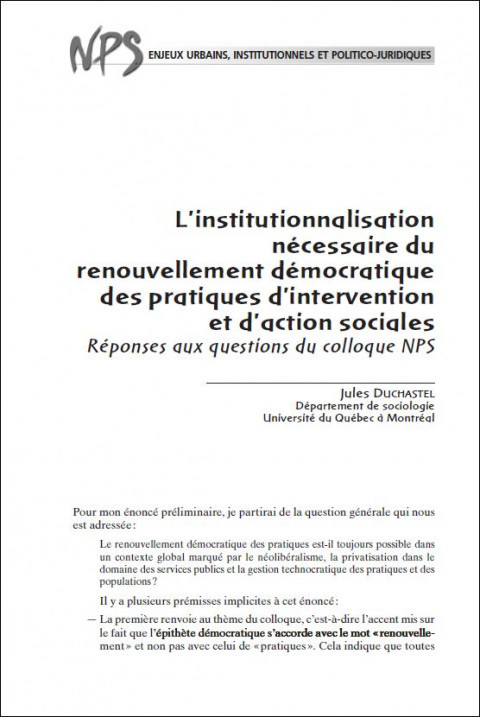 L’institutionnalisation nécessaire du renouvèlement démocratique des pratiques d’intervention et d’action sociales Year of publication: 2009 Author: Jules Duchastel Corporate author: Nouvelles pratiques sociales Pour mon énoncé préliminaire, je partirai de la question générale qui nous est adressée :Le renouvellement démocratique des pratiques est-il toujours possible dans un contexte global marqué par le néolibéralisme, la privatisation dans le domaine des services publics et la gestion technocratique des pratiques et des populations ?Il y a plusieurs prémisses implicites à cet énoncé :La première renvoie au thème du colloque, c’est-à-dire l’accent mis sur le fait que l’épithète démocratique s’accorde avec le mot « renouvellement » et non pas avec celui de « pratiques ». Cela indique que toutes les pratiques, pas seulement celles qui sont généralement associées aux institutions démocratiques, devraient être envisagées sous l’angle de la démocratie. Il s’agirait donc d’élargir la portée de l’idéal démocratique.La deuxième prémisse est qu’il y a des obstacles à cet élargissement. Ces obstacles seraient au nombre de trois :la prédominance du néolibéralisme, la privatisation des services publics, la gestion technocratique.Je vais tenter d’éclairer chacune de ces prémisses, dans un premier temps, de manière générale pour y revenir de manière plus spécifique à l’occasion des sous-questions posées par les organisateurs.
 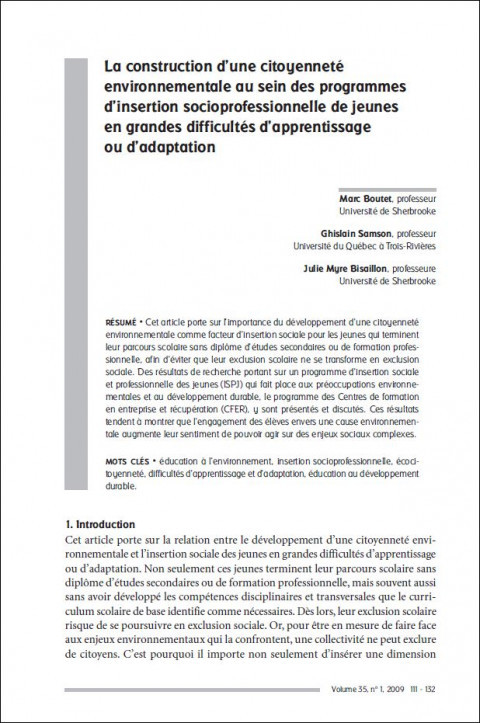 Constructing Environmental Citizenship through Socio-professional Insertion Programs for Youth with Severe Learning and Adaptation Difficulties Year of publication: 2009 Author: Marc Boutet | Ghislain Samson | Julie Myre Bisaillon Corporate author: Revue des sciences de l’éducation This article is about the importance of environmental citizenship as a factor of socio-professional insertion for students who terminate their schooling without a secondary or professional training diploma, in order to prevent that their school exclusion leads to a social exclusion. Results of a research on a socio-professional insertion program for youth that integrates environmental and sustainable development issues and the Corporate Training and Recuperation Centres Network (CFER) are presented and discussed. Those results tend to demonstrate that the students’ involvement in an environmental cause increases their empowerment towards complex social issues. La construcción de una ciudadanía medioambiental en los programas de inserción socioprofesional de los jóvenes con grandes dificultades de aprendizaje o de adaptación Year of publication: 2009 Author: Marc Boutet | Ghislain Samson | Julie Myre Bisaillon Corporate author: Revue des sciences de l’éducation Se trata en este artículo de la importancia del desarrollo de una ciudadanía medioambiental como factor de inserción social para los jóvenes que terminan su recorrido escolar sin diploma de escuela secundaria o de formación profesional, con la finalidad de evitar que su exclusión escolar se transforme en exclusión social. Se presentan y analizan algunos resultados de investigación acerca de un programa de inserción social y profesional de los jóvenes (ISPJ) que toma en cuenta las preocupaciones medioambientales y el desarrollo duradero, el programa de los Centros de formación en empresa y recuperación (CFER). Estos resultados tienden a demostrar que el compromiso de los alumnos hacia una causa medioambiental aumenta su sentimiento de poder actuar en asuntos sociales complejos. La construction d’une citoyenneté environnementale au sein des programmes d’insertion socioprofessionnelle de jeunes en grandes difficultés d’apprentissage ou d’adaptation Year of publication: 2009 Author: Marc Boutet | Ghislain Samson | Julie Myre Bisaillon Corporate author: Revue des sciences de l’éducation Cet article porte sur l’importance du développement d’une citoyenneté environnementale comme facteur d’insertion sociale pour les jeunes qui terminent leur parcours scolaire sans diplôme d’études secondaires ou de formation professionnelle, afin d’éviter que leur exclusion scolaire ne se transforme en exclusion sociale. Des résultats de recherche portant sur un programme d’insertion sociale et professionnelle des jeunes (ISPJ) qui fait place aux préoccupations environnementales et au développement durable, le programme des Centres de formation en entreprise et récupération (CFER), y sont présentés et discutés. Ces résultats tendent à montrer que l’engagement des élèves envers une cause environnementale augmente leur sentiment de pouvoir agir sur des enjeux sociaux complexes.
  [Video] Citizenship and Human Rights Education for Change Year of publication: 2019 Corporate author: Global Campus of Human Rights In increasingly selective, violent and intolerant times, it becomes crucial to reinforce our capacities to deal with topical, controversial and contested issues undermining our human dignity and to promote the supportive values of non-discrimination, democracy, intercultural dialogue and peace. Teaching and learning about democratic citizenship, human rights and EU common values represents an opportunity to react and counter the negative forces of our time.This MOOC aims to foster the promotion of Human Rights Education and EU common values through the transfer of knowledge about the definitions, frameworks and content of Human Rights Education as well as the analysis of existing and innovative practices on teaching styles, approaches and methods.
  [Video] Learning about SDG 4 Year of publication: 2017 Corporate author: United Cities and Local Governments (UCLG) Life is continual learning, we learn to read to understand a constantly changing role, to participate and to live together. We learn in the classroom and beyond its world. Cities are places of opportunity but they can be also be places of exclusion. There are 758 million people over the age 15 in the world who can't read or write. Two out of three of them are women. Local governments because they are close to the people are able to respond to their needs and contribute to create equal educational opportunities. They work to ensure that facilities are ideal for learning and community life. They promote the adoption of sustainable life styles and provide education in values. Local government work with educators and administrations to ensure adequate resources and to improve education. In all these ways local governments contribute to achieve sustainable development goals for ensuring inclusive and quality education for all and promote lifelong learning.
 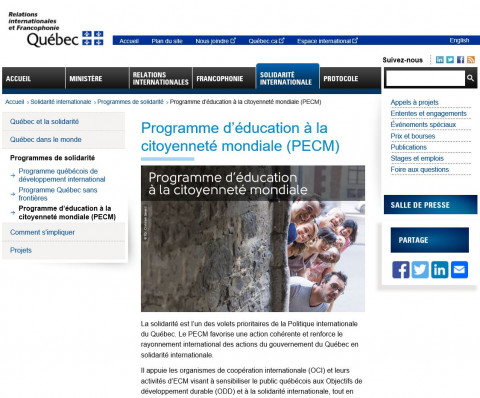 Programme d’éducation à la citoyenneté mondiale (PÉCM) Year of publication: 2018 Corporate author: Ministère des Relations internationales et de la Francophonie La solidarité est l’un des volets prioritaires de la Politique internationale du Québec. Le PECM favorise une action cohérente et renforce le rayonnement international des actions du gouvernement du Québec en solidarité internationale.Il appuie les organismes de coopération internationale (OCI) et leurs activités d’ECM visant à sensibiliser le public québécois aux Objectifs de développement durable (ODD) et à la solidarité internationale, tout en favorisant l’acquisition de connaissances, de valeurs et de comportements qui contribuent à la mise en place d’un monde plus juste, durable et équitable.
  Didactique de l’éducation à la citoyenneté Year of publication: 2016 Corporate author: Haute école pédagogique Vaud L’UER Didactiques des sciences humaines de la HEP Vaud assure l’enseignement et la recherche liés à la didactique de l’éducation à la citoyenneté.Comment concevoir une éducation à la citoyenneté pour tous les élèves, quelles que soient leurs origines et leurs nationalités ? Longtemps limitée à la connaissance des institutions politiques et de leur fonctionnement, l’éducation à la citoyenneté invite aujourd’hui également à former les élèves aux pratiques participatives et délibératives constitutives d’une démocratie. Introduite à l’origine sous le terme d’instruction civique et centrée sur la connaissance des institutions politiques comme principal moteur d’insertion dans la collectivité nationale, l’éducation à la citoyenneté est aujourd’hui bien plus conçue, dans les plans d’études, comme une éducation au pouvoir (son fonctionnement, son exercice) et aux pratiques délibératives. Dans le contexte politique et économique actuel, il semble en effet de moins en moins pertinent d’enseigner une citoyenneté figée autour de règles préétablies et visant l’insertion dans une seule communauté d’appartenance.
 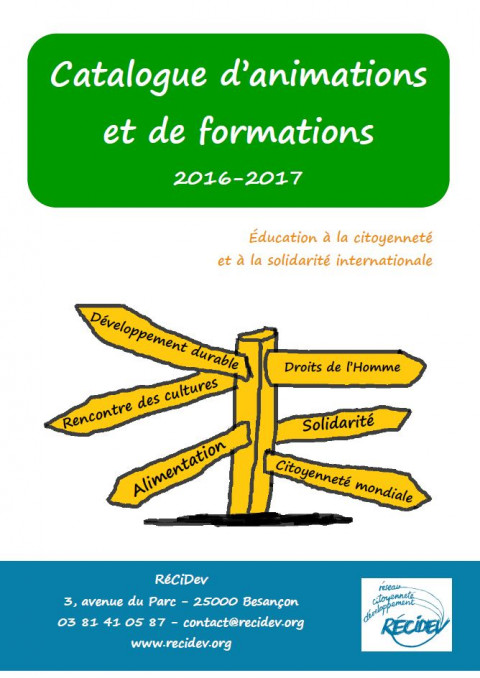 Catalogue d’animations et de formations 2016-2017 : Éducation à la citoyenneté et à la solidarité internationale Year of publication: 2016 Corporate author: Réseau Citoyenneté Développement (RéCiDev) « L’éducation à la citoyenneté et à la solidarité internationale (ECSI) est une démarche sociale et politique dont la finalité est de favoriser la contribution individuelle et collective à la construction d’un monde juste, solidaire et durable. Elle s’appuie sur un processus pédagogique qui se déroule tout au long de la vie.Son objectif est de permettre à chacun de comprendre les mécanismes d’interdépendance et d’exclusion dans le monde ; de prendre conscience de l’importance d’une démarche citoyenne ayant pour but de favoriser une solidarité entre les territoires, les générations, les groupes sociaux… et d’agir pour la construction d’un monde solidaire. L’ECSI contribue à donner à tous des clés pour développer un esprit critique face à un modèle de développement dominant producteur d’inégalités et d’exclusions. Elle vise à une transformation sociale et à la construction collective d’autres modes de développement, respectueux des droits humains et de l’environnement. Elle valorise des alternatives en cours partout dans le monde. Elle favorise le vivre ensemble et l’épanouissement personnel.Parce qu’elle bénéficie au plus grand nombre et qu’elle répond aux enjeux du monde actuel, l’ECSI sert l’intérêt général. À ce titre, la promouvoir et la garantir est un devoir des Etats en cohérence avec l’ensemble des politiques publiques. »
  Global Citizenship Education: How Much Do We Care? Year of publication: 2018 Corporate author: European confederation of Relief and Development NGOs (CONCORD) While Global Citizenship Education is recognised by many as a powerful tool to resolve the current global challenges our world is facing, the level of investment by national governments remains limited. Why is that? To answer this situation, CONCORD launches its new report “Global Citizenship Education – How much do we care?“. Based on a research across all EU Member States (+ Norway), this publication reveals the level of funding dedicated to Global Citizenship Education (GCE) in Europe between 2011 and 2015. Analysing the quantitative sources of investments by national governments as well as the qualitative narrative around GCE (How is GCE named? What is its framework of action?), this report digs into the complex world of GCE and provides a full picture of its current states in Europe. The report is composed of 2 parts:– a general overview and analysis– a comparative part made of an analysis per country of all EU member states (+ Norway), including interesting details on GCE definitions, concepts, funding trends.Strong of these analysis, the report draws conclusions and recommendations on where possible improvements at policy and advocacy level can be made.