
Resources
Explore a wide range of valuable resources on GCED to deepen your understanding and enhance your research, advocacy, teaching, and learning.
730 Results found
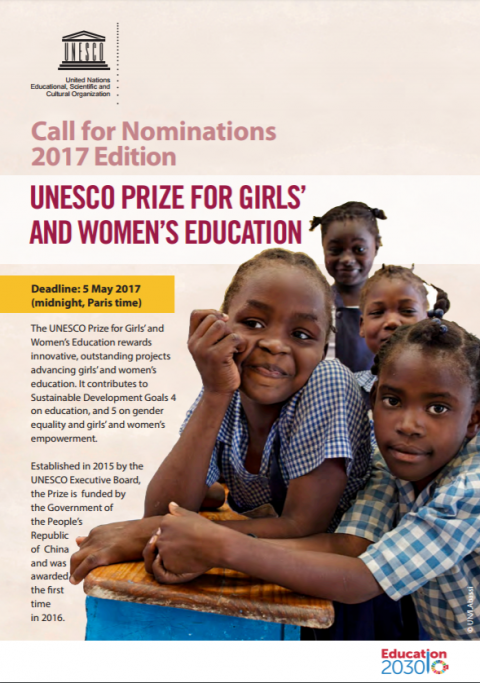 Prix UNESCO pour l'éducation des filles et des femmes, édition 2017: appel à candidatures Year of publication: 2017 Corporate author: UNESCO The UNESCO Prize for Girls’ and Women’s Education rewards innovative, outstanding projects advancing girls’ and women’s education. It contributes to Sustainable Development Goals 4 on education, and 5 on gender equality and girls’ and women’s empowerment. Premio UNESCO de educación de las niñas y las mujeres, edición de 2017: solicitud de candidaturas Year of publication: 2017 Corporate author: UNESCO The UNESCO Prize for Girls’ and Women’s Education rewards innovative, outstanding projects advancing girls’ and women’s education. It contributes to Sustainable Development Goals 4 on education, and 5 on gender equality and girls’ and women’s empowerment. Прием заявок в номинации Конкурс 2017. ПРЕМИЯ ЮНЕСКО ЗА ДОСТИЖЕНИЯ В ОБЛАСТИ ОБРАЗОВАНИЯ ДЕВОЧЕК И ЖЕНЩИН Year of publication: 2017 Corporate author: UNESCO The UNESCO Prize for Girls’ and Women’s Education rewards innovative, outstanding projects advancing girls’ and women’s education. It contributes to Sustainable Development Goals 4 on education, and 5 on gender equality and girls’ and women’s empowerment. 联合国教科文组织女童和妇女教育奖 - 2017年 - 征集提名 Year of publication: 2017 Corporate author: UNESCO The UNESCO Prize for Girls’ and Women’s Education rewards innovative, outstanding projects advancing girls’ and women’s education. It contributes to Sustainable Development Goals 4 on education, and 5 on gender equality and girls’ and women’s empowerment. UNESCO Prize for Girls' and Women's Education, 2017 edition: call for nominations Year of publication: 2017 Corporate author: UNESCO The UNESCO Prize for Girls’ and Women’s Education rewards innovative, outstanding projects advancing girls’ and women’s education. It contributes to Sustainable Development Goals 4 on education, and 5 on gender equality and girls’ and women’s empowerment.
 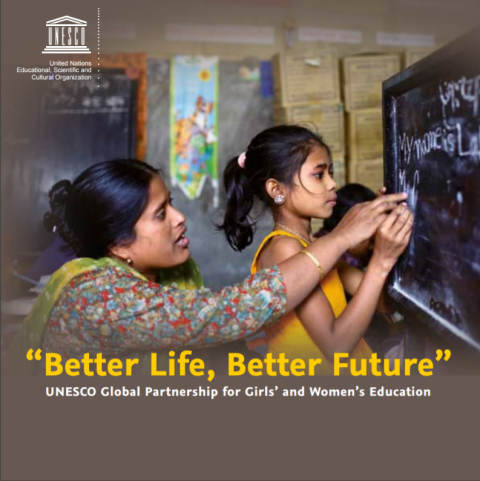 Better Life, Better Future: UNESCO Global Partnership for Girl's and Women's Education Year of publication: 2011 Corporate author: UNESCO “Better Life, Better Future”, UNESCO’s global partnership for girls’ and women’s education, addresses two main areas requiring increased attention – secondary education and adult literacy. It will seek to introduce programmes aimed at stemming the dropout of adolescent girls in the transition from primary to secondary education and in lower secondary schools, as well as focus on scaling up women’s literacy programmes through stronger advocacy and partnerships. As a first step, and in complement to other United Nations initiatives, UNESCO has recently concluded several dynamic public and private partnerships, which stand to benefit marginalized girls and women in Africa and Asia.
 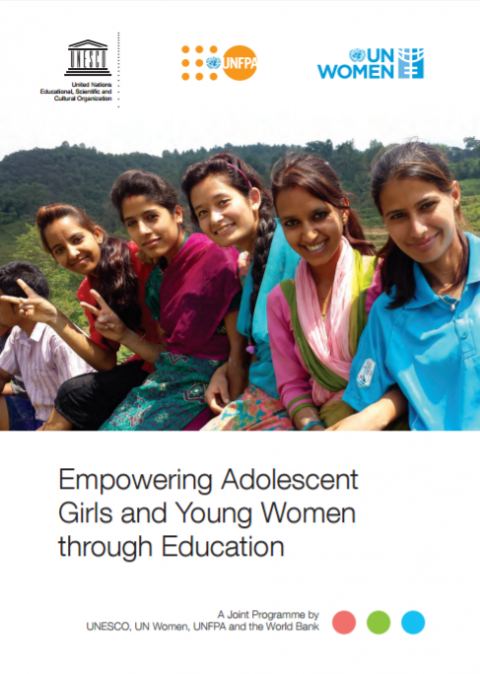 Empowering Adolescent Girls and Young Women through Education Year of publication: 2015 Corporate author: UNESCO L'Autonomisation des adolescentes et des jeunes femmes par l'éducation Year of publication: 2015 Corporate author: Organisation des Nations Unies pour l'éducation, la science et la culture (UNESCO)
  [Video] Global Citizenship Education to Prevent Violent Extremism Year of publication: 2016 Corporate author: UNESCO The UNESCO video on “Global Citizenship Education to prevent violent extremism” explains how education can prevent violent extremism through equipping young people with the skills to dialogue and think critically, and engage meaningfully with others and their communities in order to build peaceful societies.
 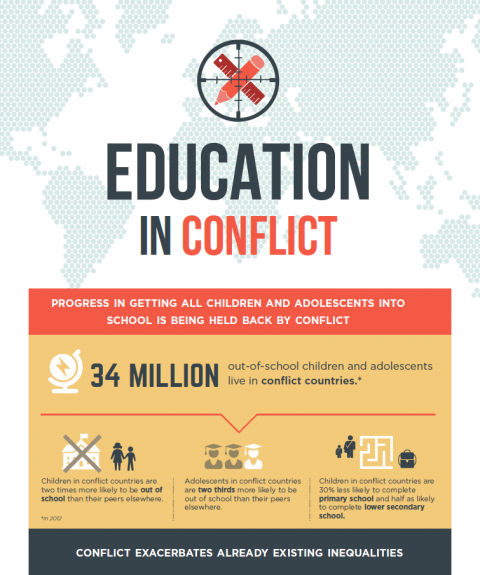 EDUCATION IN CONFLICT Corporate author: EFA Global Monitoring Report Team | UNESCO PROGRESS IN GETTING ALL CHILDREN AND ADOLESCENTS INTO SCHOOL IS BEING HELD BACK BY CONFLICT - 34 million out-of-school children and adolescents live in conflict countries. - Children in conflict countries are two times more likely to be out of school than their peers elsewhere.- Adolescents in conflict countries are two thirds more likely to be out of school than their peers elsewhere.- Children in conflict countries are 30% less likely to complete primary school and half as likely to complete lower secondary school.- Girls are almost two and a half times more likely to be out of school if they live in a conflict country than those elsewhere.- Adolescent girls are almost 90% more likely to be out of secondary school than young women elsewhere.- The poorest children in conflict countries are twice as likely to be out of school as the poorest elsewhere.