
Resources
Explore a wide range of valuable resources on GCED to deepen your understanding and enhance your research, advocacy, teaching, and learning.
1,180 Results found
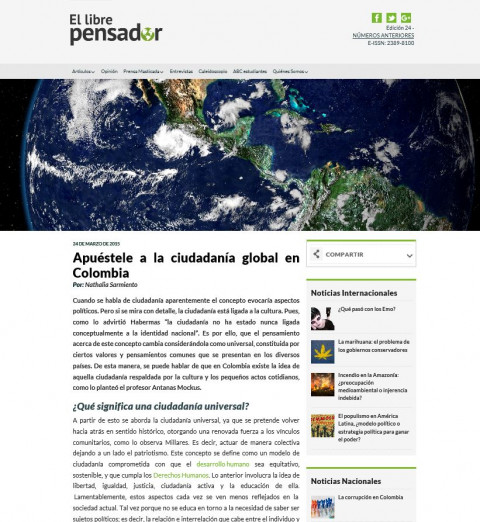 Bring Global Citizenship in Colombia Year of publication: 2015 Author: Nathalia Sarmiento The blog from the Universidad Extremado from Colombia defines what global citizenship is and its ideals, and promotes a citizenship of this type for Colombia. It states that a humanistic and universal perspective, committed with human development, will foster greater liberty, equality, justice, an active citizenship and the education that goes with it. Apuéstale a la ciudadanía global en Colombia Year of publication: 2015 Author: Nathalia Sarmiento El blog de la Universidad Externado de Colombia define lo que es la ciudadanía global y sus cometidos, y propone una ciudadanía de este tipo para Colombia. Asegura que desde una perspectiva humanista y universal, comprometida con el desarrollo humano, promoverá mayor libertad, igualdad, justicia, ciudadanía activa y la educación de ella.
  Learning to Leapfrog: Innovative Pedagogies to Transform Education Year of publication: 2019 Author: David Istance | Alejandro Paniagua | Rebecca Winthrop | Lauren Ziegler Corporate author: Center for Universal Education at Brookings This report follows up on the book “Leapfrogging Inequality: Remaking Education to Help Young People Thrive,” published in 2018 by the Center for Universal Education (CUE) at the Brookings Institution. The book argued the importance of education leapfrogging–creating transformative shifts rather than incremental evolution by harnessing the power of innovation to advance a breadth of skills. The book put forth a framework for leapfrogging that outlined two core elements (teaching and learning, and recognition of learning) and two support elements (people and places, and technology and data).This report focuses on the teaching and learning element of the leapfrog framework, especially on pedagogical approaches and the role of teachers, but draws on the others as relevant. It does not attempt to be exhaustive and does not pretend to address neither all education policy variables, nor critical system factors such as political will and adequate funding, nor demand-side factors such as student and parent support for innovative approaches.
  "Education First" - UN Secretary-General's video message Year of publication: 2012 Author: United Nations. Secretary-General, 2007-2016 (Ban, Ki-moon) UN Secretary-General, Mr. Ban Ki-moon launched a Global Initiative on Education (Education First), which aims to achieve quality, relevant and inclusive education for every child on 26 September, 2012. "Education First" - UN Secretary-General's video message Year of publication: 2012 Author: United Nations. Secretary-General, 2007-2016 (Ban, Ki-moon) Secrétaire général de l'ONU, M. Ban Ki-moon, a lancé une initiative Mondiale sur lÉducation (Education First), qui vise à atteindre une qualité, une éducation pertinente et inclusive pour tous les enfants le 26 Septembre, de 2012.
 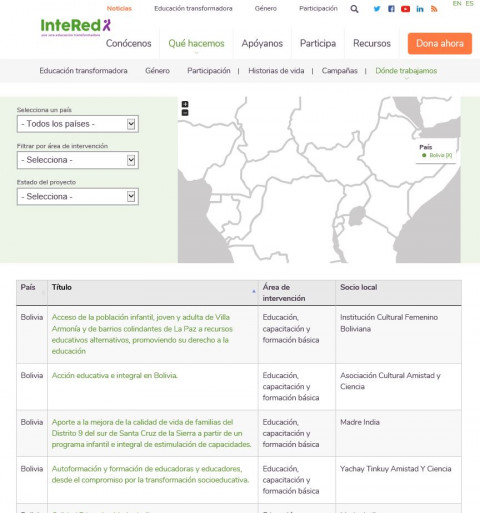 InteRed. Educational Projects in Bolivia Year of publication: 2019 Corporate author: InteRed InteRed carries out educational projects to solve specific social problems around the planet. The projects tackle things such as poverty, health, access to education, Human Rights, access to food, among other things. InteRed. Proyectos educativos en Bolivia Year of publication: 2019 Corporate author: InteRed InteRed lleva a cabo projectos educacionales intentando resolver problemas específicos en el planeta. Los proyectos abordan cuestiones como pobreza, salud, acceso a la educación, Derechos Humanos, acceso a alimentos, entre otras cosas.
 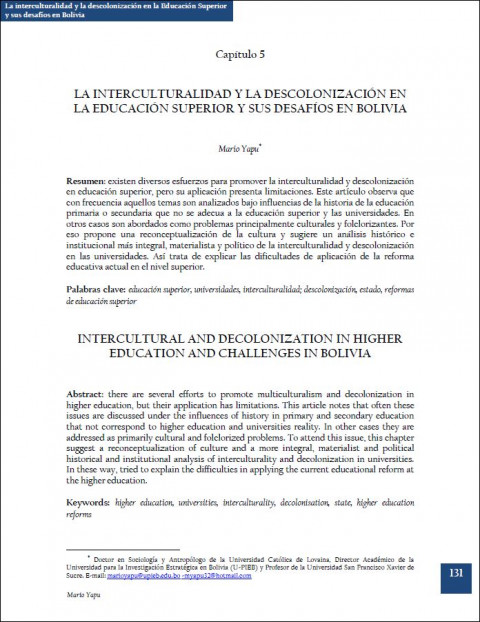 Intercultural and Decolonization in Higher Education and Challenges in Bolivia Year of publication: 2016 Author: Mario Yapu Corporate author: CELEI Chile There are several efforts to promote multiculturalism and decolonization in higher education, but their application has limitations. This article notes that often these issues are discussed under the influences of history in primary and secondary education that not correspond to higher education and universities reality. In other cases they are addressed as primarily cultural and folclorized problems. To attend this issue, this chapter suggest a reconceptualization of culture and a more integral, materialist and political historical and institutional analysis of interculturality and decolonization in universities. In these way, tried to explain the difficulties in applying the current educational reform at the higher education. La interculturalidad y la descolonización en la Educación Superior y sus desafíos en Bolivia Year of publication: 2016 Author: Mario Yapu Corporate author: CELEI Chile Existen diversos esfuerzos para promover la interculturalidad y descolonización en educación superior, pero su aplicación presenta limitaciones. Este artículo observa que con frecuencia aquellos temas son analizados bajo influencias de la historia de la educación primaria o secundaria que no se adecua a la educación superior y las universidades. En otros casos son abordados como problemas principalmente culturales y folclorizantes. Por eso propone una reconceptualización de la cultura y sugiere un análisis histórico e institucional más integral, materialista y político de la interculturalidad y descolonización en las universidades. Así trata de explicar las dificultades de aplicación de la reforma educativa actual en el nivel superior.
  Education for Citizenship in the New Global Order Year of publication: 2018 Author: Walter Fernando Pérez Niño This article analyzes the concept of citizenship from a historical perspective and confronting it with an analysis of the different hegemonies that have tried to impose a global order and the consequences of applying policies that obey to this order. After this, it revises the right of receiving an education bearing in mind the new global realities; and, finally, it centers the study in the different problems education is facing as a consquence of the world order and proposes a perspective to follow.