
Resources
Explore a wide range of valuable resources on GCED to deepen your understanding and enhance your research, advocacy, teaching, and learning.
661 Results found
 Saving our world heritage Year of publication: 2023 Author: Hopkinson, Leo Corporate author: UNESCO
  Technology-facilitated gender-based violence in an era of generative AI Year of publication: 2023 Corporate author: UNESCO <Short summary>Experiments reveal how generative AI facilitates gender-based violence Generative Artificial Intelligence (AI) — deep-learning models that create voice, text, and image — are revolutionizing the way people access information and produce, receive and interact with content. While technological innovations like ChatGPT, DALL-E and Bard offer previously unimaginable gains in productivity, they also present concerns for the overall protection and promotion of human rights and for the safety of women and girls.The arrival of generative AI introduces new, unexplored questions: what are the companies’ policies and normative cultures that perpetuate technology-facilitated gender-based violence and harms? How do AI-based technologies facilitate gender-specific harassment and hate speech? What “prompt hacks” can lead to gendered disinformation, hate speech, harassment, and attacks? What measures can companies, governments, civil society organisations and independent researchers take to anticipate and mitigate these risks?A combination of measures are proposed to be put in place by generative AI companies and the technology companies that platform them, regulators and policy makers, by civil society organisations and independent researchers, as well as users.
  UNESCO's Communication and Information Sector: upholding information as a public good, advancing universal access, digital inclusion and freedom of expression Year of publication: 2023 Corporate author: UNESCO
  Digital initiatives for indigenous languages Year of publication: 2023 Author: Genner Llanes-Ortiz Corporate author: UNESCO | Global Voices (Amsterdam) <Short summary> Supported by UNESCO and Global Voices’ Rising Voices (RV), this toolkit extends the efforts of dedicated Indigenous digital practitioners. It illustrates how internet and other digital tools can be utilized to conserve, revive, and promote Indigenous languages, as well as other marginalized or minority languages.This toolkit has been co-designed in close partnership with both established and emerging networks of Indigenous digital practitioners, language advocates, and collaborators, within the framework of the International Decade of Indigenous Languages 2022-2032. The toolkit promotes the foundation of language preservation, revival, and promotion on eight key approaches:Facilitating, Multiplying, Normalizing, Educating, Reclaiming, Imagining, Defending and Protecting. It also offers a curated list of valuable resources, including guides, tutorials, and manuals for utilizing digital tools. In conjunction with the advisory group established for the toolkit’s preparation and other collaborating organizations, it presents a wealth of inspiring stories showcasing innovative projects that have made a significant impact on languages at local, national, or global levels.Finally, the toolkit is openly licensed as an Open Educational Resource. It is expected that the toolkit will continue to evolve and grow as the needs of language users and digital language defenders and promoters change alongside the introduction of new technological solutions, innovation and creativity.
  Empowering women for the good of society: gender-based resilience Year of publication: 2023 Author: Squicciarini, Mariagrazia | Sarlat, Garance | Manca, Anna Rita Corporate author: UNESCO <Short Summary> Let’s change the resilience paradigmWhat are the root causes and drivers of resilience? Societal resilience is shaped by the unique roles that individuals play and their ability to respond to shocks, gender-based expectations and discriminations hinder women’s and girls’ ability to participate in, and contribute to, society. In times of crises, their vulnerability intensifies resulting in a weakened response that ripples throughout society.In response, UNESCO designed the first Gender-Based Resilience Framework. As a compass for inclusive policymaking, this report analyzes how differences in opportunities, needs and constraints impact resilience and proposes a measurement Framework based on: (1) fundamental human rights; (2) socioeconomic characteristics, such as health, education, work, political engagement, and climate justice; (3) contextual factors, such as values and perceptions.Moving beyond the standard approach of coping with and recovering from shocks; UNESCO calls for a gender-transformative resilience, which leverages the interrelations between individuals and institutions. Decision- and policy-makers, researchers, and gender equality advocates are invited to use and add to this Framework to effectively navigate through current and future crises.It is only by empowering all women and girls, and people of all genders, that we will be able to face the challenges ahead.
 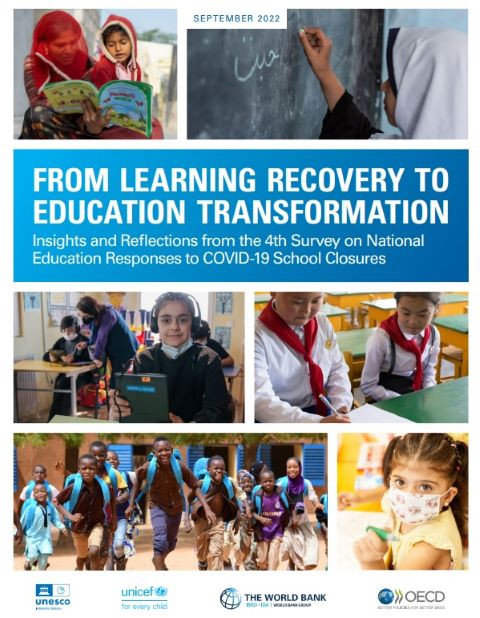 From Learning Recovery to Education Transformation: Insights and Reflections from the 4th Survey on National Education Responses to COVID-19 School Closures Year of publication: 2022 Corporate author: UNESCO | UNESCO Institute for Statistics (UIS) | United Nations Children's Fund (UNICEF) | World Bank | Organisation for Economic Co-operation and Development (OECD) From Learning Recovery to Education Transformation, a new joint report by UNESCO, UNESCO Institute for Statistics (UIS), UNICEF, The World Bank and The OECD, presents findings from the fourth round of the Survey on National Education Responses to COVID-19 School Closures, administered between April–July 2022 with responses from Ministries of Education in 93 countries. It explores how countries are progressing in the RAPID actions to recover learning: Reach every child and keep them in school; Assess learning levels regularly; Prioritize teaching the fundamentals; Increase the efficiency of instruction; and Develop psychosocial health and wellbeing.
  Artificial Intelligence and Digital Transformation: Competencies for Civil Servants Year of publication: 2022 Corporate author: UNESCO | Broadband Commission for Sustainable Development. Working Group on AI Capacity Building | International Telecommunication Union (ITU) This report presents a competency framework for civil servants on AI and digital transformation, and recommends ways to implement it to support related capacities in government. The research for this report was guided by the following question: What competencies need to be developed for public-sector officials to effectively design and implement digital and AI transformation initiatives in government, and to create an enabling environment for digital transformation in society?The report provides an overview of the major digital competencies for public sector officials when dealing with digital transformation. The competency framework provides guidance for civil servants, but also for international organisations and research centers to develop curricula and provide a basis for the development of action plans and strategies on digital competencies.
  Citizenship Education in the Global Digital Age: Thematic Paper Year of publication: 2022 Corporate author: UNESCO This document, prepared by UNESCO Section on Global Citizenship and Peace Education with the contribution of Laura Engel and Evelyne Koumtingue, is part of several thematic papers developed by UNESCO to inform the Revision of the 1974 Recommendation concerning education for international understanding, co-operation and peace. These papers focus on topics that are not currently covered in the Recommendation but that require greater attention in the revised version in view of ensuring it addresses contemporary challenges to lasting peace.
  The Concept of Sustainability and Its Contribution Towards Quality Transformative Education: Thematic Paper Year of publication: 2022 Corporate author: UNESCO This thematic paper explores the concept of sustainability and its contribution towards quality transformative education, and serves as a background document to clarify the scope and depth of the revised 1974 Recommendation. Specifically, this document presents the need to update and broaden the scope of the 1974 Recommendation by introducing the concept of sustainable development, and discussing the role of education in addressing contemporary global challenges in particular climate change and climate justice, peace, biodiversity loss, poverty and inequality, and discriminations and human rights.
  Freedom of Expression, Media and Information Literacy and Digital Competencies to Support Peace and Human Rights: Thematic Paper Year of publication: 2022 Corporate author: UNESCO This document is part of the thematic papers developed by UNESCO to inform the Revision of the 1974 Recommendation concerning education for international understanding, co-operation and peace. It focuses on Freedom of Expression, Media and Information Literacy and Digital Competencies that are not currently covered in the Recommendation but that require greater attention in the revised version in view of ensuring it addresses contemporary challenges to lasting peace.