
Resources
Explore a wide range of valuable resources on GCED to deepen your understanding and enhance your research, advocacy, teaching, and learning.
1,405 Results found
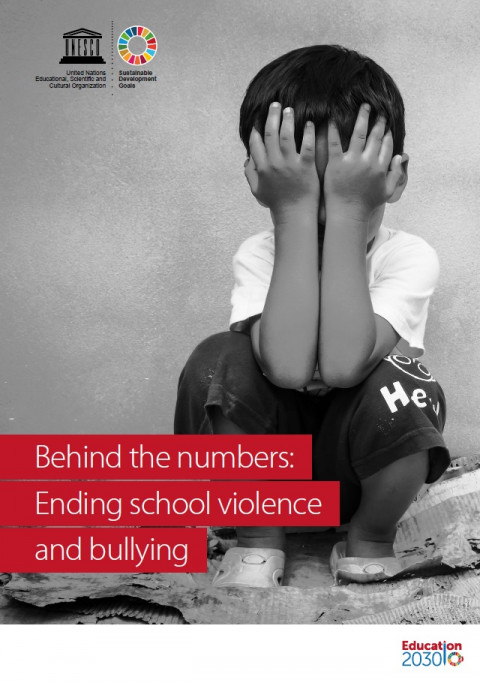 Behind the Numbers: Ending School Violence and Bullying Year of publication: 2019 Corporate author: UNESCO School-related violence in all its forms, including bullying, is an infringement of children’s and adolescents’ rights to education and health and well-being. No country can achieve inclusive and equitable quality education for all if learners experience violence in school.This report provides an overview of the most up-to-date evidence on school violence and bullying. It includes global and regional prevalence and trends, factors that influence vulnerability to school violence and bullying, and consequences. The publication brings together for the first time in one place a wealth of quantitative data from two large-scale international surveys: the Global School-based Student Health Survey (GSHS) and the Health Behaviour in Schoolaged Children (HBSC) study. The surveys cover 144 countries and territories in all regions of the world, and from a wide range of other global and regional surveys. The publication also includes an analysis of factors that contribute to effective national responses, based on a series of case studies commissioned by UNESCO of countries that have succeeded in reducing the prevalence of school violence and bullying or have maintained low levels of school violence over time. Au-delà des chiffres: en finir avec la violence et le harcèlement à l’école Year of publication: 2019 Corporate author: UNESCO La violence en milieu scolaire sous toutes ses formes, y compris le harcèlement, porte atteinte aux droits des enfants et des adolescents à l’éducation, la santé et au bien-être. Aucun pays ne peut assurer une éducation de qualité inclusive et équitable si les élèves sont confrontés à la violence dans les écoles.Cette publication fournit un aperçu de la prévalence des différentes formes de violence et de harcèlement à l’école au niveau mondial. Elle présente les tendances en termes d’évolution de cette prévalence, globalement et dans les différentes régions du monde. Elle examine les facteurs qui rendent les jeunes plus vulnérables à la violence et au harcèlement à l’école, ainsi que les conséquences de ces phénomènes. Pour la première fois, cette publication rassemble une multitude de données quantitatives issues de deux vastes enquêtes internationales, l’Enquête mondiale en milieu scolaire sur la santé des élèves (Global School-based Student Health Survey, GSHS) et l’Enquête sur le comportement de santé des enfants d’âge scolaire (Health Behaviour in Schoolaged Children, HBSC), qui couvrent 144 pays et territoires de toutes les régions du monde ; mais aussi d’un grand nombre d’autres études internationales et régionales. Cette publication contient également une analyse des facteurs qui contribuent à l’efficacité des réponses nationales, fondée sur les études de cas commandées par l’UNESCO dans les pays étant parvenus à réduire la violence et le harcèlement dans leurs écoles ou à maintenir dans la durée les faibles taux de prévalence de ces phénomènes. Más allá de los números: poner fin a la violencia y el acoso en el ámbito escolar Year of publication: 2019 Corporate author: UNESCO Todas las formas de violencia en la escuela, incluido el acoso, representan una vulneración del derecho de niños, niñas y adolescentes a la educación y a la salud y el bienestar. Ningún país puede lograr una educación inclusiva, equitativa y de calidad si sus estudiantes son víctimas de violencia en el ámbito escolar.Esta publicación ofrece una visión general de los datos más actualizados sobre violencia y acoso en el ámbito escolar. Incluye información acerca de tendencias y prevalencia a escala mundial y regional, los factores que influyen en la vulnerabilidad a la violencia y el acoso, y sus consecuencias. La publicación reúne por primera vez en un solo lugar una gran cantidad de datos cuantitativos extraídos de dos encuestas internacionales a gran escala: la Encuesta Mundial de Salud a Escolares (GSHS) y la Encuesta sobre las conductas saludables de los jóvenes escolarizados (HBSC) que abarcan 144 países y territorios de todas las regiones del mundo, así como de otras muchas encuestas mundiales y regionales. La publicación incluye asimismo un análisis de los factores que contribuyen al logro de respuestas nacionales eficaces, para lo que se basa en una serie de estudios de caso, encargados por la UNESCO, de países que han logrado reducir la prevalencia de la violencia y el acoso en las escuelas, o han mantenido niveles bajos de violencia escolar a lo largo del tiempo.
 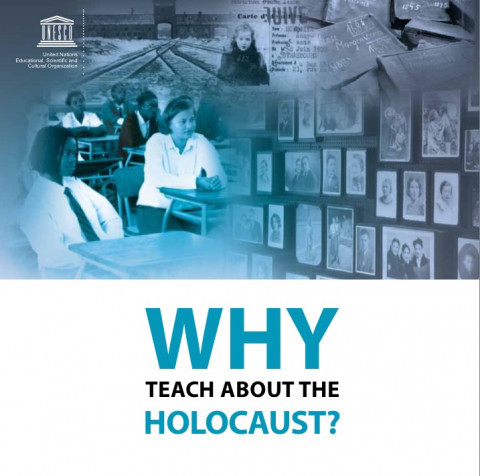 Pourquoi enseigner l'holocauste Year of publication: 2014 Corporate author: UNESCO The Holocaust was a turning point in human history. Understanding the genocide of the Jewish people and other crimes perpetrated by the Nazi regime remains of great signi cance in the modern world.Regardless of where we live or who we are, learning about this universal history can help engage students in a critical re action about the roots of genocide and the necessity to nurture peace and human rights to prevent such atrocities in the future.This short introduction provides an essential overview on education about the Holocaust that can support policymakers, educators and students alike in their understanding of genocide and why it is vital that we continue to teach about the Holocaust today. ¿Por qué enseñar sobre el holocausto? Year of publication: 2014 Corporate author: UNESCO The Holocaust was a turning point in human history. Understanding the genocide of the Jewish people and other crimes perpetrated by the Nazi regime remains of great signi cance in the modern world.Regardless of where we live or who we are, learning about this universal history can help engage students in a critical re action about the roots of genocide and the necessity to nurture peace and human rights to prevent such atrocities in the future.This short introduction provides an essential overview on education about the Holocaust that can support policymakers, educators and students alike in their understanding of genocide and why it is vital that we continue to teach about the Holocaust today. Зачем преподавать историю Холокоста? Year of publication: 2014 Corporate author: UNESCO The Holocaust was a turning point in human history. Understanding the genocide of the Jewish people and other crimes perpetrated by the Nazi regime remains of great signi cance in the modern world.Regardless of where we live or who we are, learning about this universal history can help engage students in a critical re action about the roots of genocide and the necessity to nurture peace and human rights to prevent such atrocities in the future.This short introduction provides an essential overview on education about the Holocaust that can support policymakers, educators and students alike in their understanding of genocide and why it is vital that we continue to teach about the Holocaust today. ما الداعي إلى التعليم بشأن محرقة اليهود Year of publication: 2014 Corporate author: UNESCO The Holocaust was a turning point in human history. Understanding the genocide of the Jewish people and other crimes perpetrated by the Nazi regime remains of great signi cance in the modern world.Regardless of where we live or who we are, learning about this universal history can help engage students in a critical re action about the roots of genocide and the necessity to nurture peace and human rights to prevent such atrocities in the future.This short introduction provides an essential overview on education about the Holocaust that can support policymakers, educators and students alike in their understanding of genocide and why it is vital that we continue to teach about the Holocaust today.
  Country Commitments to Gender Equality in Education Year of publication: 2018 Author: Erica Murphy Corporate author: UNESCO The international community has committed through legal and political frameworks to achieving gender equality in all spheres, including education. These frameworks include obligations to protect and secure women and girls' right to education through the elimination of discriminatory barriers, whether they exist in law or in everyday life, and to undertake positive measures to bring about equality, including in access of, within, and through education.This paper firstly sets out the legal and political frameworks on gender equality in education to which states have committed and then describes how they have committed.In the second section, the content of states’ commitments to achieve gender equality in education is explained, including the normative content of relevant provisions found in international and regional human rights treaties and the 2030 Agenda for Sustainable Development. This section also includes a classification of states according to what legal commitments to women and girls’ right to education they have made.The final section details how states can be held accountable for failure to meet their legal commitments to gender equality in education, including what mechanisms are available and examples of how these mechanisms have been used to hold states accountable.This paper is also background paper prepared for the 2018 Global education monitoring report gender review: Meeting our commitments to gender equality in education.
 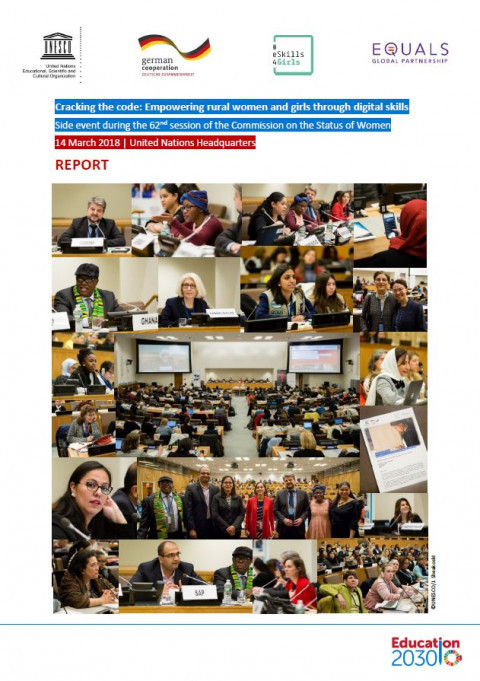 Cracking the Code: Empowering Rural Women and Girls through Digital Skills; Side Event during the 62nd Session of the Commission on the Status of Women, 14 March 2018, United Nations Headquarters: Report Year of publication: 2018 Corporate author: UNESCO | Germany. Federal Ministry for Economic Cooperation and Development (BMZ) UNESCO and the German Federal Ministry of Economic Cooperation and Development (BMZ) co-organised the side event ‘Cracking the code: Empowering rural women and girls through digital skills’ on 14 March 2018, United Nations Headquarters in New York, on the margins of the 62nd session of the CSW. More than 500 participants participated in the event while a broad global audience followed the discussions through live webcast.This report provides an overview of the discussions and examples of government, civil society organizations, and private sector initiatives to close the gender digital gap and empower rural girls and women to be ICT users, creators and innovators through gender-responsive digital skills training as well as science, technology, engineering and mathematics (STEM) education more broadly.
 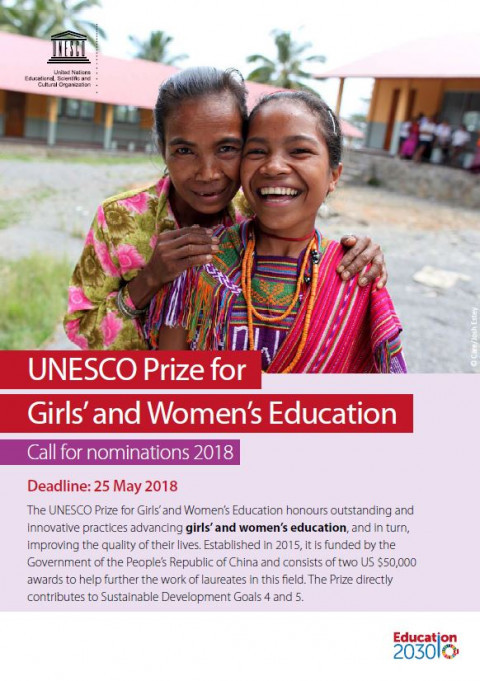 UNESCO Prize for Girls' and Women's Education: Call for Nominations 2018 Year of publication: 2018 Corporate author: UNESCO The UNESCO Prize for Girls’ and Women’s Education honours outstanding and innovative practices advancing girls’ and women’s education, and in turn, improving the quality of their lives. Established in 2015, it is funded by the Government of the People’s Republic of China and consists of two US $50,000 awards to help further the work of laureates in this field. The Prize directly contributes to Sustainable Development Goals 4 and 5.