
Resources
Explore a wide range of valuable resources on GCED to deepen your understanding and enhance your research, advocacy, teaching, and learning.
306 Results found
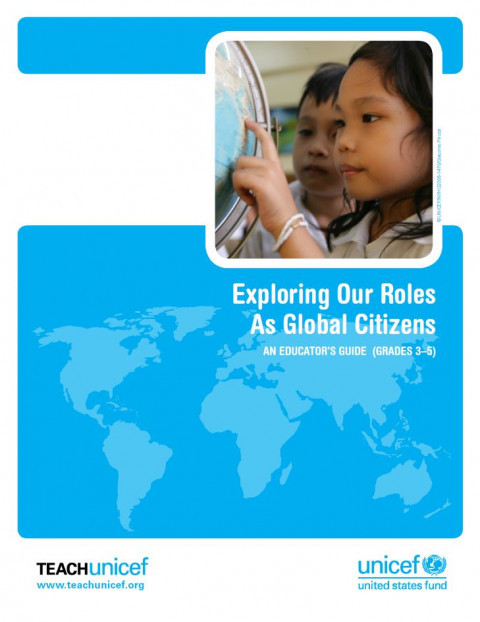 Exploring our roles as global citizens: an educator's guide (grades 3-5) Year of publication: 2013 Author: Elizabeth O. Crawford Corporate author: TeachUNICEF La définition se fonde sur le travail séminal dans les états et un large éventail d'organisations de travail pour faire avancer les connaissances mondiales et de la pensée critique. Un processus d'articulation minutieuse et vetting a abouti à la définition de la compétence globale proposée ici: la compétence globale est la capacité et la disposition pour comprendre et agir sur les questions d'importance mondiale. Globalement les personnes compétentes sont au courant, curieux et intéressés à en apprendre sur le monde et comment il fonctionne. Ils peuvent utiliser les grandes idées, des outils, des méthodes et des langues qui sont au cœur de toutes les disciplines (mathématiques, la littérature, l'histoire, la science et les arts) pour engager les questions pressantes de notre temps. Ils déploient et développer cette expertise comme ils enquêtent sur ces questions, reconnaissent de multiples points de vue, de communiquer leurs points de vue de manière efficace, et prendre des mesures pour améliorer les conditions. Eduquer pour Global Competence: Préparer les jeunes d'engager le monde est destiné aux enseignants, administrateurs, éducateurs informels, les décideurs, les leaders communautaires, les chercheurs, les parents, les étudiants et toutes les autres parties intéressées à préparer nos jeunes pour le 21e siècle. Devenir meilleur à l'éducation pour la compétence globale implique de repenser les pratiques et en reconnaissant qu'il n'y a pas de recettes simples pour le succès. En tant que tel, ce livre est destiné à être utilisé avec souplesse - parcourir, faire des liens, et de se concentrer sur les chapitres que vous trouverez les plus pertinents pour votre travail. Expérience avec des idées, des concepts de défi, et de partager avec des collègues. En fin de compte ce livre doit travailler pour vous. Il est destiné à être lu de la manière qui répond le mieux à vos besoins, inspire votre curiosité, et prouve fructueuse dans la salle de classe. Le premier chapitre offre un rationnel pour l'éducation mondiale dans notre pays et dans le monde. Le deuxième chapitre présente un cadre conceptuel pour la compétence globale et explique le rôle clé des fondations disciplinaires et interdisciplinaires dans l'apprentissage des élèves. Chapitre trois, quatre, cinq et six focus, respectivement, sur quatre capacités essentielles associées à la compétence mondiale: enquête dans le monde, reconnaissant les perspectives, communiquer des idées, et de prendre des mesures. Le chapitre sept considère les principes de base de l'enseignement pour l'enseignement de la compétence globale. Chapitre huit examine ce que les étudiants et les établissements d'enseignement peuvent faire pour promouvoir la compétence globale - et comment ils pourraient créer une culture de compétence globale pour les jeunes et les adultes. Enfin, le chapitre neuf places compétence globale dans le cadre plus large des systèmes d'éducation du public dans et au-delà des États-Unis.
 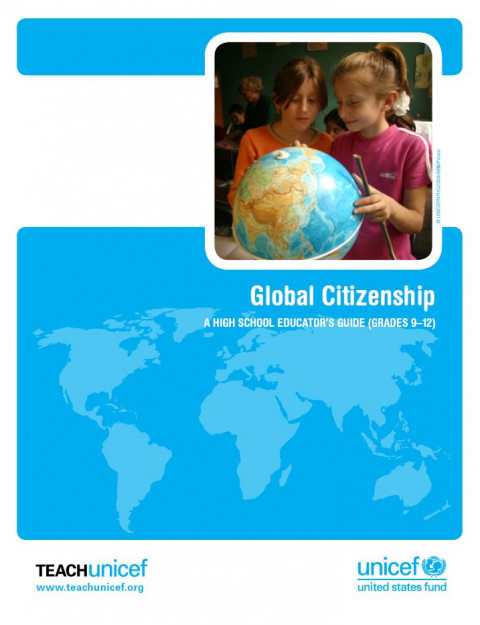 Global citizenship: a high school educator's guide (grades 9-12) Year of publication: 2013 Corporate author: TeachUNICEF Global Citizenship is a unit of four lessons designed to introduce the concept of global citizenship and place it in the context of international human rights; to engage students in a guided inquiry into the meaning of global citizenship and its relationship to national citizenship; to educate about how the United Nations has framed global rights and responsibilities for the 21st century and is acting on them via the Millennium Development Goals (MDGs); and to investigate how the U.S. Fund for UNICEF has engaged individuals in support of global citizenship as well as to engage students in designing and implementing a plan to act locally in support of global issues. La citoyenneté mondiale: Guide d'un éducateur de l'école secondaire (les niveaux 9-12) Year of publication: 2013 Corporate author: TeachUNICEF La citoyenneté mondiale est une unité de quatre leçons visant à introduire le concept de la citoyenneté mondiale et le placer dans le contexte des droits de l'homme internationaux; pour engager les élèves dans une enquête guidée dans le sens de la citoyenneté mondiale et de sa relation à la citoyenneté nationale; d'éduquer sur la façon dont l'Organisation des Nations Unies a formulé des droits et des responsabilités mondiales pour le 21e siècle et est d'agir sur eux par l'intermédiaire des Objectifs du Millénaire pour le développement (OMDs); et d'enquêter sur la façon dont le Fonds américain pour l'UNICEF a engagé des individus à l'appui de la citoyenneté mondiale, ainsi que d'engager les élèves dans la conception et la mise en œuvre d'un plan d'agir localement en faveur des enjeux mondiaux.
  Stepping Forward: Parliaments in the Fight Against Hate Speech Year of publication: 2023 Author: Kevin Deveaux | Tim Baker | Mary O’Hagan | David Ennis Corporate author: United Nations Development Programme (UNDP) This brief provides an overview of the background, drivers, enablers and the impact of hate speech and identifies strategies to counter it, with a focus on the role of parliaments as a positive force for change. Of particular relevance are the concrete actions parliaments can take to address and mitigate the prevalence and impact of hate speech on those who are most vulnerable in society, including women, minorities and other underrepresented groups. The objective of this brief is to provide meaningful and practical guidance for parliaments and parliamentarians, as well as those who programmatically support them, on steps they can take to reduce and counter hate speech while fostering peace, constructive dialogue and trust.
  Summit of the Future Outcome Document: Pact for the Future, Global Digital Compact, and Declaration on Future Generations Year of publication: 2024 Corporate author: United Nations (UN) At the Summit of the Future on 22 September 2024, world leaders adopted a Pact for the Future that includes a Global Digital Compact and a Declaration on Future Generations. This Pact is the culmination of a years-long process to adapt international cooperation to the realities of today and the challenges of tomorrow. The hard work of implementation begins immediately. The adoption of the Pact demonstrates that countries are committed to an international system with the United Nations at its center. Leaders set out a clear vision of a multilateralism that can deliver on its promises, is more representative of today’s world and draws on the engagement and expertise of governments, civil society and other key partners.
  Summit of the Future Outcome Document: Pact for the Future, Global Digital Compact and Declarations on Future Generations Year of publication: 2024 Corporate author: United Nations (UN) World leaders adopt a Pact for the Future that includes a Global Digital Compact and a Declaration on Future Generations (A/RES/79/1). The Pact covers a broad range of themes including peace and security, sustainable development, climate change, digital cooperation, human rights, gender, youth and future generations, and the transformation of global governance.
  Declaration on a Culture of Peace Year of publication: 1999 Corporate author: United Nations (UN) Solemnly proclaims the present Declaration on a Culture of Peace to the end that Governments, international organizations and civil society may be guided in their activity by its provisions to promote and strengthen a culture of peace in the new millennium.
  The Sustainable development goals report 2016 Year of publication: 2016 Corporate author: United Nations (UN) This inaugural report on the global Sustainable Development Goals (SDGs) is a first accounting of where the world stands at the start of our collective journey to 2030. The report analyses selected indicators from the global indicator framework for which data are available as examples to highlight some critical gaps and challenges. The list of SDG indicators agreed upon by the UN Statistical Commission in March 2016 will be subject to refinements and improvements as methods and data availability improve. Every journey has a beginning and an end. Plotting that journey and establishing key milestones along the way requires accessible, timely and reliable disaggregated data. The data requirements for the global indicators are almost as unprecedented as the SDGs themselves and constitute a tremendous challenge to all countries. Nevertheless, fulfilling these requirements through building national statistical capacity is an essential step in establishing where we are now, charting a way forward and bringing our collective vision closer to reality
  Address by Irina Bokova, Director-General of UNESCO, to the Global Hope Coalition Joint Action Meeting: Women, Children and the Trauma of Extremism Year of publication: 2017 Corporate author: UNESCO. Director-General, 2009-2017 (Bokova, I.G.) This address was delivered by Irina Bokova, Director-General of UNESCO, to the Global Hope Coalition Joint Action Meeting: Women, Children and the Trauma of Extremism; UNGA, New York, 18 September 2017.
  Contributions of Early Childhood Development Programming to Sustainable Peace and Development Year of publication: 2018 Author: Chelsea K. Donaldson | Friedrich W. Affolter | Liliana Angelica Ponguta | Rima Salah | Pia R. Britto | James Leckman | Paul Connolly | Siobhan Fitzpatrick | Pauline Walmsley By intervening early and engaging with children’s families, ECD services offer a unique opportunity to make a cost-effective and sustainable impact on interrupting cycles of poverty and violence. Given that efforts towards sustainable peace must encompass all sectors and address all societal levels, there is a crucial need for implementing “multi-level ECD services” that center on the whole child and engage his or her surrounding ecological context. These comprehensive ECD services can not only improve child development outcomes, but also strengthen competencies in caregivers, address stressors and conflict drivers in the community and build institutional capacities to reduce structural violence. The purpose of this background paper is to merge insights from both micro and macro-level perspectives to demonstrate how ECD services can be leveraged to sustainable peace and development. While peacebuilding experts have traditionally focused on macro-level strategies such as government reform or economic rehabilitation interventions, ECD practitioners have focused primarily on micro-level interventions of individual children and families without much exploration of how ECD services can be leveraged to mitigate risks of conflict and transform relationships across communities and regions.