
Resources
Explore a wide range of valuable resources on GCED to deepen your understanding and enhance your research, advocacy, teaching, and learning.
1,726 Results found
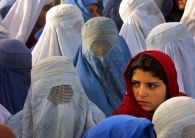 Women’s Education: Promoting Development, Countering Radicalism Year of publication: 2014 Author: Hedieh Mirahmadi Corporate author: World Organization for Resource Development and Education (WORDE) Increasing access to quality secular education can create better jobs for women and reduce some of the economic drivers of radicalization. Educated women can in turn play a pivotal role in inoculating their children and communities against the radical narratives used to recruit followers. Women’s Education: Promoting Development, Countering Radicalism Year of publication: 2014 Author: Hedieh Mirahmadi Corporate author: World Organization for Resource Development and Education (WORDE) Améliorer l'accès à une éducation laïque de qualité peut contribuer à la création de meilleurs emplois pour les femmes et réduire certains facteurs économiques de la radicalisation. Les femmes éduquées peuvent à leur tour jouer un rôle essentiel en protégeant leurs enfants et les communautés contre les récits radicaux utilisés pour recruter des adeptes.
  Achieving Social Justice Through a Demographic-driven Initiative: Responding to the Unique Needs of Youth, Women and Refugees Year of publication: 2017 Author: Nader Said-Foqahaa | Nicholas Hyman Corporate author: International Labour Organization (ILO) The Arab world is currently going through a period of great socio-economic change, unprecedented since the revolutions and wars of independence more than half a century ago. The issue of social justice, which has been a challenge to Arab states over the past decades, is a matter of particular concern. The authors attempt to establish a conceptual background of social justice, and to discuss its linkage with youth, children, women, and refugees. The paper concludes with recommendations on social justice in the Arab world. تحقيق العدالة الاجتماهية من خلال مبادرة ديموغرافية: تلبية الاحتياجات الفريدة للشباب والنساء واللاجئين Year of publication: 2017 Author: Nader Said-Foqahaa | Nicholas Hyman Corporate author: International Labour Organization (ILO) يمرّ العالم العربي حالياً بفترة من التغيير الاجتماعي الاقتصادي الكبير، الذي لم يسبق له مثيل منذ الثورات وحروب الاستقلال منذ أكثر من نصف قرن. وتُعتبر مسألة العدالة الاجتماعية التي شكّلت تحدياً للدول العربية على مدى العقود الماضية، مسألة مثيرة للقلق بشكل خاص. يحاول المؤلفون لوضع خلفية مفاهيمية للعدالة الاجتماعية، ومناقشة ربطها بالشباب والأطفال والمرأة واللاجئين. تنتهي الورقة بوضع توصيات حول العدالة الاجتماعية في الوطن العربي.
  Justice in Matters Involving Children in Conflict with the Law: Model Law on Juvenile Justice and Related Commentary Year of publication: 2013 Corporate author: UN. Office on Drugs and Crime (UNODC) This Model Law and the related Commentary are designed to provide legal guidance to States in the process of juvenile justice reform and assist them in drafting juvenile justice legislation. It translates compelling international juvenile justice standards and norms into a national context and aims at harmonizing national legislation with international requirements. International standards and norms in the area of juvenile justice are detailed. Правосудие: Вопросы, Касающиеся Детей, Находящихся в Конфликте с Законом Year of publication: 2013 Corporate author: UN. Office on Drugs and Crime (UNODC) Данный Типовой Закон и соответствующие комментарии являются руководством для проведения реформы правосудия по делам несовершеннолетних в различных странах и призван помочь в создании законодательства по делам несовершеннолетних. Данный Типовой Закон объединяет международные нормы и стандарты законодательства по делам несовершеннолетних, которые необходимо привести в соответствие с национальным законодательством с тем, чтобы гармонизировать национальное и международное законодательства. Данная работа детально описывает международные стандарты и нормы законодательства по делам несовершеннолетних.
  Rethinking Schooling for the 21st Century: The State of Education for Peace, Sustainable Development and Global Citizenship in Asia Year of publication: 2017 Corporate author: Mahatma Gandhi Institute of Education for Peace and Sustainable Development (MGIEP) Calls to gear up schools for the 21st century are ubiquitous today. Dominant international educational discourse hails the potential of 'the youth dividend' and digital technology for enhancing growth. Some Asian education systems are held up as models for an innovation-led utopian future. But across much of Asia, neither the reality of schooling nor the patterns of development with which it is associated give cause for blithe optimism.This study is informed by UNESCO’s commitment to realising the Sustainable Development Goals (SDGs) through educational reform worldwide. Since its inception, UNESCO has championed a humanistic vision of education — a vision today encapsulated in SDG 4.7. These ideals need to be strongly restated and defended in an era when educational debate worldwide has come to be framed by a narrowly economistic and instrumentalist agenda.Deriving urgent significance from this broader context, the present report analyses how far the ideals of SDG 4.7 – of 'education for peace, sustainable development and global citizenship' - are embodied in policies and curricula across 22 Asian societies. At one level, it seeks to develop benchmarks against which future progress can be assessed. It also argues forcefully that conceptions of the fundamental purposes of schooling need to be reconfigured, if the ideals to which the global community has subscribed are actually to be realised.
  Pacific education for sustainable development framework; endorsed by the Pacific Ministers of Education, 27 September 2006, Nadi Fiji Year of publication: 2006 Corporate author: UNESCO Apia This paper presents a Pacific developed and driven Framework as a mechanism to assist in the implementation of the Pacific Plan and the basis for a regional approach to coordinating actions to achieve its vision of a prosperous region where “all people can lead free and worthwhile lives.” It further recognises the commitment made by Pacific countries in adopting the UN Decade of Education for Sustainable Development. The Framework can be adapted for national policy as well as regional strategy documents. The Framework can also be used by both national and regional organisations to identify priority initiatives for implementation in Education for Sustainable Development (ESD) within the Pacific. L'éducation du Pacifique pour cadre de développement durable; approuvé par les ministres de L'éducation du Pacifique, le 27 Septembre 2006, Nadi Fiji Year of publication: 2006 Corporate author: UNESCO Apia Cet article présente un Pacifique développé et entraîné cadre comme un mécanisme pour aider à la mise en œuvre du Plan Pacifique et la base d'une approche régionale pour la coordination des actions pour réaliser sa vision d'une région prospère où «toutes les personnes peuvent mener une vie libre et valables. "Il reconnaît en outre l'engagement pris par les pays du Pacifique en adoptant la Décennie de l'éducation pour le développement durable des Nations Unies. Le cadre peut être adapté à la politique nationale, ainsi que les documents de stratégie régionale. Le cadre peut également être utilisé par les organisations nationales et régionales pour identifier les initiatives prioritaires pour la mise en œuvre de l'éducation pour le développement durable (EDD) dans le Pacifique.
 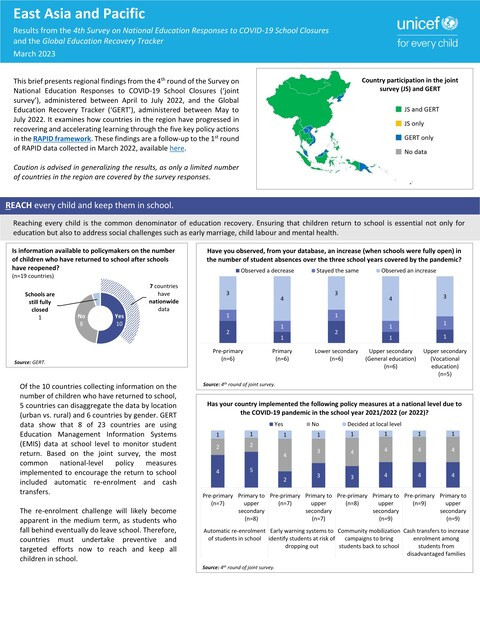 Education in a Post-COVID World: Towards a Rapid Transformation; East Asia and Pacific Regional Brief Year of publication: 2023 Corporate author: United Nations Children's Fund (UNICEF) On March 11, 2020, the World Health Organization declared COVID-19 a global pandemic, resulting in disruptions to education at an unprecedented scale. In response to the urgent need to recover learning losses, countries worldwide have taken RAPID actions to: Reach every child and keep them in school; Assess learning levels regularly; Prioritize teaching the fundamentals; Increase the efficiency of instruction; and Develop psychosocial health and wellbeing. This brief presents regional findings from the 4th round of the Survey on National Education Responses to COVID-19 School Closures (‘joint survey’), administered between April to July 2022, and the Global Education Recovery Tracker (‘GERT’), administered between May to July 2022. It examines how countries in the region have progressed in recovering and accelerating learning through the five key policy actions in the RAPID framework. These findings are a follow-up to the 1st round of RAPID data collected in March 2022.