
Resources
Explore a wide range of valuable resources on GCED to deepen your understanding and enhance your research, advocacy, teaching, and learning.
2,775 Results found
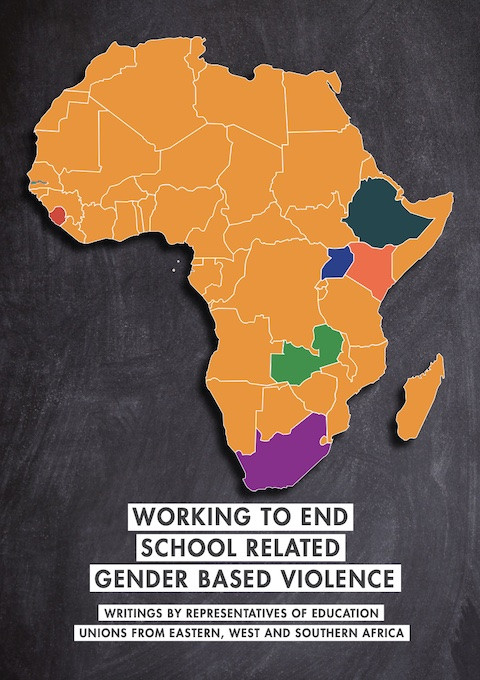 Working to End School Related Gender Based Violence: Writings by Representatives of Education Unions From Eastern, West and Southern Africa Year of publication: 2019 Author: Shamim Meer Corporate author: Gender at Work | Labour Research Service (LRS) | Global Affairs Canada (GAC) | United Nations Girls' Education Initiative (UNGEI) | Education International (EI) School Related Gender Based Violence (SRGBV) is violence that undermines the bodily integrity, human rights, and gender equality of all those involved in the school but primarily that of the school child.In 2016, 7 teacher unions i.e. SADTU and NAPTOSA from South Africa, BETUZ and ZNUT from Zambia, UNATU from Uganda, ETA from Ethiopia and KNUT from Kenya and in 2018, SLTU from Sierra Leone, GTU from the Gambia and the staff from the Ghana-based Education International Regional Africa Office - actively engaged in a Gender at Work - Gender Action Learning Process (GAL).The main aim of this specific GAL process was to create a participatory EI pilot program in Southern, East and West Africa focusing on individual teachers’ and teacher unions’ capacity to address SRGBV. With the support of Gender at Work facilitators, participants strengthened their understanding of gender inequality and gender based violence in the context of the school. Throughout the GAL Process participants spoke from their hearts, sharing inspirational stories of change.
  Strengthening the Quality of Early Childhood Education and Care Through Inclusion Year of publication: 2020 Author: Susie Lee | Barbara Janta Corporate author: European Union (EU) The quality in Early Childhood Education and Care (ECEC) has risen up the policy agenda globally, leading to a general consensus that quality ECEC can lead to positive and equitable outcomes for all children. Given these contexts, the European Commission considers inclusion as an integral part of quality ECEC. However, ensuring effective access to quality ECEC for all children remains a challenge, especially for those from disadvantaged backgrounds. This is in part because both inclusion and quality ECEC are multi-faceted concepts. This present policy memo helps policymakers better understand this challenge and suggests some possible solutions. To do so, this memo introduces what inclusion means in education generally and in ECEC particularly, and then discusses how inclusion in ECEC is understood in the current EU policy context. Lastly, the memo summarises findings from recent EU-level projects on how inclusion is integrated into different aspects of quality in ECEC.
  Digital Education Action Plan 2021-2027: Resetting Education and Training for the Digital Age Year of publication: 2020 Corporate author: European Union (EU) The Digital Education Action Plan (2021-2027) outlines the European Commission’s vision for high quality, inclusive and accessible digital education in Europe.It is a call to action for stronger cooperation at European level to learn from the COVID-19 crisis during which technology is being used at a scale never seen before in education and training make education and training systems fit for the digital age
  The Future of Language Education in Europe: Case Studies of Innovative Practices; Analytical Report Year of publication: 2020 Author: Emmanuelle Le Pichon-Vorstman | Hanna Siarova | Eszter Szőnyi Corporate author: NESET II | European Union (EU) The main purpose of this report is to inspire educators and policy makers to innovate and implement forward-looking policies and practices in language education, by exploring novel approaches and strategies for language teaching across in Europe that support learners’ plurilingualism.
  Indigenous Peoples and the United Nations Human Right System Year of publication: 2013 Corporate author: UN Human Rights Council The United Nations general assembly approved the United Nations declaration on the rights of indigenous peoples on September 13, 2007. The rights of indigenous peoples have evolved based on current international law, including human rights treaties, and depending on the circumstances in which the communities found themselves and their priorities, such as the rights to their lands, territories, resources and self-determination. Unfortunately, many indigenous peoples continue to encounter problems in the field of human rights. Some of the greatest difficulties they face stem from the pressure on their lands, territories and resources as a result of their activities related to development and resource extraction. Los pueblos indigenas y el sistema de derechos humanos de las naciones unidas Year of publication: 2013 Corporate author: UN Human Rights Council La asamblea general de Las Naciones Unidas aprobó la declaración de Las Naciones Unidas sobre los derechos de los pueblos indigenas el 13 de septiembre de 2007. Los derechos de los pueblos indígenas han evolucionado partiendo del derecho internacional vigente, inlcuidos los tratados de derechos humanos, en función de las circunstacias en que se encontraban los pueblos y sus prioridades, como los derechos a sus tierras, territorios, recursos y a la libre determinación. Lamentablemente, muchos pueblos indigenas siguen encontrando problemas en la esfera de los derechos humanos. Algunas de las mayores dificultades a las que hacen frente derivan de la presión de que son objeto sus tierras, territorios y recursos como consecuencia de sus actividades relacionadas con el desarrollo y la extracción de recursos.
  Introducing the Global Goals Corporate author: United Nations Children's Fund (UNICEF) Learners can explain what the Global Goals for Sustainable Development are, why they are important and how they relate to the learner her/himself.
 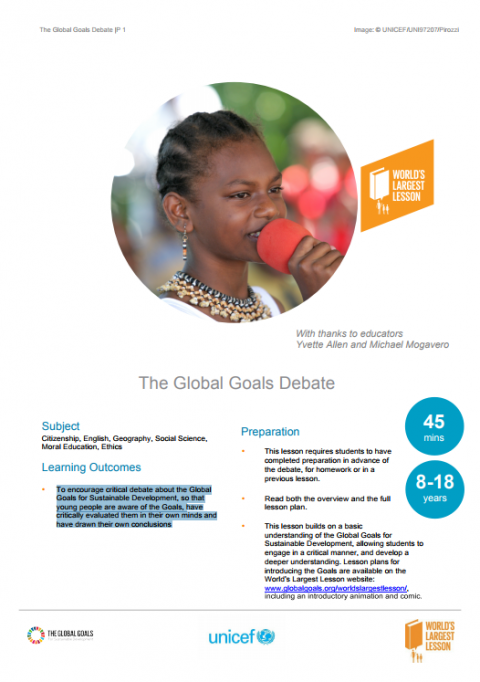 The global goals debate Corporate author: United Nations Children's Fund (UNICEF) Learning outcomes: To encourage critical debate about the Global Goals for Sustainable Development, so that young people are aware of the Goals, have critically evaluated them in their own minds and have drawn their own conclusions
 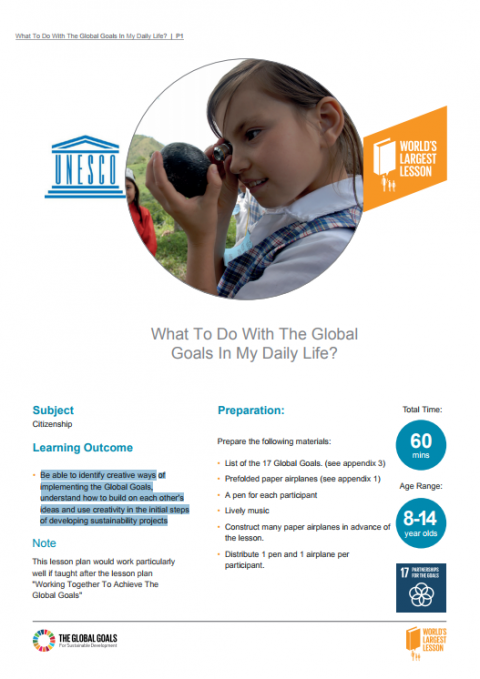 What To Do With The Global Goals In My Daily Life? Corporate author: United Nations Children's Fund (UNICEF) Learning outcomes: Be able to identify creative ways of implementing the Global Goals, understand how to build on each other’s ideas and use creativity in the initial steps of developing sustainability projects
 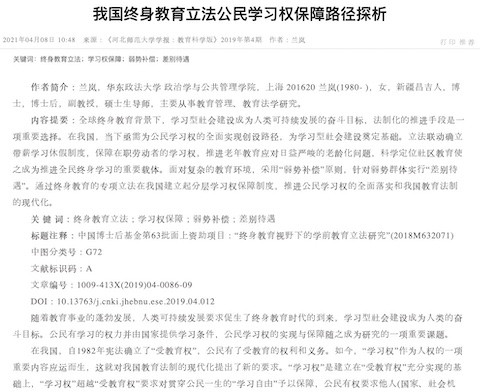 The Legislation of Lifelong Learning in China: Measures to Guarantee Citizens' Rights of Learning Year of publication: 2019 Author: Lan Lan Corporate author: Hebei Normal University This paper advocates the legislation of lifelong learning in China to guarantee the right of study for various disadvantaged groups such as the elders, youths, farmers, disableds, and ethnic minorities.