
Resources
Explore a wide range of valuable resources on GCED to deepen your understanding and enhance your research, advocacy, teaching, and learning.
1,727 Results found
 Éduquer à la citoyenneté à l’ère de la multiculturalité Year of publication: 2016 Author: Nadine Fink La citoyenneté est un statut juridique lié à la nationalité : est citoyen tout membre d’un Etat qui jouit des droits civils et politiques garantis par cet Etat, principalement le droit de vote et le droit d’éligibilité. Mais la citoyenneté renvoie aussi au principe d’une participation active de chaque individu à la vie de la société, indépendamment de sa nationalité et de l’éventuelle pluralité de ses appartenances.
  Éducation à la citoyenneté et à la solidarité internationale Corporate author: Education à la citoyenneté et à la solidarité internationale (ECSI) De nombreuses associations représentatives du domaine de l’Éducation à la citoyenneté et à la solidarité internationale (ECSI) proposent d'expliquer cette notion et ses objectifs : Ritimo, le réseau d'information et de documentation pour le développement durable et la solidarité internationale ; le Centre de recherche et d’information pour le développement (CRID) ; EDUCASOL, la plateforme associative de référence pour l’ECSI en France qui a écrit une charte « Pour une éducation à la Citoyenneté et à la Solidarité Internationale ».Pour résumer, l’Éducation à la citoyenneté et à la solidarité internationale permet de faire évoluer le regard de l’individu sur des changements de comportement à adopter, c’est-à-dire de lui permettre de développer un esprit critique sur les enjeux d’une mondialisation effrénée. Cette démarche favorise la solidarité entre les différentes cultures, groupes sociaux et pays afin de construire un monde solidaire.
  Research Models Laying the Foundation for the Unesco Chair: Democracy, Global Citizenship and Transformative Education (DCMÉT) Year of publication: 2018 Author: Paul R. Carr | Gina Thésée Corporate author: Chaire UNESCO Démocratie, citoyenneté mondiale et éducation transformatoire (DCMÉT) The conceptual and theoretical models presented in this document were developed over a roughly twelve-year period, starting in 2005, by the Chair (Paul R. Carr, Université du Québec en Outaouais) and Co-Chair (Gina Thésée, Université du Québec à Montréal) of the UNESCO Chair DCMÉT. These models have been published in diverse academic journals in either English or French, and have been translated and adapted herein to produce an updated and bilingual representation of the Education for Democracy research that Carr and Thésée have produced. In some cases, the models have been refined (and improved) over time, and they are presented as a means of attempting to elucidate, interrogate and highlight the meaning of the three themes that underpin the UNESCO Chair DCMÉT.
  Éducation à la citoyenneté Corporate author: Ligue de l’enseignement de l’Aveyron La question de l’Education à la citoyenneté est largement transversale à toutes nos actions, néanmoins certains dispositifs et certaines de nos actions ne peuvent être classés que sous cette rubrique :Formation des délégués élèves :Proposer aux élèves élus représentants de leur classe, tant en collège qu’en lycée, une formation est une obligation de l’établissement, nous pensons aussi que c’est une opportunité particulièrement pertinente d’éduquer à la citoyenneté.Par contre, rien n’oblige les établissements à faire appel à un partenaire extérieur. Pourtant, à la lueur de notre expérience quelques arguments semblent plaider pour l’intervention extérieure en général et pour la fédération de la Ligue de l’Enseignement en particulier.
 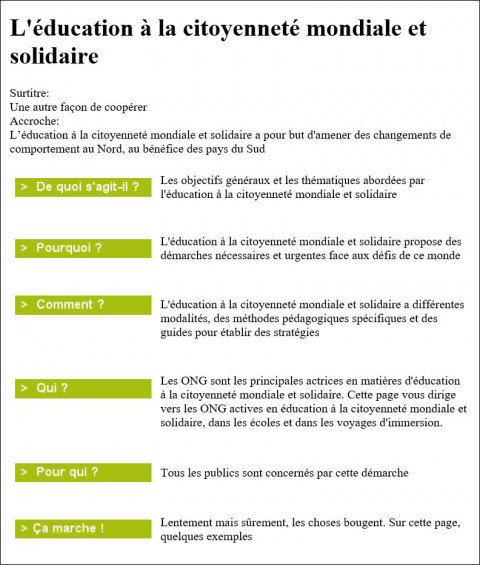 L'éducation à la citoyenneté mondiale et solidaire : Une autre façon de coopérer Corporate author: Les ONG membres d'ACODEV L’éducation à la citoyenneté mondiale et solidaire est un processus qui vise le changement social. Elle a pour but de permettre aux individus de s’approprier une conviction empreinte de solidarité internationale et de la manifester par des engagements concrets, individuels et collectifs. Objectifs généraux: Faciliter une compréhension globale des enjeux du développement et des mécanismes d’exploitation injustes qui engendrent des relations inégalitaires entre le Nord et le Sud ; Accompagner l’acquisition d’un regard conscient et critique de la réalité, tant au niveau de relations microsociales qu’au niveau macro ; Favoriser un meilleur dialogue entre les citoyens à travers une approche interculturelle basée sur le respect mutuel et l’égalité ; Promouvoir des valeurs, attitudes, et aptitudes liées à la solidarité
 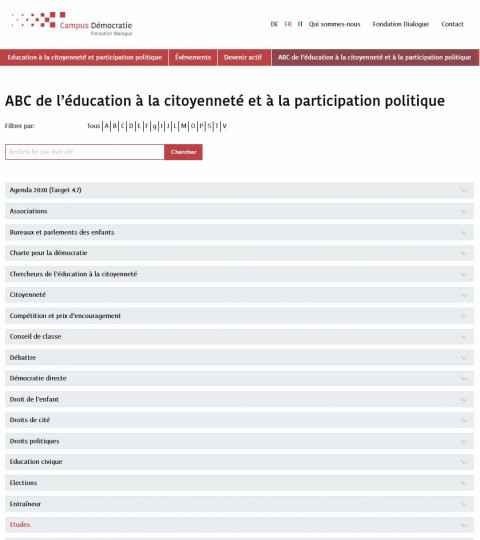 ABC de l’éducation à la citoyenneté et à la participation politique Year of publication: 2018 Corporate author: Campus pour la démocratie Les thèmes éducation à la citoyenneté et participation politique sont discutés de manière controversée. Pour des raisons de lisibilité, nous ne présentons ici que quelques définitions et modèles abrégés et renonçons à la prétention d’exhaustivité.
 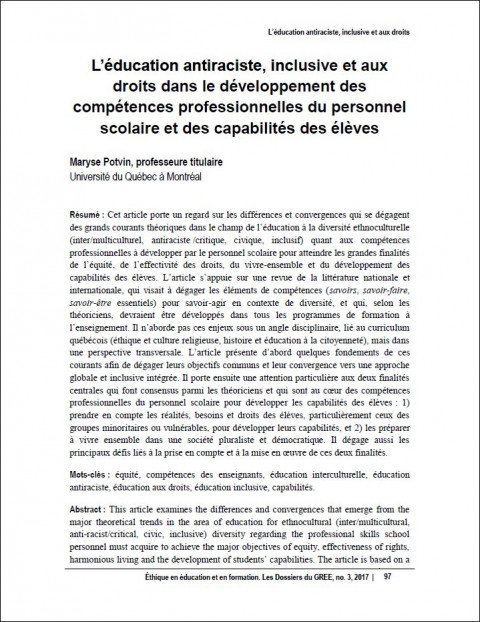 Anti-racist, Inclusive and Human Rights Education in the Development of Professional Competencies for School Personnel and Student Capabilities Year of publication: 2017 Author: Maryse Potvin Corporate author: Éthique en éducation et en formation This article examines the differences and convergences that emerge from the major theoretical trends in the area of education for ethnocultural (inter/multicultural, anti-racist/critical, civic, inclusive) diversity regarding the professional skills school personnel must acquire to achieve the major objectives of equity, effectiveness of rights, harmonious living and the development of students’ capabilities. The article is based on a review of the national and international literature, which aimed to identify the skills (knowledge, expertise, soft skills) that are essential for knowing how to act in the context of diversity and that, according to theoreticians, should be developed in all teacher training programs. These issues are discussed from a crosscutting perspective rather than from a disciplinary angle related to the Quebec curriculum (ethics and religious culture, history and education for citizenship). The article begins by providing some background on these trends in order to identify their common objectives and convergence toward an integrated and inclusive global approach. It then examines two objectives supported by all theoreticians in terms of the core professional skills needed by school personnel for developing students’ capabilities: 1) taking into account the realities, needs and rights of students, particularly those in minority or vulnerable groups, and 2) preparing students to live together in a pluralistic and democratic society. As well, it identifies the key challenges involved in the consideration and implementation of these two goals. L’éducation antiraciste, inclusive et aux droits dans le développement des compétences professionnelles du personnel scolaire et des capabilités des élèves Year of publication: 2017 Author: Maryse Potvin Corporate author: Éthique en éducation et en formation Cet article porte un regard sur les différences et convergences qui se dégagent des grands courants théoriques dans le champ de l’éducation à la diversité ethnoculturelle (inter/multiculturel, antiraciste /critique, civique, inclusif) quant aux compétences professionnelles à développer par le personnel scolaire pour atteindre les grandes finalités de l’équité, de l’effectivité des droits, du vivre-ensemble et du développement des capabilités des élèves. L’article s’appuie sur une revue de la littérature nationale et internationale, qui visait à dégager les éléments de compétences (savoirs, savoir-faire, savoir-être essentiels) pour savoir-agir en contexte de diversité, et qui, selon les théoriciens, devraient être développés dans tous les programmes de formation à l’enseignement. Il n’aborde pas ces enjeux sous un angle disciplinaire, lié au curriculum québécois (éthique et culture religieuse, histoire et éducation à la citoyenneté), mais dans une perspective transversale. L’article présente d’abord quelques fondements de ces courants afin de dégager leurs objectifs communs et leur convergence vers une approche globale et inclusive intégrée. Il porte ensuite une attention particulière aux deux finalités centrales qui font consensus parmi les théoriciens et qui sont au coeur des compétences professionnelles du personnel scolaire pour développer les capabilités des élèves : 1) prendre en compte les réalités, besoins et droits des élèves, particulièrement ceux des groupes minoritaires ou vulnérables, pour développer leurs capabilités, et 2) les préparer à vivre ensemble dans une société pluraliste et démocratique. Il dégage aussi les principaux défis liés à la prise en compte et à la mise en oeuvre de ces deux finalités.
 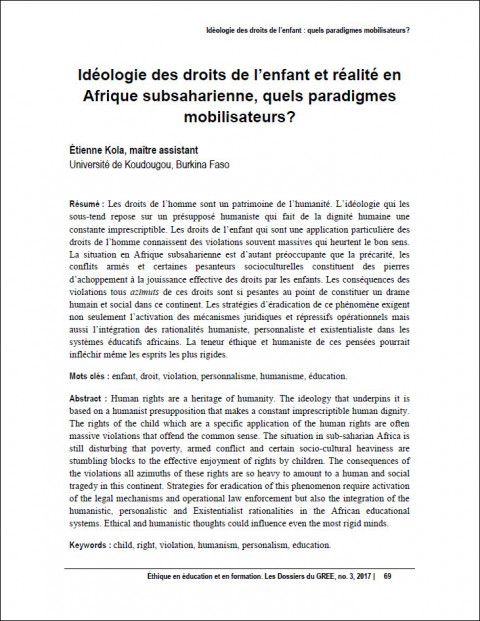 The Ideology of the Rights of Children and the Reality in Sub-Saharan Africa: What Are the Mobilizing Paradigms? Year of publication: 2017 Author: Étienne Kola Corporate author: Éthique en éducation et en formation Human rights are a heritage of humanity. The ideology that underpins it is based on a humanist presupposition that makes a constant imprescriptible human dignity. The rights of the child which are a specific application of the human rights are often massive violations that offend the common sense. The situation in sub-saharian Africa is still disturbing that poverty, armed conflict and certain socio-cultural heaviness are stumbling blocks to the effective enjoyment of rights by children. The consequences of the violations all azimuths of these rights are so heavy to amount to a human and social tragedy in this continent. Strategies for eradication of this phenomenon require activation of the legal mechanisms and operational law enforcement but also the integration of the humanistic, personalistic and Existentialist rationalities in the African educational systems. Ethical and humanistic thoughts could influence even the most rigid minds. Idéologie des droits de l’enfant et réalité en Afrique subsaharienne, quels paradigmes mobilisateurs? Year of publication: 2017 Author: Étienne Kola Corporate author: Éthique en éducation et en formation Les droits de l’homme sont un patrimoine de l’humanité. L’idéologie qui les sous-tend repose sur un présupposé humaniste qui fait de la dignité humaine une constante imprescriptible. Les droits de l’enfant qui sont une application particulière des droits de l’homme connaissent des violations souvent massives qui heurtent le bon sens. La situation en Afrique subsaharienne est d’autant préoccupante que la précarité, les conflits armés et certaines pesanteurs socioculturelles constituent des pierres d’achoppement à la jouissance effective des droits par les enfants. Les conséquences des violations tous azimuts de ces droits sont si pesantes au point de constituer un drame humain et social dans ce continent. Les stratégies d’éradication de ce phénomène exigent non seulement l’activation des mécanismes juridiques et répressifs opérationnels mais aussi l’intégration des rationalités humaniste, personnaliste et existentialiste dans les systèmes éducatifs africains. La teneur éthique et humaniste de ces pensées pourrait infléchir même les esprits les plus rigides.