
Resources
Explore a wide range of valuable resources on GCED to deepen your understanding and enhance your research, advocacy, teaching, and learning.
3,790 Results found
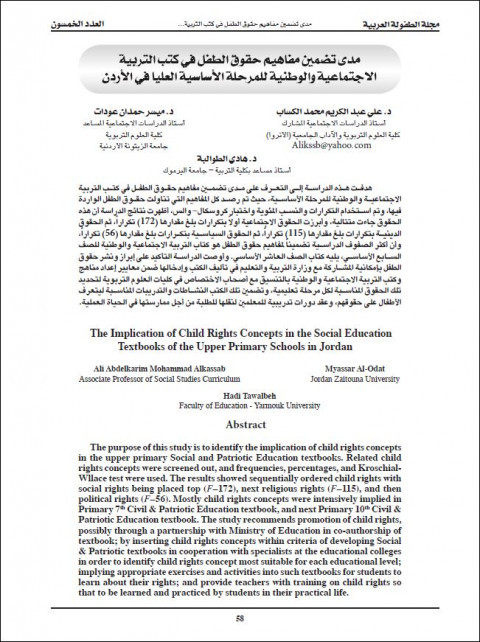 The Implication of Child Rights Concepts in the Social Education Textbooks of the Upper Primary Schools in Jordan Year of publication: 2012 Author: الكساب، علي عبد الكريم محم Corporate author: Kuwait Society for the Advancement of Arab Children (KSAAC) The purpose of this study is to identify how far are the concepts of child rights included in the Social and National Education textbooks of the the basic education classes. Relevant child rights concepts were monitored and frequencies, percentages, and KroschialWllace test were used. The results showed that child rights came in a sequence of order. Social rights came on top (F=172), followed by religious rights (F=115) and political rights (F=56). The text books with most referencies to child rights concepts were the Civic and National education books of class Basic Education 10.The study recommends promoting child rights by writing relevant books and adding child rehigts concepts to the criteria of authoring civic and national education curriculla and textbooks, possibly in partnership with the Ministry of Education and in cooperation with specialists at the faculties of sciences of education, in order to identify child rights concepts, most suitable for each educational level, with appropriete activities and excercises for children to lern about their implying appropriate into such textbooks for students to learn about their rights. Teachers should be provided with training in order to help children parctice them in reality.
 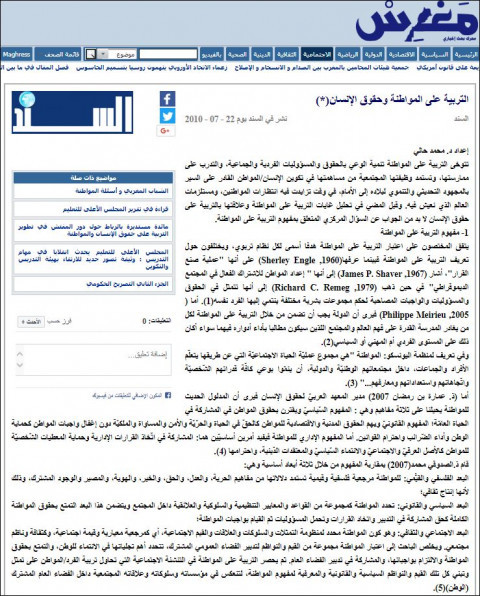 التربية على المواطنة وحقوق الإنسان Year of publication: 2010 Author: محمد حالي يقدم هذا المقال تعريفات لمقوّمات مفهوم التربية على المواطنة بأبعاده الثلاثة، على خلفية حالة المغرب، انطلاقاً من أن التربية على المواطنة تتوخى "تنمية الوعي بالحقوق والمسؤوليات الفردية والجماعية، والتدرب على ممارستها، وتستمد وظيفتها المجتمعية من مساهمتها في تكوين الإنسان/المواطن القادر على السير بالمجهود التحديثي والتنموي لبلاده إلى الأمام، في وقت تزايدت فيه انتظارات المواطنين، ومستلزمات العالم الذي نعيش فيه". أما الأبعاد الثلاثة فهي: 1) البعد الفلسفي والقيمي: 2) البعد السياسي والقانوني 3) البعد الاجتماعي والثقافي. إلى ذلك، فإن المقال يعالج المحاور التي تتكامل في تقديم المفهوم: 1) التربية على المواطنة بتعريفاتها المختلفة (ومنها أنها تشكل" هدفاً أسمى لكل نظام تربوي") ،؛ و2) مواصفات المواطن الصالح والقيم المعلنة في " الميثاق الوطني للتربية والتكوين" (القيم الإسلامية ووقيم الهوية الحضارية،ن وقيم المواطنة، وقيم حقوق الإنسان)؛ 3) غايات التربية على المواطنة؛ 4) أهداف التربية على المواطنة؛ 5) الكفايات المرجعية المرتبطة بالتربية على المواطنة؛ 6) وسائل وطرق تحقيق الأهداف؛ 7) علاقة التربية على المواطنة بالتربية على حقوق الإنسان. وتختم المقالة بالإشارة إلى أن التربية على المواطن وحقوق الإنسان "تتم بواسطة ثلاث قنوات أساسية، تتعاضد في ما بينها وتتكامتل أهدافها وهي: العائلة، البيئة الاجتماعية والسياسية، والمدرسة". Education on Citizenship and Human Rights Year of publication: 2010 Author: محمد حالي This article presents definitions for the determinants of the concept of education on citizenship, in its three principles, using Morocco as a background, considering that education on citizenship aims at “Developing awareness of the rights and responsibilities, both individual and collective, training on practicing it and that citizenship derives its social function from its contribution to the formation of the human being/citizen who is capable of carrying forward the modernizing and developmental effort of his country, at a time where the citizens’ expectations and the living requirements of today’s world are growing”.The three dimensions of the definition are: 1) the philosophic and value dimension; 2) the legal and political dimension; 3) the social and cultural dimension. In addition, the article deals with the parameters that complement each other in presenting the concept: 1) Education on citizenship with its different definitions; 2) The attributes of the Good Citizen and the declared values in the Moroccan “National Charter of Education and Training” (namely the Islamic values, values of the civil identity, identity values and human rights values); 3) the aims of education on citizenship; 4) the objectives of education on citizenship; 5) The relevant reference capacities; 6) Means and ways of implementing the objectives; 7) the relationship between education on citizenship and the education on human rights. The article concludes by pointing that education on citizenship in practiced through three main channels that synergize and integrate their objectives: the family, the social environment and the school”.
  Genocide Timeline Year of publication: 2024 Corporate author: United States Holocaust Memorial Museum (USHMM) This timeline proposed by the United States Holocaust Memorial Museum shows the major conceptual and legal advances in the evolution of the term "genocide" . It does not seek to detail every case that could be considered genocide, but to show how the term has entered the political, legal and ethical vocabulary from 1900 to 2016 to express threats of violence against groups. Chronologie du génocide Year of publication: 2024 Corporate author: United States Holocaust Memorial Museum (USHMM) Cette chronologie proposée par le Musée du mémorial américain sur la Shoah montre les avancées conceptuelles et juridiques majeures dans l’évolution du terme « génocide » . Elle ne cherche pas à détailler tous les cas pouvant être considérés comme des génocides, mais à montrer comment le terme a intégré le vocabulaire politique, juridique et éthique de 1900 à 2016 pour exprimer les menaces de violences contre des groupes.
  World Education Statistics 2024 Year of publication: 2024 Corporate author: UNESCO Institute for Statistics (UIS) The report summarizes the education data published by UIS and serves as a fundamental resource and essential guide for policy-makers, researchers and analysts, as well as anyone interested in education data and statistics. Statistics are presented in 11 thematic chapters, covering primary and secondary education; early childhood; technical, vocational and tertiary education; skills for work; parity; literacy and numeracy; sustainable development and global citizenship; learning environment; scholarships; teachers; and financing education.
 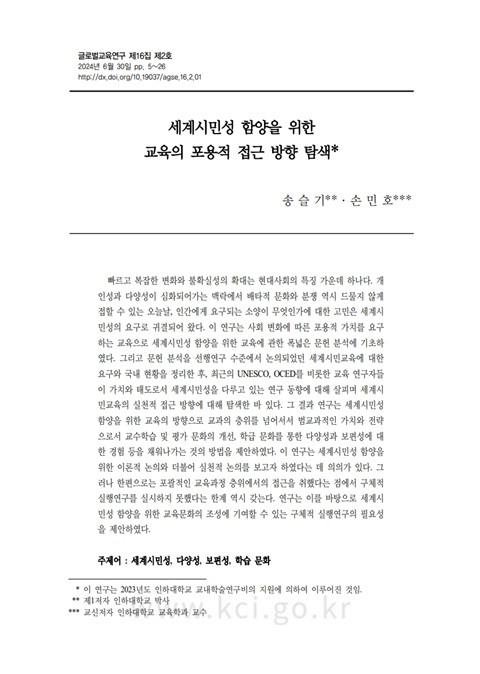 세계시민성 함양을 위한 교육의 포용적 접근 방향 탐색 (글로벌교육연구; Vol. 16, No.2) Year of publication: 2024 Author: 송슬기 | 손민호 Corporate author: 글로벌교육연구학회 빠르고 복잡한 변화와 불확실성의 확대는 현대사회의 특징 가운데 하나다. 개인성과 다양성이 심화되어가는 맥락에서 배타적 문화와 분쟁 역시 드물지 않게 접할 수 있는 오늘날, 인간에게 요구되는 소양이 무엇인가에 대한 고민은 세계시민성의 요구로 귀결되어 왔다. 이 연구는 사회 변화에 따른 포용적 가치를 요구하는 교육으로 세계시민성 함양을 위한 교육에 관한 폭넓은 문헌 분석에 기초하였다. 그리고 문헌 분석을 선행연구 수준에서 논의되었던 세계시민교육에 대한 요구와 국내 현황을 정리한 후, 최근의 UNESCO, OCED를 비롯한 교육 연구자들이 가치와 태도로서 세계시민성을 다루고 있는 연구 동향에 대해 살피며 세계시민교육의 실천적 접근 방향에 대해 탐색한 바 있다. 그 결과 연구는 세계시민성 함양을 위한 교육의 방향으로 교과의 층위를 넘어서서 범교과적인 가치와 전략으로서 교수학습 및 평가 문화의 개선, 학급 문화를 통한 다양성과 보편성에 대한 경험 등을 채워나가는 것의 방법을 제안하였다. 이 연구는 세계시민성 함양을 위한 이론적 논의와 더불어 실천적 논의를 보고자 하였다는 데 의의가 있다. 그러나 한편으로는 포괄적인 교육과정 층위에서의 접근을 취했다는 점에서 구체적 실행연구를 실시하지 못했다는 한계 역시 갖는다. 연구는 이를 바탕으로 세계시민성 함양을 위한 교육문화의 조성에 기여할 수 있는 구체적 실행연구의 필요성을 제안하였다.
 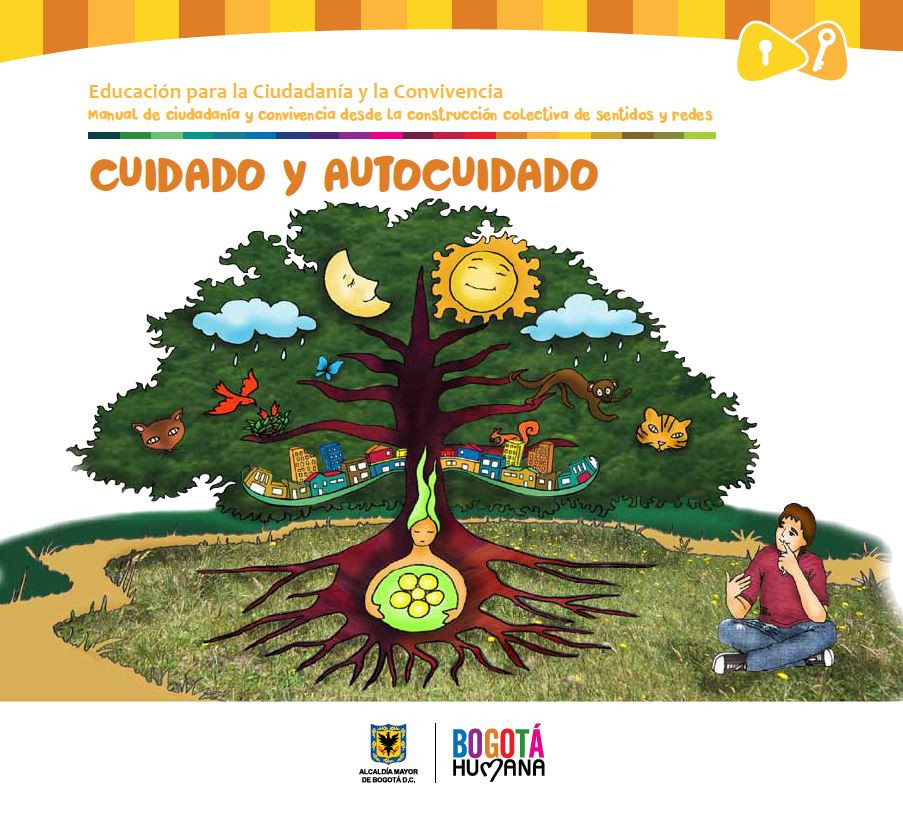 Care and Self-care: Manual of Citizenship and Coexistence from the Collective Construction of Meanings and Networks Year of publication: 2015 Corporate author: Centro de Investigación y Educación Popular (CINEP) This manual, which corresponds to the second phase of the Pedagogical Tool Box for Education for Citizenship and Coexistence, presents three axes of reflection: 1) self-care; 2) care of the others and the others: people near and far; and 3) care of strangers and the other. Each of the axes is accompanied by didactic tools that allow deepening in the contents. Cuidado y autocuidado: Manual de ciudadanía y convivencia desde la construcción colectiva de sentidos y redes Year of publication: 2015 Corporate author: Centro de Investigación y Educación Popular (CINEP) Este manual, que corresponde a la segunda fase de la Caja de Herramientas Pedagógicas de Educación para la Ciudadanía y la Convivencia, presenta tres ejes de reflexión: 1) autocuidado; 2) cuidado de los otros y las otras: personas cercanas y lejanas; y 3) cuidado de las personas extrañas y de lo otro. Cada uno de los ejes se encuentra acompañado de herramientas didácticas que permiten profundizar en los contenidos.
 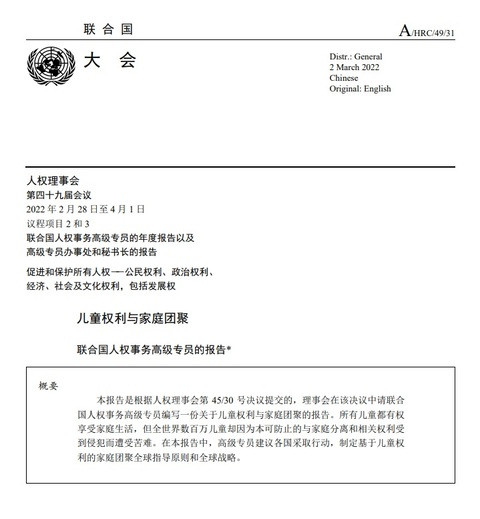 Report on the Rights of the Child and Family Reunification Year of publication: 2022 Corporate author: UN Human Rights This document is a report by the UN Special Rapporteur on Human Rights on the issue of separation of children from their families, describing the different forms the issue takes, as well as addressing the relevant international legal framework, and making relevant recommendations for each situation.