
Resources
Explore a wide range of valuable resources on GCED to deepen your understanding and enhance your research, advocacy, teaching, and learning.
1,180 Results found
 Ecopedagogy et Citoyenneté à l'ère de la Mondialisation: des liens entre l'environnement et l'éducation à la citoyenneté Mondiale (ECM) pour sauver la planète Year of publication: 2015 Author: Greg William Misiaszek Corporate author: Wiley‑Blackwell Enseigner les liens entre les actes nuisibles à l'environnement et les conflits sociaux est essentielle, mais est souvent ignorée dans l'éducation. Cet article présente deux façons dont ceux-ci ne sont pas enseignées à cause des politiques de ceux qui profitent de l'ignorance de ces connexions: d'abord, l'évitement de l'enseignement connectivité mondiale-locale et, deuxièmement, la dévalorisation des cultures non dominantes. Ecopedagogy est une société démocratique, la pédagogie transformative centrée sur l'augmentation de la justice par l'enseignement critique la politique des questions environnementales. Je soutiens que L'éducation à la citoyenneté Mondiale (ECM) doit être un élément de ecopedagogy apprendre contextuellement les effets de la mondialisation sur les communautés locales. En outre, l'objectif de l'ECM est d'accroître la compréhension des élèves de diverses cultures à les respecter. Ecopedagogy est également essentiel d'ECM pour enseigner pleinement les conflits sociaux résultant d'actes préjudiciables à l'environnement. Je propose des changements politiques et pédagogiques pour perturber les pédagogies environnementaux de reproduction qui aident à maintenir les maux environnementaux pour les modèles ecopedagogy-ECM à émerger.
 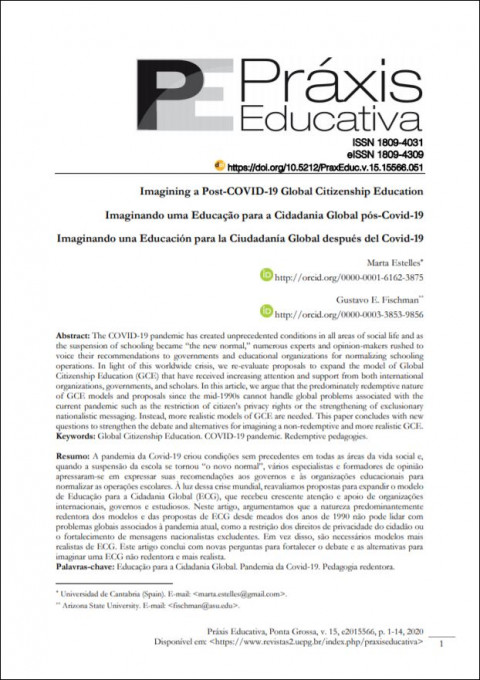 Imagining a Post-COVID-19 Global Citizenship Education Year of publication: 2020 Author: Marta Estelles | Gustavo E. Fischman Corporate author: State University of Ponta Grossa The COVID-19 pandemic has created unprecedented conditions in all areas of social life and as the suspension of schooling became “the new normal,” numerous experts and opinion-makers rushed to voice their recommendations to overnments and educational organizations for normalizing schooling operations. In light of this worldwide crisis, we re-evaluate proposals to expand the model of Global Citizenship Education (GCE) that have received increasing attention and support from both international organizations, governments, and scholars.In this article, we argue that the predominately redemptive nature of GCE models and proposals since the mid-1990s cannot handle global problems associated with the current pandemic such as the restriction of citizen’s privacy rights or the strengthening of exclusionary nationalistic messaging. Instead, more realistic models of GCE are needed. This paper concludes with new questions to strengthen the debate and alternatives for imagining a non-redemptive and more realistic GCE. Imaginando una educación para la ciudadanía global después del Covid-19 Year of publication: 2020 Author: Marta Estelles | Gustavo E. Fischman Corporate author: State University of Ponta Grossa La pandemia del Covid 19 ha creado condiciones sin precedentes en todas las áreas de la vida. A medida que la suspensión de las actividades escolares se ha convertido en "la nueva normalidad", numerosos expertos y formadores de opinión se han apresurado a lanzar sus recomendaciones a gobiernos y organizaciones educativas para normalizar las operaciones escolares. En este contexto novedoso, analizamos las propuestas para expandir el modelo de Educación para la Ciudadanía Global (ECG) que está siendo cada vez más apoyada por organizaciones internacionales, gobiernos y académicos.En este artículo, sostenemos que la orientación redentora que los modelos y propuestas de ECG han desarrollado en las últimas décadas resulta muy limitada para entender y resolver problemas actuales como la restricción de derechos de privacidad de la ciudadanía o el fortalecimiento de los nacionalismos excluyentes. En cambio, se necesitan modelos más realistas de ECG. Este documento concluye con nuevas preguntas para robustecer el debate y las alternativas para imaginar una ECG realista y no redentora. Palabras clave: Educación para la ciudadanía global. Pandemia de Covid-19. Pedagogía redentora.
  Democracy in the Educational Institution: Between the Qualification of Schooling and the Rooting of Training Year of publication: 2017 Author: Abdel Karim Belhadj | Abd al-Ilah Shrayat Corporate author: Supreme Council for Education, Training, and Scientific Research This paper discusses the relationship between school and democracy. It shows the intersection between them. Then the paper turns on how to educate for democracy. The paper concludes with a vision for global citizenship education. الديمقراطية بالمؤسسة التعليمية : بين تأهيل التمدرس وتأصيل التمرس Year of publication: 2017 Author: Abdel Karim Belhadj | Abd al-Ilah Shrayat Corporate author: Supreme Council for Education, Training, and Scientific Research تناقش الورقة العلاقة بين المدرسة والديمقراطية. وتوضح التقاطع بينهما. ثم تعرج الورقة علي كيفية التربية من أجل الديمقراطية. تنتهي الورقة بوضع تصور للتربية من أجل المواطنة العالمية.
 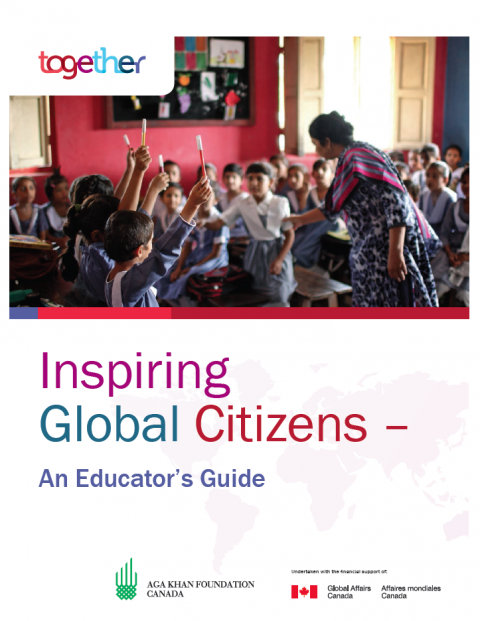 Inspiring Global Citizens - An Educator's Guide Year of publication: 2017 Corporate author: AGA Khan Foundation Canada This resource is intended for use by teachers of intermediate and secondary school grades to support education about global development and related themes such as global citizenship. The activities included in the resource are designed to assist students in increasing their understanding of the interconnectedness of the world, of the factors contributing to global inequalities, and of some effective and sustainable ways to help reduce global poverty. It is hoped that students will be inspired to take action to make their own contribution to improving lives everywhere.
 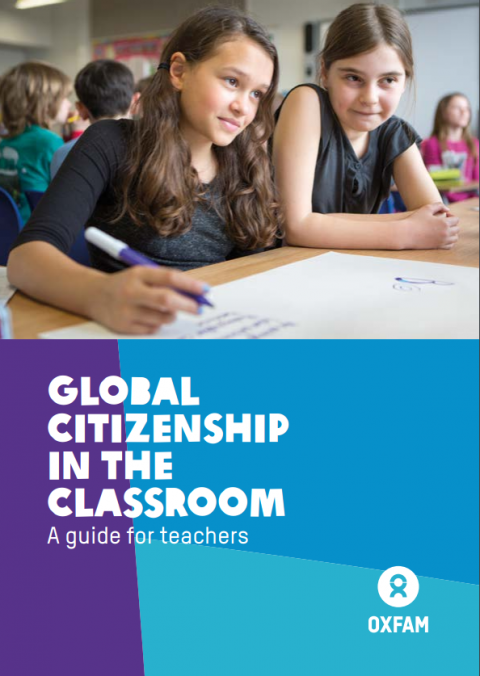 Global Citizenship in the Classroom: A guide for teachers Year of publication: 2015 Corporate author: Oxfam GB A practical and reflective guide full of practical tools and ideas that can be applied to almost any topic to develop learner participation and global learning.
  Radicalisations Awareness Network (RAN) Edu's Guide on training programmes 'Effective and confident teachers and other school staff' Year of publication: 2016 Corporate author: Radicalisations Awareness Network (RAN) This document will help teachers, principals, schools and (local and national) authorities discuss and design training programmes. Different training modules are identified, like (de)polarisation training, critical thinking, and how to turn a school into a safe and democratic mini society. Radicalisations Awareness Network (RAN) Edu's Guide on training programmes 'Effective and confident teachers and other school staff' Year of publication: 2016 Corporate author: Radicalisations Awareness Network (RAN) Ce document aidera les enseignants, les directeurs d'école, les écoles et les autorités (locales et nationales) à discuter et à concevoir des programmes de formations. Différents modules de formation sont identifiés, comme la formation de dépolarisation, la pensée critique, et comment transformer une école en une mini société sûre et démocratique. Educar para una ciudadanía global: construir un mundo justo desde la escuela Year of publication: 2009 Author: Colette Grech | Roderick Mallia | William Grech Corporate author: Conectando Mundos Consortium (Cidac, inizjamed, Intermon Oxfam, Ucodep) This publication is based on an initiative about the development education, intercultural education, popular education, the education of values, human rights education, education for sustainability, education for peace, education for gender equality, etc. The pedagogical proposal of Global Citizenship Education aspires to integrate in a coherent and challenging vision all these themes, keeping them in a close relationship with one another and taking into consideration the (increasing) interdependence of human beings living in a planet whose sustainability is under threat. This book is the fruit of a process that was triggered off by the joint effort of four European development NGOs, namely Cidac, Inizjamed, Intermón Oxfam and Ucodep within the frame of a project co-financed by the European Commission. These organisations set for themselves the objective to promote the acknowledgment and the inclusion of the contents and the methodology of Global Citizenship Education in the formal educational contexts in their respective countries, in order to kick-start a process of change in attitudes, values, and the beliefs of the pupils. Thanks to the initiative and efforts of the above-mentioned four organisations, and through various meetings and seminars carried out over the last three years in Spain, Italy, Portugal and Malta, groups of educators have been able to come face-to-face with each other, exchange experiences and reflect on the role of formal education with respect to the challenges of our times. Among the other experiences, the publication contains that of a key moment in the process. This took place in July 2008 in Cortona, a small and beautiful Tuscan city close to the border with Umbria, and in which many educators shared the benefit of what was the first international encounter of educators for global citizenship. The Cortona experience, in which around ninety teachers coming from Spain, Portugal, Malta, Italy, the Dominican Republic and Costa Rica have participated, was one of the stages – the starting point, in fact – of a process and a relationship that it is our aim to develop at the regional, national and international levels. In this publication, therefore, one can find theoretical cues put forward at Cortona that encourage educators to share their experiences and to compare the work done by different groups.This publication has two parts. The first part contains contributions of a theoretical type, whereas the second part concentrates on the educational experiences of the participants in the Cortona meeting.