
Resources
Explore a wide range of valuable resources on GCED to deepen your understanding and enhance your research, advocacy, teaching, and learning.
1,448 Results found
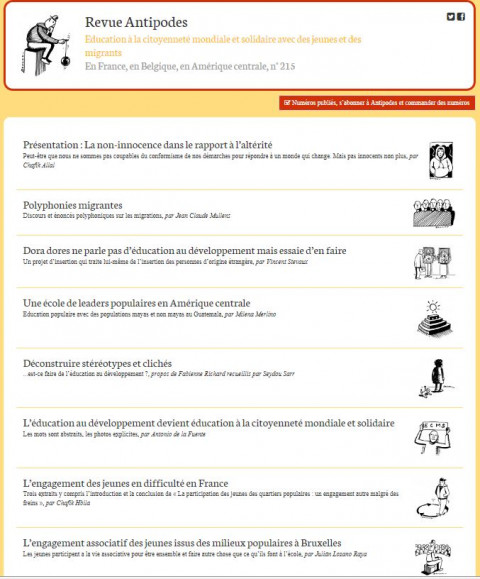 Revue Antipodes: Education à la citoyenneté mondiale et solidaire avec des jeunes et des migrants Year of publication: 2016 Corporate author: Centre de formation pour le développement et la solidarité internationale Dans le milieu de l’éducation au développement, à la citoyenneté mondiale et solidaire, tout comme d’autres questions sociétales liées à la mixité des groupes ou des tribus (comme on dit parfois dans la novlangue urbaine), les questions à l’origine des articles du présent numéro d’Antipodes existent depuis longtemps ; elles ont rarement été considérées comme prioritaires. La mixité des groupes reste une bonne intention, espérée, défendue ou imaginée, ici et là, mais rarement on a réussi à construire des dispositifs la facilitant.Evidemment que beaucoup d’ONG et d’associations aimeraient avoir des groupes avec une présence de jeunes d’origine populaire et de migrants, en même temps que le public actuel. On a pu néanmoins constater que dans le contexte actuel, en Belgique, ça reste rare d’y arriver. Si personne n’est coupable d’une telle situation, personne n’est innocent non plus . Nous laissons faire, nous consacrons peu de temps, ou en tous cas pas suffisamment pour aller construire avec eux des dispositifs qui intègrent, intéressent, amènent des publics hétérogènes. La « diversité » des processus s’en trouve affectée, et nous nous retrouvons à « parler de », « dire au nom de », « défendre les » sans avoir leur avis, leur point de vue politique, ni leur contribution.Ce numéro d’Antipodes présente succinctement les polyphonies d’une recherche, d’un début de quelque chose qui est plus ouvrant que donné sous forme de résultats. Parce que cette histoire est compliquée et nous refusons de la simplifier. Nous avons arpenté des chemins nouveaux pour pouvoir faire face à nos faiblesses et nos insuffisances en toute humilité et tenter de comprendre pourquoi les jeunes des classes populaires et les migrants sont peu présents à nos formations.
  Éduquer à la citoyenneté à l’ère de la multiculturalité Year of publication: 2016 Author: Nadine Fink La citoyenneté est un statut juridique lié à la nationalité : est citoyen tout membre d’un Etat qui jouit des droits civils et politiques garantis par cet Etat, principalement le droit de vote et le droit d’éligibilité. Mais la citoyenneté renvoie aussi au principe d’une participation active de chaque individu à la vie de la société, indépendamment de sa nationalité et de l’éventuelle pluralité de ses appartenances.
  Éducation à la citoyenneté et à la solidarité internationale Corporate author: Education à la citoyenneté et à la solidarité internationale (ECSI) De nombreuses associations représentatives du domaine de l’Éducation à la citoyenneté et à la solidarité internationale (ECSI) proposent d'expliquer cette notion et ses objectifs : Ritimo, le réseau d'information et de documentation pour le développement durable et la solidarité internationale ; le Centre de recherche et d’information pour le développement (CRID) ; EDUCASOL, la plateforme associative de référence pour l’ECSI en France qui a écrit une charte « Pour une éducation à la Citoyenneté et à la Solidarité Internationale ».Pour résumer, l’Éducation à la citoyenneté et à la solidarité internationale permet de faire évoluer le regard de l’individu sur des changements de comportement à adopter, c’est-à-dire de lui permettre de développer un esprit critique sur les enjeux d’une mondialisation effrénée. Cette démarche favorise la solidarité entre les différentes cultures, groupes sociaux et pays afin de construire un monde solidaire.
  Research Models Laying the Foundation for the Unesco Chair: Democracy, Global Citizenship and Transformative Education (DCMÉT) Year of publication: 2018 Author: Paul R. Carr | Gina Thésée Corporate author: Chaire UNESCO Démocratie, citoyenneté mondiale et éducation transformatoire (DCMÉT) The conceptual and theoretical models presented in this document were developed over a roughly twelve-year period, starting in 2005, by the Chair (Paul R. Carr, Université du Québec en Outaouais) and Co-Chair (Gina Thésée, Université du Québec à Montréal) of the UNESCO Chair DCMÉT. These models have been published in diverse academic journals in either English or French, and have been translated and adapted herein to produce an updated and bilingual representation of the Education for Democracy research that Carr and Thésée have produced. In some cases, the models have been refined (and improved) over time, and they are presented as a means of attempting to elucidate, interrogate and highlight the meaning of the three themes that underpin the UNESCO Chair DCMÉT.
 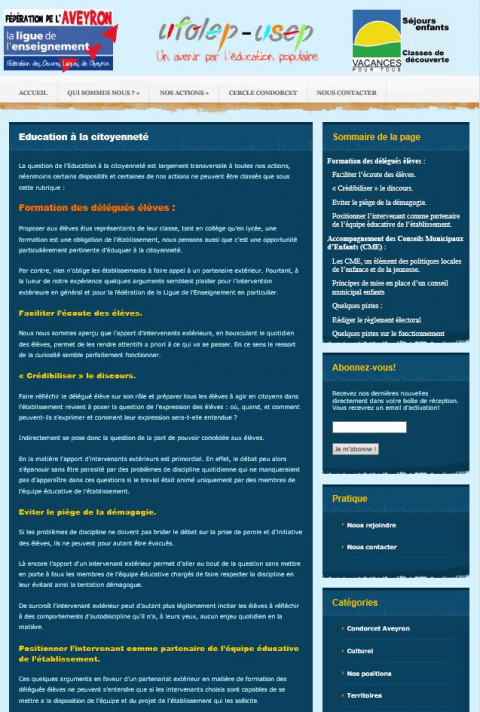 Éducation à la citoyenneté Corporate author: Ligue de l’enseignement de l’Aveyron La question de l’Education à la citoyenneté est largement transversale à toutes nos actions, néanmoins certains dispositifs et certaines de nos actions ne peuvent être classés que sous cette rubrique :Formation des délégués élèves :Proposer aux élèves élus représentants de leur classe, tant en collège qu’en lycée, une formation est une obligation de l’établissement, nous pensons aussi que c’est une opportunité particulièrement pertinente d’éduquer à la citoyenneté.Par contre, rien n’oblige les établissements à faire appel à un partenaire extérieur. Pourtant, à la lueur de notre expérience quelques arguments semblent plaider pour l’intervention extérieure en général et pour la fédération de la Ligue de l’Enseignement en particulier.
 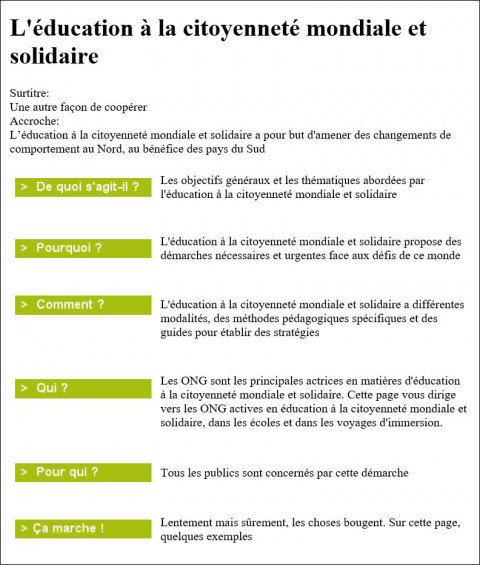 L'éducation à la citoyenneté mondiale et solidaire : Une autre façon de coopérer Corporate author: Les ONG membres d'ACODEV L’éducation à la citoyenneté mondiale et solidaire est un processus qui vise le changement social. Elle a pour but de permettre aux individus de s’approprier une conviction empreinte de solidarité internationale et de la manifester par des engagements concrets, individuels et collectifs. Objectifs généraux: Faciliter une compréhension globale des enjeux du développement et des mécanismes d’exploitation injustes qui engendrent des relations inégalitaires entre le Nord et le Sud ; Accompagner l’acquisition d’un regard conscient et critique de la réalité, tant au niveau de relations microsociales qu’au niveau macro ; Favoriser un meilleur dialogue entre les citoyens à travers une approche interculturelle basée sur le respect mutuel et l’égalité ; Promouvoir des valeurs, attitudes, et aptitudes liées à la solidarité
 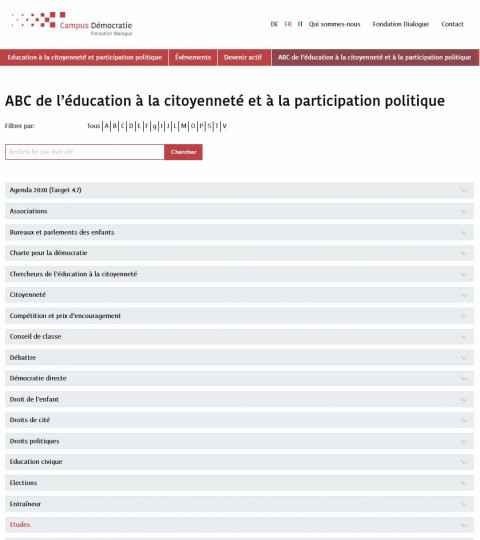 ABC de l’éducation à la citoyenneté et à la participation politique Year of publication: 2018 Corporate author: Campus pour la démocratie Les thèmes éducation à la citoyenneté et participation politique sont discutés de manière controversée. Pour des raisons de lisibilité, nous ne présentons ici que quelques définitions et modèles abrégés et renonçons à la prétention d’exhaustivité.
 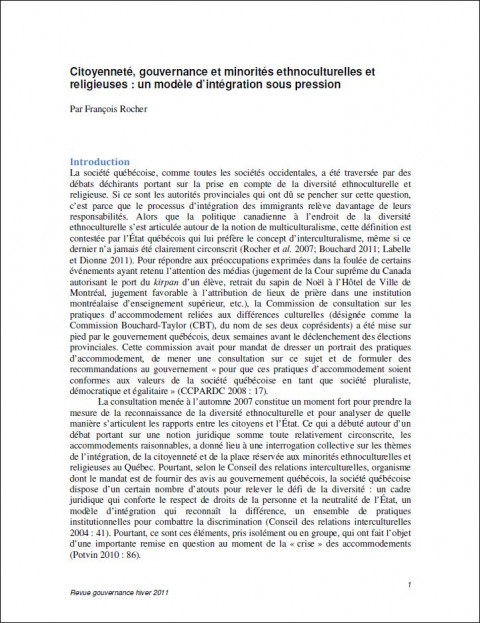 Citoyenneté, gouvernance et minorités ethnoculturelles et religieuses : un modèle d’intégration sous pression Year of publication: 2011 Author: François Rocher Corporate author: Revue Gouvernance S’appuyant sur la notion de citoyenneté substantive, cet article vise à mieux cerner les conditions d’inclusion et d’exclusion des minorités ethnoculturelles et religieuses au sein de l’État québécois. Il s’intéresse aussi aux modèles de gouvernance privilégiés par ceux‐ci et examine le rapport entre la participation civique et la gestion des affaires publiques afin de mieux comprendre le type de gouvernance privilégiée par l’État et l’incidence de ce choix sur le rapport qu’entretiennent les minorités face à l’État. Son originalité repose sur un angle d’approche qui demeure peu étudié, notamment le discours des minorités ethnoculturelles et religieuses face à l’État. Au Québec plusieurs moments critiques autour de la question des accommodements raisonnables se sont enchaînés, culminant en la création de la Commission Bouchard‐Taylor en 2007. Ce qui a débuté autour d’un débat portant sur une notion juridique somme toute relativement circonscrite a donné lieu à une interrogation collective sur les thèmes de l’intégration, de la citoyenneté et de la place réservée aux minorités ethnoculturelles et religieuses au Québec. Cette recherche analyse les positions exprimées par les leaders des minorités ethnoculturelles ou religieuses quant aux principes et modalités de participation à la vie publique et aux rapports qu’elles veulent entretenir avec l’État. Elle cherchera à montrer l’hétérogénéité des approches privilégiées et les défis que cela pose sur les différents modèles de gouvernance pouvant être adoptés.
 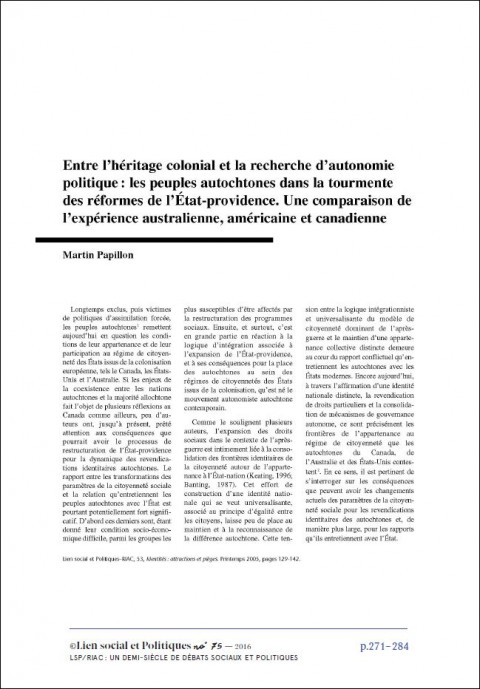 Between Colonial Heritage and Political Autonomy. Comparing the Experience of Australian, American and Canadian Aboriginal Peoples in the Turmoil of Welfare State Reform Year of publication: 2016 Author: Martin Papillon Corporate author: Lien social et Politiques Long excluded, then victims of forced assimilation, aboriginal peoples are now evaluating the conditions of their belonging to and participation in citizenship regimes in these three former colonies. The processes of welfare state restructuring may influence the dynamic of identity claims of aboriginal peoples, by modifying the parameters of social citizenship and the relations that aboriginal peoples have with the state. These reforms lean, on the one hand, towards integrated policy with targeted programmes and, on the other hand, towards greater local autonomy in programme management. The post-war citizenship regime in contrast favoured a uniform relationship between citizens and the state, thereby setting up a contradiction between the terms of the citizenship regime and maintenance of a distinct legal regime for aboriginal peoples. The current model seems less likely to constitute a block to recognition of multiplicity and differentiation. Entre l’héritage colonial et la recherche d’autonomie politique: les peuples autochtones dans la tourmente des réformes de l’État-providence. Une comparaison de l’expérience australienne, américaine et canadienne Year of publication: 2016 Author: Martin Papillon Corporate author: Lien social et Politiques Longtemps exclus, puis victimes de politiques d’assimilation forcée, les peuples autochtones remettent aujourd’hui en question les conditions de leur appartenance et de leur participation au régime de citoyenneté des États issus de la colonisation européenne. Le processus de restructuration de l’État-providence pourrait influencer la dynamique des revendications identitaires autochtones, en modifiant les paramètres de la citoyenneté sociale et la relation des peuples autochtones avec l’État. On tend aujourd’hui, d’une part, à l’intégration programmatique accompagnée de mesures ciblées et, d’autre part, à une plus grande autonomie locale dans la gestion de ces programmes. Le régime de citoyenneté d’après-guerre favorisait plutôt une uniformisation du rapport entre les citoyens et l’État, et donc posait en contradiction l’intégration à ce régime et le maintien d’un régime statutaire distinct pour les autochtones. Le modèle actuel peut ainsi paraître moins réfractaire à la multiplicité et à la différenciation.