
Resources
Explore a wide range of valuable resources on GCED to deepen your understanding and enhance your research, advocacy, teaching, and learning.
1,180 Results found
 2016 UN Global Citizenship Education Seminar Year of publication: 2016 Corporate author: United Nations (UN) 2016 UN Global Citizenship Education SeminarSeminar on “Global Citizenship Education: An emerging agenda for peace and preventing violent extremism and promoting sustainable development and human dignity”. This seminar was co-organized by the Permanent Missions of Andorra, Croatia, Jordan and the Republic of Korea; and the Asia-Pacific Centre of Education for International Understanding (APCEIU), the United Nations Educational, Scientific and Cultural Organization/Global Education First Initiative (UNESCO/GEFI), the United Nations Academic Impact (UNAI), the UN-Women, InterPress Service, and the Coalition for Global Citizenship 2030.
  Interrupting Extremism by Creating Educative Turbulence Year of publication: 2014 Author: Lynn Davies Corporate author: Curriculum Inquiry This article begins from the premise that it is important to explore how people unlearn, as well as learn, specifically in terms of extremist or violent attitudes. Three different country examples are given of intergroup encounters that interrupt rigidities in attitudes: working across ethnic groups in Sri Lanka, tackling religious divides in Northern Ireland through shared classes, and initiatives to prevent violent extremism in the United Kingdom. Pedagogical implications of unlearning involve working with the four Ds of deradicalization, debiasing, disengagement and desistence. Interrupting Extremism by Creating Educative Turbulence Year of publication: 2014 Author: Lynn Davies Corporate author: Curriculum Inquiry Cet article développe l'idée qu'il est important d'analyser les processus de désapprentissage, autant que d'apprentissage, qui conduisent un individu à adopter des attitudes extrémistes ou violentes. Des exemples tirés de trois pays sont mobilisés pour montrer comment des rencontres intergroupes conduisent à infléchir des comportements rigides : le travail entre groupes ethniques au Sri Lanka, la lutte contre les divisions religieuses en Irlande du Nord à l'aide de classes mixtes, et des initiatives visant à prévenir l'extrémisme violent au Royaume-Uni. Les implications pédagogiques d'une approche par le "désapprentissage" nécessitent de mobiliser les quatre "D": déradicalisation, désubjectivation, désengagement et désistance.
  Beyond Bali Education Package Year of publication: 2012 Author: Lily Taylor | Saul Karnovsky The Beyond Bali Project funded by Building Community Resilience (BCR) aims to develop and produce an education resource for secondary school students (years 8/9) on the Bali bombings and the Bali Peace Park. The resource is designed to build social resilience to violent extremism by: - providing students with the skills and tools to critically analyze and challenge violent extremism, its causes and consequences - raising awareness and education on the social impacts of violent extremism - encouraging students to think about how societies can resist the influence of violent extremism - engaging students through activities and discussion about the Bali Peace Park as social resistance to terrorism. Beyond Bali Education Package Year of publication: 2012 Author: Lily Taylor | Saul Karnovsky Le projet Beyond Bali financé par Building Community Resilience (BCR) a pour objectif l’élaboration d’une ressource pédagogique pour les collégiens (de 5ème et 4ème) qui porte sur les attentats survenus à Bali et le Bali Peace Park. Cette ressource est conçue afin de renforcer la résilience sociale à l’extrémisme violent. Pour ce faire, elle :- Fournit aux étudiants les compétences et les outils nécessaires pour analyser de façon critique et remettre en question l’extrémisme violent, ses causes et ses conséquences,- Sensibilise aux impacts sociaux de l’extrémisme violent- Encourage les étudiants à réfléchir sur les façons dont les sociétés peuvent résister à l’influence de l’extrémisme violent- Propose aux étudiants de participer à des activités et à engager des discussions autour du Bali Peace Park.
  2022 세계시민교육 선도교사 활동 참여 교사의 세계시민교육 확산도 연구 Year of publication: 2022 Author: 박환보 | 이인영 | 이지홍 본 연구는 유네스코 아시아태평양 국제이해교육원이 추진한 ‘세계시민교육 선도교사 사업’ 효과 분석을 목표로 한다. ‘선도교사 활동 참여를 통해 세계시민교육 실천 역량이 향상되었는지’, ‘연수 받은 내용을 학교 현장에서 얼마나 어떻게 확산시키고 있는지’, 그리고 이러한 활동을 통해 ‘학교 현장에서 세계시민교육은 얼마나 확산되고 있는지’ 등을 분석하였다. 이를 토대로 세계시민교육 선도교사 활동의 성과를 보다 종합적으로 이해하고, 향후 성과 확산을 위한 정책적 시사점을 도출하였다. 연구기관: 유네스코 아시아태평양 국제이해교육원연구책임자: 박환보 (충남대학교)공동연구원: 이인영 (한국청소년정책연구원)이지홍 (유네스코 아시아태평양 국제이해교육원)연구보조원: 정성경 (충남대학교)조유진 (유네스코 아시아태평양 국제이해교육원) 목차제1장 서론제2장 세계시민교육 선도교사 활동 성과분석 체계제3장 세계시민교육 선도교사 활동 성과분석제4장 세계시민교육 선도교사의 세계시민교육 확산 사례 분석제5장 세계시민교육 선도교사의 세계시민교육 확산 활동과 확산도 인식제6장 결론참고문헌부록
  Inquiry into practice: learning and teaching global matters in local classrooms Year of publication: 2014 Author: David Montemurro | Mira Gambhir | Mark Evans | Kathryn Broad Corporate author: University of Toronto. Ontario Institute for Studies in Education This Inquiry into Practice publication, Learning and Teaching Global Matters in Local Classrooms, is the most recent addition to the series. It examines and shares varied perspectives, curricula, instructional practices, and resources intended to enhance student learning related to the infusion of global and international dimensions of education into classroom and schoolwide teaching and learning. It is organized in three sections: Educator Perspectives, Inquiry into Practice, and Resources. In this introduction, we briefly discuss how the text is organized, common themes that emerged across the sections, and concluding reflections.The first section, Educator Perspectives, provides insights from a range of university scholars and fieldbased leaders who, in multiple and distinct ways, have made learning and teaching about global matters in local classrooms a core feature of their work. Each was invited to comment on purposes, opportunities, and challenges related to infusing global and international dimensions into teaching and learning. Therefore, this section offers both contrasting conceptual perspectives and concrete suggestions that can impress the reader with a sense of urgency, critique, hope, and challenge when engaging in the complex and shifting work of teaching and learning about global matters.The second section, Inquiry into Practice, presents the 11 school-based and university-linked professional inquiries undertaken over a two-year period. The inquiries focus on a range of topics including critical global citizenship, the use of children’s literature to develop students’ understanding of sustainability in science education, and the refugee experience in personal and global understanding of “home.” The inquiries were carried out mostly with OISE partner schools and districts located in the city of Toronto and the GTA (regional municipalities including Durham, Halton, Peel, and York). This region of Canada provides a distinctly international, diverse context for this type of study. Local schools and districts linked with OISE’s Initial Teacher Education program have become sites of fascinating explorations into the possibilities of learning and teaching in pluralist contexts. The collection of inquiries in this publication speaks to the process of crossing borders demarcated by tangibles such as regions, nationalities, citizenship, and also by less tangible mindsets, identities, beliefs, and understandings. The voices across the project represent stakeholders in education: including voices of youth, beginning and experienced teachers, administrators, and researchers.The Resources section provides an annotated bibliography of print, media, and web resources to support those interested in teaching with global perspectives in mind. Recommended by project leaders and participants, by the authors, and by experts with various lenses, these resources are offered as a means to extend the exploration of the topics, ideas, and questions posed throughout the publication.
 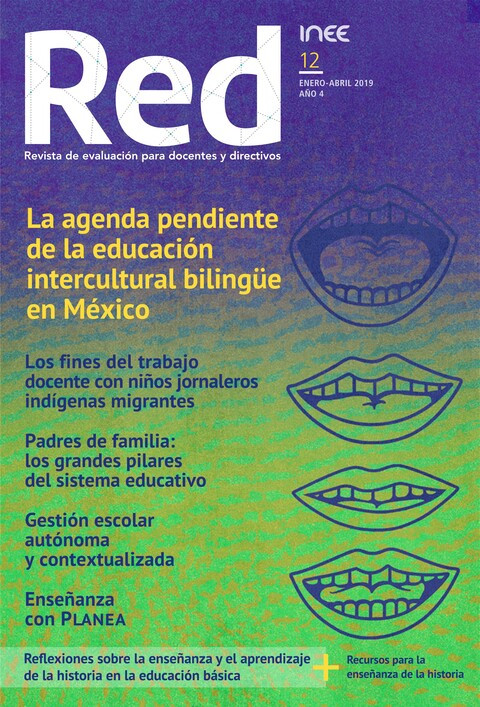 Journal of Evaluation for Teachers and Managers: The Pending Agenda of Bilingual Intercultural Education in Mexico (Red Magazine; No.4, 2019) Year of publication: 2019 Corporate author: National Institute for the Evaluation of Education (NIEE) This journal addresses an outstanding concern within the Mexican state: indigenous, intercultural, and bilingual education in our nation. It delves into the pedagogy of history at the elementary and secondary levels, along with an exploration of the internet's resources for stimulating student interest in this subject, as presented in our inaugural issue of 2019. Equally noteworthy are inquiries into teacher professionalization and insights shared by several educators on this subject. In the direct discourse titled "From Educator to Educator," Ms. Tsut Tsuy Tamayo also imparts her experiences in the realm of mathematics education. Additionally, this issue includes substantial statistics from the PLANEA assessment, an investigative report on parental involvement in their children's academic pursuits, and an extensive evaluation course tailored for educators, elucidated through an interview with Bernardo Naranjo, a counselor at the National Institute for the Evaluation of Education (INEE). Revista de evaluación para docentes y directivos: La agenda pendiente de la educación intercultural bilingüe en México (Revista Red; No.4, 2019) Year of publication: 2019 Corporate author: National Institute for the Evaluation of Education (NIEE) Esta revista aborda una asignatura pendiente del Estado mexicano: la educación indígena, intercultural y bilingüe en nuestro país. La enseñanza de la historia en primaria y secundaria, y los recursos que nos ofrece internet para propiciar el interés de los alumnos en esta asignatura también se plantean en nuestra primera entrega de 2019. No menos interesantes resultan la profesionalización docente y las opiniones que varias maestras nos comunican sobre este tema. En el diálogo directo “De profesor a profesor”, la maestra Tsut Tsuy Tamayo nos comparte igualmente su experiencia en la enseñanza de las matemáticas. Las significativas cifras arrojadas por PLANEA, un reportaje sobre la participación de los padres de familia en la educación académica de sus hijos, un curso masivo sobre evaluación dirigido a docentes expuesto en entrevista por Bernardo Naranjo, consejero del INEE.
 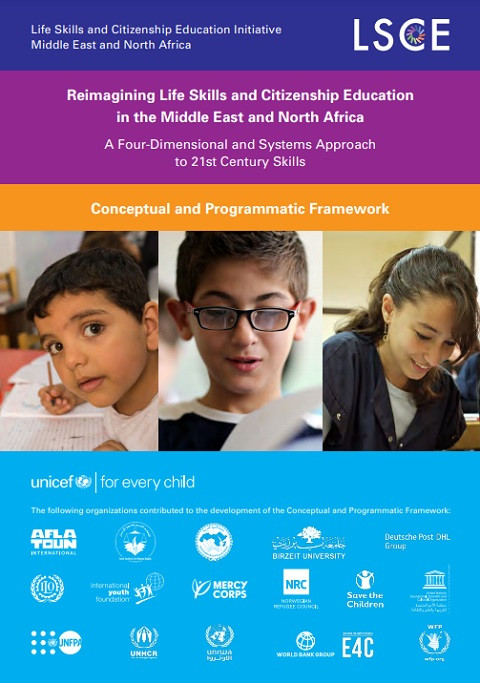 Reimagining Life Skills and Citizenship Education in the Middle East and North Africa: A Four-Dimensional and Systems Approach to 21st Century Skills; Conceptual and Programmatic Framework Year of publication: 2017 Corporate author: UNICEF Middle East and North Africa The situation of learning in MENA calls for a holistic, lifelong and rights-based vision of education that maximizes the potential of all children and youth in the region and better equips them to create meaning out of knowledge and to face the transitions from childhood to adulthood, from education to work, and from unreflective development to responsible and active citizenship. This is what drives the MENA Life Skills and Citizenship Education (LSCE) Initiative, kicked off in 2015 with the aim of supporting the countries of the region – conceptually, programmatically and technically – to improve learning and to better invest such learning in individual, social and economic development.The LSCE Conceptual and Programmatic Framework (CPF) puts forth a roadmap to guide policies, strategies and programmes on life skills and citizenship education supporting the region-wide efforts to provide children and youth with opportunities to learn, transition from childhood to adulthood, move from school to work settings, and become responsible and active citizens of their communities.A set of twelve core life skills for MENA has been identified using the four-dimensional learning model: ‘Learning to Know’ (Cognitive Dimension), ‘Learning to Do’ (Instrumental Dimension), ‘Learning to Be’ (Individual Dimension), and ‘Learning to Live Together’ (Social Dimension). The twelve core life skills are life-long, and they build on evidence that underlines the importance of skills acquisition from an early age. Furthermore, the twelve core life skills are acquired and sustained through all forms of learning in a systems approach that recognizes multiple pathways of learning, formal, non-formal and informal.