
Resources
Explore a wide range of valuable resources on GCED to deepen your understanding and enhance your research, advocacy, teaching, and learning.
1,727 Results found
 Fostering Digital Citizenship through Safe and Responsible Use of ICT: A Review of Current Status in Asia and the Pacific as of December 2014 Year of publication: 2015 Corporate author: UNESCO Bangkok The publication examines various interventions to address issues concerning cybersafety, rights, and wellness. It provides a synthesis of various policy responses, programmes, and initiatives implemented by governments, international organizations, civil society, and the private sector.The report ends with a preliminary set of recommendations with regards to policy, research, education, and partnerships. It is hoped that the report can provide an insight into the current status of digital citizenship in the region and consequently highlight the importance of maintaining a conscious balance of opportunities and risks when dealing with ICT.
  A Policy Review: Building Digital Citizenship in Asia-Pacific through Safe, Effective and Responsible Use of ICT Year of publication: 2016 Corporate author: UNESCO Bangkok This report is a major output of the project. The policy review described in this report took stock of national policies in 22 Member States in the Asia-Pacific region and assessed the capacity of their education sectors to foster digital citizenship among children aged 0-18.It is encouraging to note from the study that surveyed Member States’ policies to promote ICT opportunities mature alongside policies that address potential risks, at varying levels of policy maturity. However, while the surveyed Member States recognize the importance of equipping children with ICT skills and providing basic infrastructure, the findings indicate that there is much to be done for young learners (e.g. early childhood education and lower primary education) in introducing the concept of safe, effective and responsible use of ICT to their national curriculum as well as to their teacher professional development programmes.
  Addressing Anti-semitism through Education: Guidelines for Policymakers Year of publication: 2018 Corporate author: OSCE. Office for Democratic Institutions and Human Rights (ODIHR) A new UNESCO and OSCE co-publication takes up the challenge of educating learners to resist contemporary anti-Semitism at a time when the issue is becoming ever more crucial around the world. It suggests concrete ways to address anti-Semitism, counter prejudice and promote tolerance through education, by designing programmes based on a human rights framework, global citizenship education, inclusiveness and gender equality.It also provides policymakers with tools and guidance to ensure that education systems build the resilience of young people to anti-Semitic ideas and ideologies, violent extremism and all forms of intolerance and discrimination, through critical thinking and respect for others. Prévenir l’antisémitisme par l’éducation: Lignes directrices à l’intention des décideurs politiques Year of publication: 2018 Corporate author: OSCE. Office for Democratic Institutions and Human Rights (ODIHR) Cette nouvelle publication UNESCO/OSCE relève le défi de l’antisémitisme contemporain à un moment où la question devient de plus en plus cruciale dans le monde entier. Elle propose des moyens concrets pour combattre l’antisémitisme, lutter contre les préjugés et promouvoir la tolérance par l’éducation, sur la base de programmes fondés sur les droits humains, l’éducation à la citoyenneté mondiale, l’inclusion et l’égalité des sexes. Elle fournit également aux décideurs politiques des outils et des recommandations pour garantir que les systèmes éducatifs renforcent la résilience des jeunes aux idées et idéologies antisémites, à l’extrémisme violent et à toutes les formes d’intolérance et de discrimination, par l’acquisition d’une pensée critique et le respect des autres. Addressing Anti-semitism through Education: Guidelines for Policymakers Year of publication: 2018 Corporate author: OSCE. Office for Democratic Institutions and Human Rights (ODIHR) A new UNESCO and OSCE co-publication takes up the challenge of educating learners to resist contemporary anti-Semitism at a time when the issue is becoming ever more crucial around the world. It suggests concrete ways to address anti-Semitism, counter prejudice and promote tolerance through education, by designing programmes based on a human rights framework, global citizenship education, inclusiveness and gender equality.It also provides policymakers with tools and guidance to ensure that education systems build the resilience of young people to anti-Semitic ideas and ideologies, violent extremism and all forms of intolerance and discrimination, through critical thinking and respect for others.
  التعليم كوسيلة للتعافي: معالجة صدمة النزوح من خلال التعلم الاجتماعي والعاطفي Year of publication: 2019 وتتناول هذه الوثيقة أنشطة التعليم النظامي وغير النظامي، ولا سيما الأنشطة التي تركز على التعلم الاجتماعي والعاطفي، كنهج واعد لتوفير الدعم النفسي والاجتماعي للمهاجرين واللاجئين في مواجهة الآثار السلبية للصدمات التي تعرضوا لها. وتغطي الوثيقة سياقات الطوارئ والأوضاع المجتمعية التي تقود فينهاية المطاف إلى استقرار أطفال المهاجرين واللاجئين. كما تغطي الدراسة مسألة توفير التعليم وبيئة التعلم؛ ومحتوى التعليم والتعلم لكل من الأطفال وأولياء أمورهم؛ والدور الذي يمكن أن يقوم به المعلمون وغيرهم من المهنيين . Education as healing: addressing the trauma of displacement through social and emotional learning Year of publication: 2019 The conditions under which migrants and refugees have to leave their homes and homelands can be traumatic in the extreme. Whether they have crossed the Mediterranean in an overcrowded and unsafe boat, been barricaded in a Syrian basement for protection from shelling, or been chased away from a burning village in Myanmar, the events of their departures and their journeys can leave scars on those affected – and none more than on children who have witnessed and experienced death, loss, violence, separation from family and prolonged insecurity. Even those fortunate enough to find a sanctuary often face further hardship or discrimination in their host communities that can exacerbate their vulnerability.
  Youth and the Field of Countering Violent Extremism Year of publication: 2018 Author: Marc Sommers Most youth are peaceful. Even if the field known as “countering violent extremism” (CVE) did not exist, most young people still would not join a violent extremist organization (VEO). At the same time, the overwhelming majority of people who become violent extremists are youth — most of whom are male. The challenge at the center of CVE is thus an unusual one: identifying the fraction of youth populations most likely to enter a VEO and thwarting that option. This paper investigates that challenge, with analysis featuring interviews with 21 experts and over 400 publications on violent extremism, CVE, and youth. Two correlations inform this work: the direct relationship between nations with “youth bulge” populations and state repression, and the connection between state repression and increased violent extremism, with repressive states usually targeting male youth.
 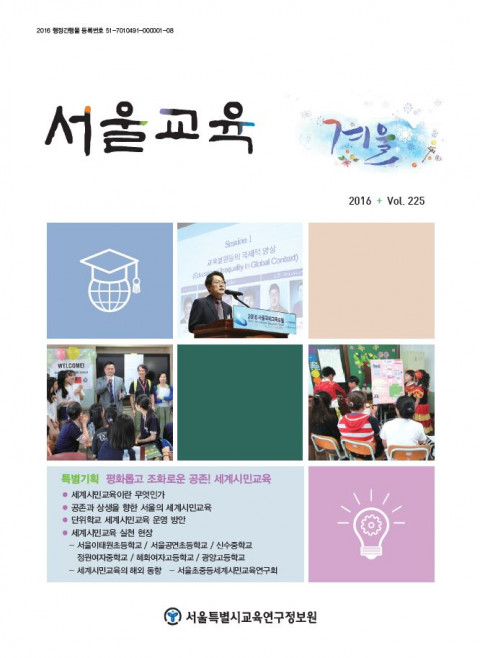 서울교육 2016년 겨울호 (제58권 통권 225호) Year of publication: 2016 Corporate author: 서울특별시교육청 교육연구정보원 권두칼럼:혁신미래교육으로서의 세계시민교육특별기획: 평화롭고 조화로운 공존! 세계시민교육세계시민교육이란 무엇인가공존과 상생을 향한 서울의 세계시민교육단위학교 세계시민교육 운영 방안세계시민교육 실천 현장 해외교육:세계시민교육의 해외 동향 출처 URL:http://www.serii.re.kr/photo/viw.do?method=getView&mcode=S029a&seq=921
  서울교육 2018년 겨울호 (제60권 통권 233호) Year of publication: 2018 Corporate author: 서울특별시교육청 교육연구정보원 권두칼럼:통일교육 패러다임 전환 키워드: #평화특별기획:평화시대를 여는 새로운 통일교육 – 평화와 민주시민교육을 담는 통일교육으로 –화해로 나아가는 평화와 공존의 통일교육한반도 대변혁기의 학교 평화·통일교육 방향 – 통일교육연구학교 운영사례를 중심으로 –해외교육:독일 통일교육이 한국 통일교육에 주는 시사점통일독일의 동독청소년 사회통합을 통해 보는 21세기 통일한국의 청소년 사회통합 정책연구:평화에 대한 비판적 공부: 평화학 출처 URL:http://www.serii.re.kr/photo/viw.do?method=getView&mcode=S029a&seq=1081