
Resources
Explore a wide range of valuable resources on GCED to deepen your understanding and enhance your research, advocacy, teaching, and learning.
1,322 Results found
 Education in the Time of COVID-19 (COVID-19 Report; ECLAC-UNESCO) Year of publication: 2020 Corporate author: Economic Commission for Latin America and the Caribbean (ECLAC) | UNESCO Santiago The coronavirus disease (COVID-19) pandemic has caused an unprecedented crisis in all areas. In the field of education, this emergency has led to the massive closure of face-to-face activities of educational institutions in more than 190 countries in order to prevent the spread of the virus and mitigate its impact. The Economic Commission for Latin America and the Caribbean (ECLAC) has argued that even before the pandemic hit, the social situation in the region was deteriorating, owing to rising rates of poverty and extreme poverty, the persistence of inequalities and growing social discontent. In this context, the crisis will have a profoundly negative impact on the various social sectors, particularly health and education, as well as on employment and poverty. Meanwhile, UNESCO has identified major gaps in educational outcomes, which are related to the unequal distribution of teachers in general, and of the best qualified teachers in particular, to the detriment of lower-income countries and regions and of rural areas, where indigenous and migrant populations tend to be concentrated.In the sphere of education, many of the measures that the region’s countries have adopted in response to the crisis are related to the suspension of face-to-face classes at all levels, which has given rise to three main areas of action: the deployment of distance learning modalities through a variety of formats and platforms (with or without the use of technology); the support and mobilization of education personnel and communities; and concern for the health and overall well-being of students.The aim of this document is to shed light on various consequences that these measures will have on educational communities in the short and medium term, and to offer key recommendations on how to manage those consequences in the best possible manner, drawing attention to opportunities for learning and innovation in the post-pandemic education system. La educación en tiempos de la pandemia de COVID-19 (Inform COVID-19; CEPAL-UNESCO) Year of publication: 2020 Corporate author: Economic Commission for Latin America and the Caribbean (ECLAC) | UNESCO Santiago La pandemia de enfermedad por coronavirus (COVID-19) ha provocado una crisis sin precedentes en todos los ámbitos. En la esfera de la educación, esta emergencia ha dado lugar al cierre masivo de las actividades presenciales de instituciones educativas en más de 190 países con el fin de evitar la propagación del virus y mitigar su impacto.La Comisión Económica para América Latina y el Caribe (CEPAL) ha planteado que, incluso antes de enfrentar la pandemia, la situación social en la región se estaba deteriorando, debido al aumento de los índices de pobreza y de pobreza extrema, la persistencia de las desigualdades y un creciente descontento social. En este contexto, la crisis tendrá importantes efectos negativos en los distintos sectores sociales, incluidos particularmente la salud y la educación, así como en el empleo y la evolución de la pobreza. Por su parte, la UNESCO ha identificado grandes brechas en los resultados educativos, que se relacionan con una desigual distribución de los docentes, en general, y de los docentes mejor calificados, en particular, en desmedro de países y regiones con menores ingresos y de zonas rurales, las que suelen concentrar además a población indígena y migrante.En el ámbito educativo, gran parte de las medidas que los países de la región han adoptado ante la crisis se relacionan con la suspensión de las clases presenciales en todos los niveles, lo que ha dado origen a tres campos de acción principales: el despliegue de modalidades de aprendizaje a distancia, mediante la utilización de una diversidad de formatos y plataformas (con o sin uso de tecnología); el apoyo y la movilización del personal y las comunidades educativas, y la atención a la salud y el bienestar integral de las y los estudiantes.El objetivo de este documento es visibilizar la diversidad de consecuencias que estas medidas tendrán sobre las comunidades educativas a corto y mediano plazo, así como plantear las principales recomendaciones para sobrellevar el impacto de la mejor manera posible, proyectando oportunidades para el aprendizaje y la innovación en la educación posterior a la pandemia.
  A Case Study on Teaching and Learning Process for Global Citizenship Education: Focused on Classes on the Refugee Disputes (Journal of Educational Innovation Research; Vol. 26, No. 3) Year of publication: 2016 Author: Junho Choi Corporate author: Pusan National University. Educational Development Institute Purpose: With the advent of the global civil society, this study is initiated from the necessity to design and make practical educational contents and methods which help us find relevant social studies’ topics and deal with them profoundly. For this reason, this study, in relation to our Global Citizenship Education(GCE) at school, was to focus on finding out practical strategies for the solutions to the refugee disputes and to find practical syllabuses. Method: This study was performed by using a literature research methods. I collected and examined relevant existing paper materials such as journals, reports, and books. Thereby, I searched a related topic and extracted meanings, values, perspectives on the topic which each materials contained. And then, I analyzed them by categorizing, integrating, and comparing the each extracted content. Based on this method, I can find the general characteristics and present practical strategies on the global citizenship education. Results: This study makes it possible to be well organized, based on self-directed and small group cooperative learning process by utilizing the PBL method(Problem Based Learning). In particular, this method allows students to make ‘Virtual Commission of Refugees’, and to debate and negotiate issues on their own. Conclusion: This process intends for students to recognize that the refugee disputes are the problem which as a member of the global civil society, all of the people should consider and overcome for the public welfare and developments. For this reason, this study, in relation to our Global Citizenship Education(GCE) at school, tries to focus on finding out practical strategies for the solutions to the refugee disputes and to find practical syllabuses. 세계시민교육을 위한 교수․학습과정안 사례연구: 난민문제 수업을 중심으로 (교육혁신연구; Vol 26, No. 3) Year of publication: 2016 Author: 최준호 Corporate author: 부산대학교 교육발전연구소 연구목적: 본 연구는 세계시민사회 도래에 대응한 적합성이 높은 사회과교육의 주제를 발굴하고 이를 더욱 심층적으로 다룰 수 있도록 하는 교육적 내용 및 방법에 관한 설계와 실천이 절실히 필요하다고 보았다. 이 같은 취지에서 본 연구의 목적은 사회교과를 통해 세계시민교육을 하고자 할 때 시의적절한 주제를 선정하고 실제 수업에 활용하기에 적절한 내용과 방법을 구체적으로 살펴보고자 함에 있다. 연구방법: 본 연구는 문헌 연구 방법을 통해 국내·외 선행연구로서의 학술논문, 단행본, 연구보고서 및 자료 등을 수집·분석하여 세계시민교육의 배경과 특징을 파악하고, 세계시민교육의 의미와 가치에 대한 이해를 바탕으로 세계시민교육 차원의 사회교과 교수·학습을 위한 구체적인 주제를 발굴함과 동시에 그에 따른 내용과 방법상의 실천 전략을 제시하고자 하였다. 연구결과: 본 연구는 PBL 기법(문제중심학습)을 활용하여 난민문제의 교수·학습 과정을 학습자의 자기주도 학습 및 소집단별 협동학습에 주안점을 두며 지식, 기능, 가치·태도, 그리고 실천적 목표를 달성하기 위한 내용과 절차를 유기적으로 구성하였다. 특히, 학습자 중심의 가상의 ‘난민조정위원회’의 구성과 토론 및 협상 과정이라는 상황을 입혀 난민문제를 학습자들이 직접 다루도록 하였다. 논의 및 결론: 세계시민교육 차원에서 난민문제가 사실상 세계시민사회 전체의 공공복리와 공영발전을 위해 극복해야 할 필수 과제이며, 세계시민의 일원으로서의 관심과 참여적 역할이 필요하다는 점을 학생들이 직접 깨닫도록 하였다.
  감염병 보도 규제의 현황 및 개선 방안 (이슈와 논점 제1665호) Year of publication: 2020 Author: 김여라 Corporate author: 국회입법조사처 최근 코로나바이러스감염증-19의 확산으로 언론의 관련 보도가 증가하면서 부정확하고 자극적인 보도, 불필요한 피해자 신원 노출, 특정 집단에 대한 혐오 확산 등에 대한 우려가 높아지고 있다. 하지만 우리의 일상생활과 밀접하게 관련이 있으면서도 알려진 정보가 없는 신종 감염병과 관련하여 국민들은 정부의 발표와 더불어 추가적인 언론보도에 의존할 수밖에 없는 상황이다. 특히 코로나19의 급격한 확산으로 인해 불안감이 심해지는 상황에서 언론의 역할은 매우 중요하다. 이 글에서는 감염병 보도 관련 규제 현황과 감염병 보도의 문제점을 살펴본 후, 감염병 보도에 대한 규제를 법률적 규제와 자율적 규제로 나누어 개선방안을 제시하고자 한다.
 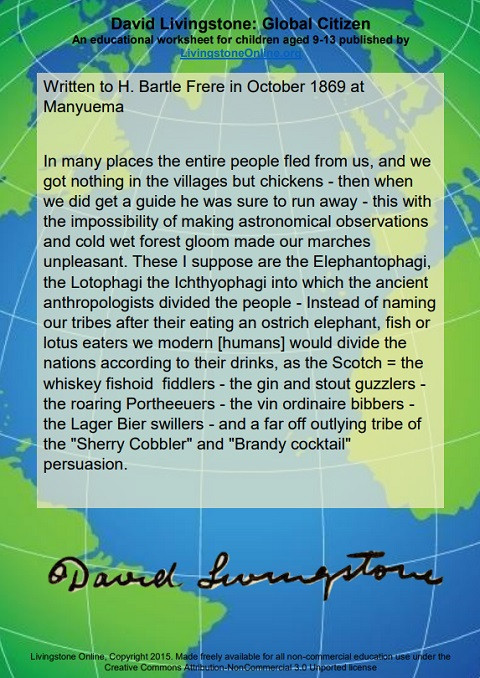 David Livingstone: Global Citizen Year of publication: 2015 Author: Kate Simpson | Megan Ward Corporate author: Livingstone Online This material urges students to explore the term global citizenship and what it means to them. Students can use Livingstone’s letter to practice their deep reading skills, finding out what the letter reveals about nineteenth-century perspectives on global life.
  Education à la citoyenneté et à la solidarité internationale en histoire-géographie Year of publication: 2020 Corporate author: Le Partenariat | Global Issues, Global Subjects (GIGS) | Union européenne Afin de promouvoir la démarche d'Education à la Citoyenneté et à la Solidarité Internationale et les Objectifs de Développement Durable dans l'enseignement secondaire, des groupes de travail d’enseignants ont conçu cette ressources pédagogique à destination de leurs collègues d'histoire-géographie.
  Education à la citoyenneté et à la solidarité internationale en mathématiques Year of publication: 2020 Author: Jean Delautre | Pierre Lasalle | Audrey Walkowiak Corporate author: Le Partenariat | Global Issues, Global Subjects (GIGS) | Union européenne Cette brochure a été publiée pour promouvoir la démarche d'Education à la Citoyenneté et à la Solidarité Internationale et les Objectifs de Développement Durable dans l'enseignement mathématique.
  Learning to Read the World?: Teaching and Learning about Global Citizenship and International Development in Post-Primary Schools Year of publication: 2011 Author: Audrey Bryan | Meliosa Bracken Corporate author: Irish Aid This is the first published study of its kind in an Irish context, offering combined insights into the status and practice of Development Education in post-primary schools as well as an interrogation of how development issues are represented in the formal curriculum. It adopted a qualitative approach, enabling a rich description of what Development Education looks like in an Irish context and how it is understood in post-primary schools, as well as an in-depth exploration of teachers’ experiences and views about ‘doing’ Development Education in post-primary settings. Combining an analysis of curriculum materials (including 75 lesson plans and a similar number of textbooks) as well as in-depth interviews with 26 in-career teachers currently teaching Development Education in a broad and diverse cross-section of post-primary schools, the study provides a comprehensive portrait of Global Citizenship Education in Irish second-level schools. The overall aim of the research was to identify the strengths, possibilities and limits in existing pedagogical and curricular approaches to Development Education across a range of subjects at post-primary level in Ireland.
  Learning about Development at A-Level: A study of the impact of the World Development A-level on Young People’s Understanding of International Development (Development Education Research Centre Research Paper; No.7) Year of publication: 2012 Author: Gill Miller | Elizabeth Bowes | Douglas Bourn | Juan Miquel Castro Corporate author: Development Education Research Centre (DERC) Learning about development has been a feature of the school curriculum in England for a number of years, most notably through Geography and there has been increased interest in examination courses at post-sixteen. By reviewing what young people have learnt and gained from such a course, this report aims to demonstrate how young people perceive international development issues and what impact this has had on their views about the wider world.