
Resources
Explore a wide range of valuable resources on GCED to deepen your understanding and enhance your research, advocacy, teaching, and learning.
1,448 Results found
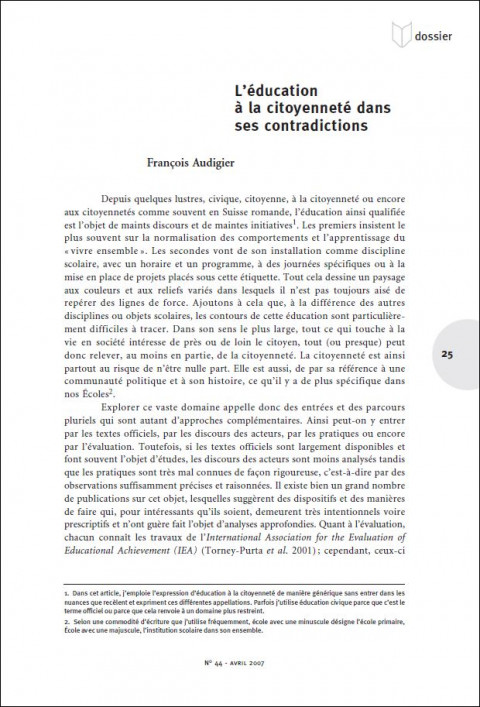 Citizenship Education and Its Contradictions Year of publication: 2007 Author: François Audigier Corporate author: Revue internationale d’éducation de Sèvres From design to implementation, citizenship education is fraught with tensions and contradictions. The concept of citizenship itself brings into play political, affective and legal aspects. Delivering citizenship education in schools raises several issues. At times treated as a subject area in its own right and at times taught using cross-disciplinary approaches, citizenship education addresses not only knowledge and skills, but also values and behaviour. The ends of citizenship education are ambitious, and often include aims that are difficult to reconcile with one another. In terms of how citizenship education is actually delivered, the once-systematic introduction to the legal and political systems has lost ground to the more recent priority of teaching students a sense of community. La educación a la ciudadanía en sus contradicciones Year of publication: 2007 Author: François Audigier Corporate author: Revue internationale d’éducation de Sèvres La educación cívica vive atravesada por tensiones y contradicciones, desde su elaboración hasta su implementación. El propio concepto de ciudadanía confronta una dimensión política, afectiva y jurídica. La enseñanza de la educación cívica en el seno de la Escuela conlleva varias dificultades. Unas veces enseñada como asignatura independiente, otras implementada desde un enfoque pluridisciplinario, la educación cívica pone en juego tanto los conocimientos y los saberes como los valores o los comportamientos. Sus metas son ambiciosas y las conminaciones que se le hace, son muchas veces contradictorias. En la práctica, la prioridad otorgada a la dimensión de “convivencia” lleva a dejar de lado una incursión más sistemática en los ámbitos jurídicos y políticos. Hoy día parece conveniente velar por que los valores, tanto en el seno de la Escuela como entre Escuela y sociedad, no sean contradictorios. L’éducation à la citoyenneté dans ses contradictions Year of publication: 2007 Author: François Audigier Corporate author: Revue internationale d’éducation de Sèvres L’éducation à la citoyenneté est parcourue de tensions et de contradictions, depuis sa conception à sa mise en œuvre. Le concept de citoyenneté lui-même met en tension une dimension politique, une dimension affective et une dimension juridique. La réalisation de l’éducation à la citoyenneté à l’École soulève plusieurs difficultés. Tantôt discipline, tantôt abordée par des approches poly-disciplinaires, elle fait entrer en jeu aussi bien des connaissances et savoirs que des valeurs ou encore des comportements. Ses finalités sont ambitieuses et les injonctions qui lui sont faites souvent contradictoires. En pratique, la priorité accordée au « vivre ensemble » conduit à laisser de côté une initiation plus systématique à l’univers juridique et politique. Il convient aujourd’hui de veiller à la non-contradiction des valeurs, tant au sein de l’École qu’entre l’École et la société.
 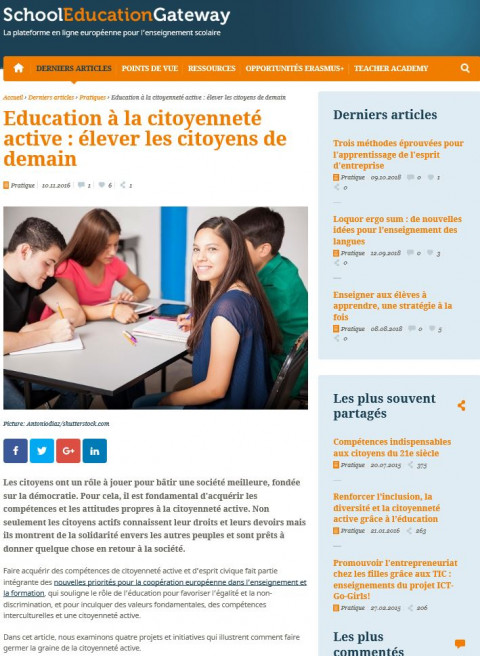 Éducation à la citoyenneté active: élever les citoyens de demain Year of publication: 2016 Corporate author: Centre européen Wergeland Les citoyens ont un rôle à jouer pour bâtir une société meilleure, fondée sur la démocratie. Pour cela, il est fondamental d'acquérir les compétences et les attitudes propres à la citoyenneté active. Non seulement les citoyens actifs connaissent leur droits et leurs devoirs mais ils montrent de la solidarité envers les autres peuples et sont prêts à donner quelque chose en retour à la société.Faire acquérir des compétences de citoyenneté active et d’esprit civique fait partie intégrante des nouvelles priorités pour la coopération européenne dans l’enseignement et la formation, qui souligne le rôle de l’éducation pour favoriser l’égalité et la non-discrimination, et pour inculquer des valeurs fondamentales, des compétences interculturelles et une citoyenneté active. Dans cet article, nous examinons quatre projets et initiatives qui illustrent comment faire germer la graine de la citoyenneté active.
  L’ÉDUCATION À LA CITOYENNETÉ Author: Nathalie Mons | Éric Favey | Jean-Michel Zakhartchouk Corporate author: CANOPé Le Parcours citoyen a pour ambition de favoriser une culture de l’engagement durant le temps scolaire. Si l’élève acquiert des connaissances et des compétences avec l’Éducation morale et civique (EMC), ou bien l’Éducation aux médias et à l’information (ÉMI), il devient par ailleurs véritablement sujet et acteur à travers une participation et des prises de responsabilité au sein des instances (conseils de classe, conseils d’administration, etc.), d’une classe coopérative ou dans la vie associative, par exemple. C’est par cette implication réelle et concrète qu’il éprouvera le mieux son rôle de citoyen.
  Les chemins de l'éducation à la citoyenneté Year of publication: 2017 Author: Franziska Flucke Corporate author: La Clé des Langues Personne ne naît « bon démocrate », c’est un processus d’apprentissage durant lequel l’école joue un rôle extrêmement important. Chaque démocratie a besoin d’une éducation à la citoyenneté afin que les futures générations apprennent à exercer de manière compétente et autonome leurs droits démocratiques. Dans cet article seront présentées les différentes variantes de l'enseignement de l'éducation civique dans les Länder de la République fédérale d’Allemagne, avant d’aborder le système scolaire allemand en général afin de pouvoir montrer dans une troisième partie quelques exemples plus concrets qui illustrent l’éducation à la citoyenneté plus en détail. Ainsi, nous étudierons les chemins que les jeunes Allemands doivent suivre afin de devenir de bons démocrates, des citoyens de leur pays, mais aussi des habitants de leur Land comme le Bade-Wurtemberg.
 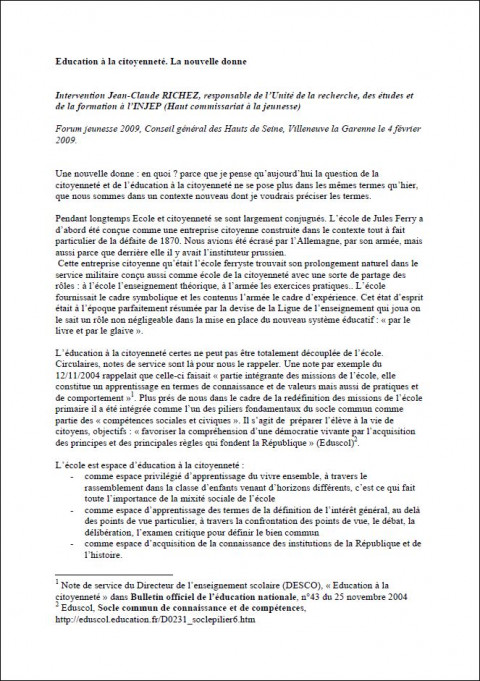 Éducation à la citoyenneté. La nouvelle donne Year of publication: 2009 Author: Jean-Claude Richez Corporate author: Haut commissariat à la jeunesse «Je pense qu'aujourd'hui, la question de la citoyenneté et de l'éducation à la citoyenneté ne se pose plus dans les mêmes termes qu'hier. (...) Nous sommes dans un contexte nouveau dont je voudais préciser les termes.»Selon Jean-Claude Richez1, la prise en compte de la dimension non formelle de l'éducation à la citoyenneté est un enjeu fondamenal dans la société d'aujourd'hui. Il a précisé pourquoi lors d'une intervention au forum jeunesse organisé par le conseil général des Hauts-de-Seine.
  Securitisation, Counterterrorism and the Silencing of Dissent: The Educational Implications of Prevent Year of publication: 2016 Author: Aislinn O'Donnell Corporate author: Society for Educational Studies | Taylor & Francis This paper outlines some of the implications of counterterrorist legislation, including Prevent, for the pedagogical relationship and for educational institutions. The concept of ‘radicalization’, central to the Prevent Strategy, is one that is contested in the field of counterterrorism, yet educators are now expected to identify and refer students ‘at risk of radicalization’. Based on the experience of teaching IRA and INLA prisoners in the Republic of Ireland, the author outlines a set of philosophical and ethical principles that ought to underpin education. It is argued that education must not be subordinated to security and intelligence agendas on pragmatic, educational and ethical grounds. Securitisation, Counterterrorism and the Silencing of Dissent: The Educational Implications of Prevent Year of publication: 2016 Author: Aislinn O'Donnell Corporate author: Society for Educational Studies | Taylor & Francis Le présent document décrit quelques impacts de la législation antiterroriste, y compris la prévention, sur l’approche pédagogique et les établissements d'enseignement. Le concept de « radicalisation » qui figure au cœur de la stratégie « Prévenir » est contesté dans le domaine de la lutte contre le terrorisme. Toutefois, les éducateurs sont maintenant en mesure d'identifier et d’orienter les élèves « en voie de radicalisation ». Sur la base de l'expérience de l'enseignement dispensé aux prisonniers de l'IRA et de l'INLA dans la République d'Irlande, l'auteur décrit un ensemble de principes philosophiques et éthiques qui devraient soutenir l'éducation. On fait valoir l’idée que l'éducation ne doit pas être subordonnée aux questions de sécurité et de renseignement pour des raisons pragmatiques, éducatives et éthiques.
 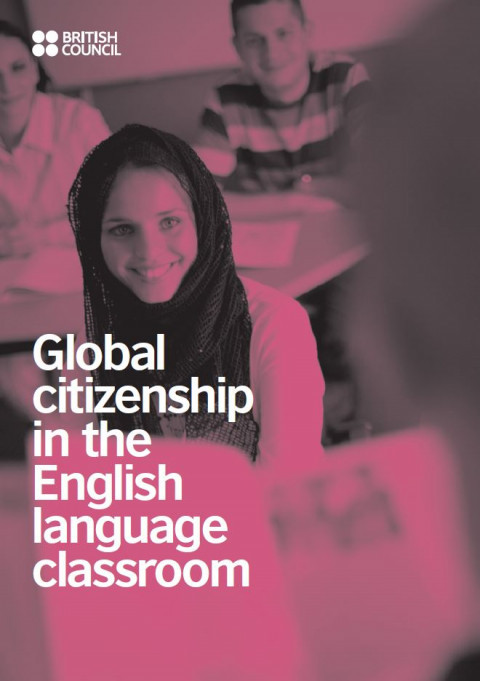 Global Citizenship in the English Language Classroom Year of publication: 2008 Author: Susan Hillyard | Elena Tarasheva | Clarissa Jordão | Francisco Fogaça | Esperanza Revelo Jiménez | Sabiha Khuram | Telma Gimenez | Vanessa Andeotti Corporate author: British Council This booklet contains a collection of papers on global citizenship in language education around the world. It provides theoretical frameworks and practical applications in different contexts.Following on from Audrey Osler and Hugh Starkey’s 'Citizenship and Language Learning: international perspectives', published in 2005, this collection aims at offering ideas and practical suggestions on how teachers around the world have tackled the teaching of English within a citizenship education perspective. There are seven chapters, from authors working in different parts of the world, such as Argentina, Bulgaria, Brazil, Colombia, and Pakistan.There are five report style chapters that deal with courses, teaching materials, research and curriculum innovation. The two remaining contributions can be seen as proposals for implementation of a global citizenship perspective in English language classrooms.The diverse interpretations teachers of English around the world have been giving to the task of promoting global citizenship in their classrooms are reflected in this collection with understandings that range from a more prescriptive approach to a transformational one. They bring the potential for new approaches to be tried out in different contexts. The aim is to inspire teachers to experiment and evaluate the results.