
Resources
Explore a wide range of valuable resources on GCED to deepen your understanding and enhance your research, advocacy, teaching, and learning.
874 Results found
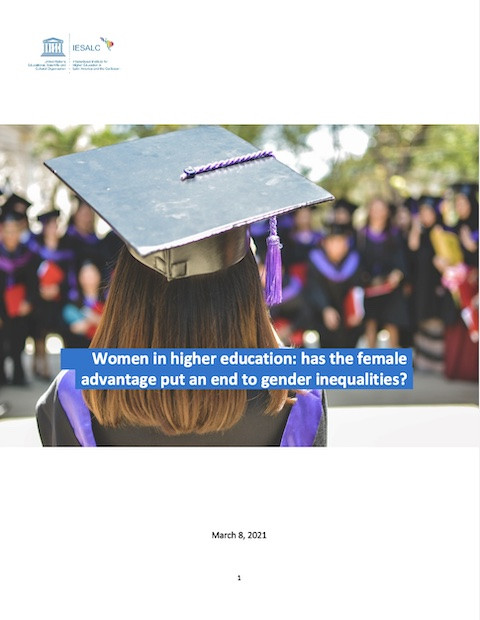 Women in Higher Education: Has the Female Advantage Put an End to Gender Inequalities? Year of publication: 2021 Author: Daniele Vieira do Nascimento | Takudzwa Mutize | Jaime Felix Roser Chinchilla Corporate author: UNESCO Regardless of encouraging statistics on women access to higher education, women still encounter obstacles when seeking to occupy key academic positions in universities, to be involved with relevant research, and to take leadership roles.Women are overrepresented among teaching staff at lower education levels, while their presence is markedly lower in tertiary education (vertical segregation). The same is true in school management and education policymaking. Women are also still underrepresented as senior faculty and in higher education decision-making bodies in many countries.In the area of research, men publish on average more articles than women showing there is a gender publication gap. Differences in men ́s and women ́s academic publication persist and are most pronounced for publications in top journals.STEM (science, technology, engineering, and mathematics) areas of study show a heavy underrepresentation of female students in most countries. This underrepresentation of female students is closely linked to the underrepresentation of female researchers in those areas. Globally, the percentage of females studying engineering, manufacturing and construction or ICT (information and communications technology) is below 25% in over two- thirds of countries.During the first wave of the COVID-19 pandemic, although submission of academic papers for publication increased in all months during the lockdown period, the rate of increase in submissions by female researchers was significantly less than those by male researchers. This deficit was also found to be especially pronounced among younger cohorts of female academics. Mujeres en la educación superior: ¿la ventaja femenina ha puesto fin a las desigualdades de género? Year of publication: 2021 Author: Daniele Vieira do Nascimento | Takudzwa Mutize | Jaime Felix Roser Chinchilla Corporate author: Organización de las Naciones Unidas para la Educación, la Ciencia y la Cultura (UNESCO) Aunque son alentadoras las estadísticas sobre el acceso de las mujeres a la enseñanza superior, las mujeres siguen topándose con obstáculos cuando intentan ejercer puestos académicos clave en las universidades, participar en investigaciones relevantes y asumir funciones de liderazgo.Las mujeres están sobrerrepresentadas entre el personal docente de los niveles educativos inferiores, mientras que su presencia es notablemente menor en la enseñanza superior (segregación vertical). Lo mismo ocurre en los puestos de dirección de centros educativos y en la elaboración de las políticas educativas. En muchos países, las mujeres siguen estando infrarrepresentadas en los niveles superiores del profesorado y en los órganos de decisión de la enseñanza superior.En el ámbito de la investigación, los hombres publican en promedio más artículos que las mujeres, lo que demuestra que existe una brecha de publicación entre ambos sexos. Las diferencias entre la cantidad de publicaciones académicas de hombres y la de mujeres persisten y son más acentuadas cuando se trata de publicaciones en las revistas más destacadas. En las áreas de estudio STEM (ciencia, tecnología, ingeniería y matemáticas) se observa una fuerte infrarrepresentación de las estudiantes en la mayoría de los países. Esta infrarrepresentación de las estudiantes guarda estrecha relación con la infrarrepresentación de las investigadoras en esas áreas. A escala mundial, el porcentaje de mujeres que estudian ingeniería, industria y construcción o tecnologías de la información y la comunicación (TIC) se ubica por debajo del 25 % en más de dos tercios de los países.
  Caribbean Sheroes Initiative: Civil Society Organizations Advancing Gender Equality; Methods & Tools Year of publication: 2021 Author: Joan Andrea Hutchinson Corporate author: Institute for Gender and Development Studies (IGDS) | UNESCO This Toolkit recognizes the achievements and commitment of women activists that engage in Civil Society Organizations (CSOs). It documents the practice and lessons learned of twelve Jamaican Civil Society Organizations that have worked relentlessly to advance women’s rights and social justice, fostering a less violent society and more equal gender relations grounded on human rights.
 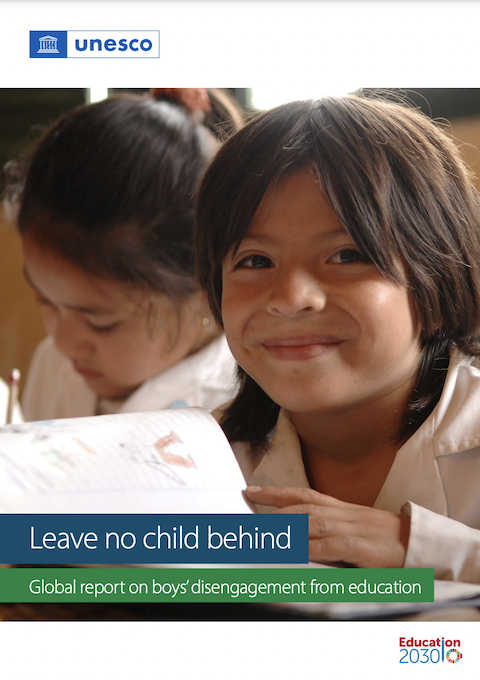 Leave No Child Behind: Global Report on Boys’ Disengagement From Education Year of publication: 2022 Corporate author: UNESCO The 2030 Agenda for Sustainable Development makes the promise to leave no one behind. While improving educational opportunities for girls globally continues to be of paramount importance to achieve gender equality in and through education, this focus on achieving gender parity and equality must not ignore boys. No less than 132 million boys of primary and secondary school age are out of school. To leave no child behind, UNESCO developed the first global report of this scope on boys’ disengagement from education, bringing together qualitative and quantitative evidence from over 140 countries. As this report shows, addressing boys’ disengagement from and disadvantage in education is not a zero-sum game. Supporting boys does not mean that girls lose out and vice versa. Addressing boys’ disengagement from and disadvantage in education not only benefits boys’ learning, employment opportunities, income and well-being, but it also benefits girls and the broader society.
 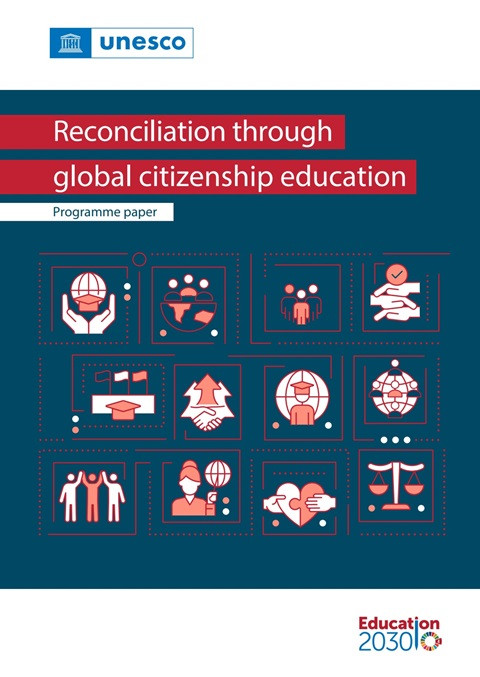 Reconciliation through Global Citizenship Education Year of publication: 2023 Corporate author: UNESCO This document zeroes in on how concepts of GCED and reconciliation are addressed in current research and practice and aims to provide existing grounds and future considerations for policy-makers concerned with reconciliation through education.
  2017 International Conference on Education and the Holocaust: Progress Report and Follow-up Year of publication: 2018 Corporate author: UNESCO | United States Holocaust Memorial Museum (USHMM) From December 4-8 2017, UNESCO and the United States Holocaust Memorial Museum (USHMM) jointly organized the second International Conference on Education and the Holocaust (ICEH) in Washington, DC. The conference brought together 26 participants from 10 countries with the goal of strengthening their capacities to advance education about the Holocaust and genocide in their respective countries. Of great importance was the relevance of this education within the teams’ national contexts. The conference ultimately led to the development of 10 country-specific initiatives. The 2017 ICEH cohort comprises representatives of institutions from Argentina, Colombia, India, Indonesia, Kenya, Mexico, Namibia, South Africa, Tunisia and Ukraine.
  Return to the Origin: Ancient Narratives about Humanity, Time and the World Year of publication: 2022 Author: Eduardo A. Rueda | Ana María Larrea | Augusto Castro | Óscar Bonilla | Nicolás Rueda | Carlos Guzmán Corporate author: Latin American Council of Social Sciences (CLACSO) | UNESCO In this brief reflection, only in an introductory way, two questions are addressed. The first has to do with the relevance or impertinence of a program to record the narratives of our original peoples about the origins and trajectories of humanity. In relation to this first point, they are interested in proposing the bases for an emancipatory approach, that is, counter-hegemonic, of the original narratives. The second question asks about the consequences that it has, for the self-understanding of the crises and tensions of current societies, to highlight non-Western conceptions of human origins and trajectories. Retornar al origen: Narrativas ancestrales sobre humanidad, tiempo y mundo Year of publication: 2022 Author: Eduardo A. Rueda | Ana María Larrea | Augusto Castro | Óscar Bonilla | Nicolás Rueda | Carlos Guzmán Corporate author: Latin American Council of Social Sciences (CLACSO) | Organización de las Naciones Unidas para la Educación, la Ciencia y la Cultura (UNESCO) En esta breve reflexión se abordan, apenas de modo introductorio, dos cuestiones. La primera tiene que ver con la pertinencia o impertinencia de un programa de registro de las narrativas de nuestros pueblos originarios sobre los orígenes y trayectorias de la humanidad. Les interesa, en relación con este primer punto, proponer las bases para un abordaje emancipatorio, es decir, contrahegemónico, de las narrativas originarias. La segunda cuestión se interroga por las consecuencias que tiene, para la autocomprensión de las crisis y tensiones de las sociedades actuales, poner en evidencia concepciones no occidentales de los orígenes y las trayectorias humanas.
  Educación y diversidad cultural: Lecciones desde la práctica innovadora en América Latina Year of publication: 2008 Author: Carolina Hirmas R. Corporate author: Organización de las Naciones Unidas para la Educación, la Ciencia y la Cultura (UNESCO) Esta publicación, que constituye el segundo volumen de la colección, es el resultado del análisis y la reflexión acerca de un conjunto experiencias educati- vas innovadoras de varios países de Latinoamérica, que responden con pertinen- cia pedagógica al contexto cultural de los estudiantes y ofrecen una educación orientada al conocimiento, comprensión y diálogo entre personas de diferentes culturas. El aporte significativo de las experiencias referidas, reside en el reco- nocimiento y valoración de la diversidad étnica y cultural de sus estudiantes y comunidades, como punto de partida para el desarrollo de nuevos aprendizajes y afirmación de su identidad. A su vez, la vida en los centros educativos promueve relaciones interculturales de respeto y fraternidad en un contexto sociogeográfico local y subregional, caracterizado por la multiculturalidad.
  UNESCO Science Report: The Race Against Time for Smarter Development Year of publication: 2021 Author: Susan Schneegans | Tiffany Straza | Jake Lewis Corporate author: UNESCO This seventh edition of the report monitors the development path that countries have been following over the past five years from the perspective of science governance. It documents the rapid societal transformation under way, which offers new opportunities for social and economic experimentation but also risks exacerbating social inequalities, unless safeguards are put in place.The report concludes that countries will need to invest more in research and innovation, if they are to succeed in their dual digital and green transition. More than 30 countries have already raised their research spending since 2014, in line with their commitment to the Sustainable Development Goals. Despite this progress, eight out of ten countries still devote less than 1% of GDP to research, perpetuating their dependence on foreign technologies.