
Resources
Explore a wide range of valuable resources on GCED to deepen your understanding and enhance your research, advocacy, teaching, and learning.
3,451 Results found
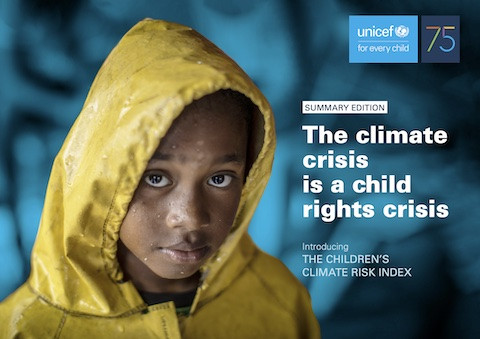 [Summary] The Climate Crisis Is a Child Rights Crisis: Introducing the Children’s Climate Risk Index Year of publication: 2021 Author: Nicholas Rees | Margaretha Barkhof | Jan Burdziej | Sophie Lee | Harriet Riley Corporate author: United Nations Children's Fund (UNICEF) The climate crisis is a child rights crisis. Recent record heat waves, wildfires and flooding in many countries portend a challenging ‘new normal’. The impacts of climate change are clear. So are the solutions. It is unconscionable that today’s children and young people face an uncertain future.Around the world, through protests, social media activity and community and civic engagement, children and young people are loud and clearin demanding change. The old ways of doing things are not good enough.This report provides the first comprehensive view of children’s exposure and vulnerability to the impacts of climate change through the Children’s Climate Risk Index (CCRI). [Resumen] La crisis climática es una crisis de los derechos de la infancia: Presentación del Índice de Riesgo Climático de la Infancia Year of publication: 2021 Author: Nicholas Rees | Margaretha Barkhof | Jan Burdziej | Sophie Lee | Harriet Riley Corporate author: United Nations Children's Fund (UNICEF) La crisis climática es una crisis de los derechos de la infancia. El carácter extremo de las olas de calor, los incendios forestales y las inundaciones que hemos presenciado recientemente en muchos países son el presagio de una adversa “nueva normalidad”. Los efectos del cambio climático son evidentes. Pero también lo son las soluciones. Es inconcebible que los niños y jóvenes de hoy se enfrenten a un futuro incierto. En todo el mundo, con sus protestas, su actividad en las redes sociales y su compromiso comunitario y cívico, son numerosos los niños y los jóvenes que exigen un cambio en voz alta y con claridad. La forma tradicional de hacer las cosas no sirve de mucho. Este informe ofrece la primera panorámica integral de la exposición y vulnerabilidad de los niños a los efectos del cambio climático a través del Índice de Riesgo Climático de la Infancia (IRCI).
 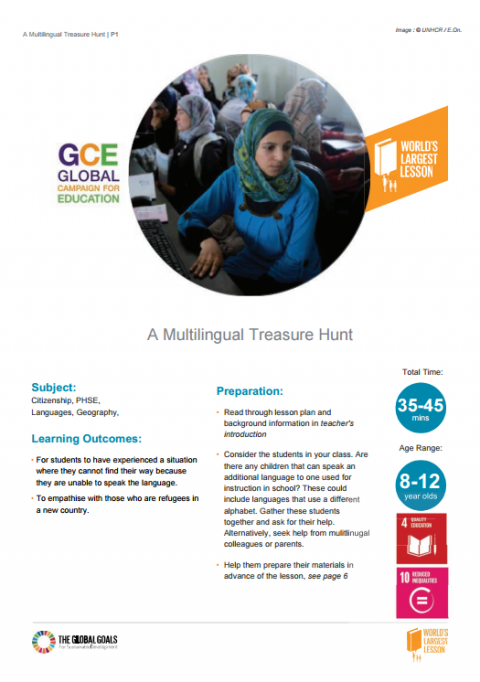 A Multilingual Treasure Hunt Corporate author: United Nations Children's Fund (UNICEF) World’s Largest Lesson is a collaborative education project to support the announcement of the United Nations Global Goals for Sustainable Development. Learning outcomes of the project: • For students to have experienced a situation where they cannot find their way because they are unable to speak the language. • To empathise with those who are refugees in a new country.
 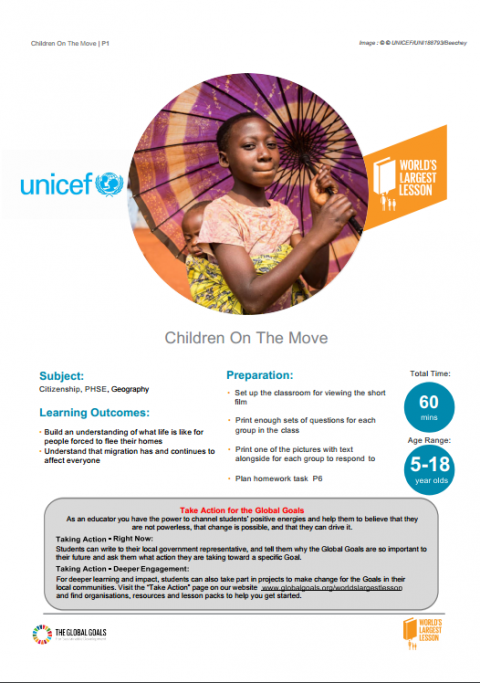 Children on the Move Corporate author: United Nations Children's Fund (UNICEF) World’s Largest Lesson is a collaborative education project to support the announcement of the United Nations Global Goals for Sustainable Development. Learning outcomes of the project: • Build an understanding of what life is like for people forced to flee their homes • Understand that migration has and continues to affect everyone
 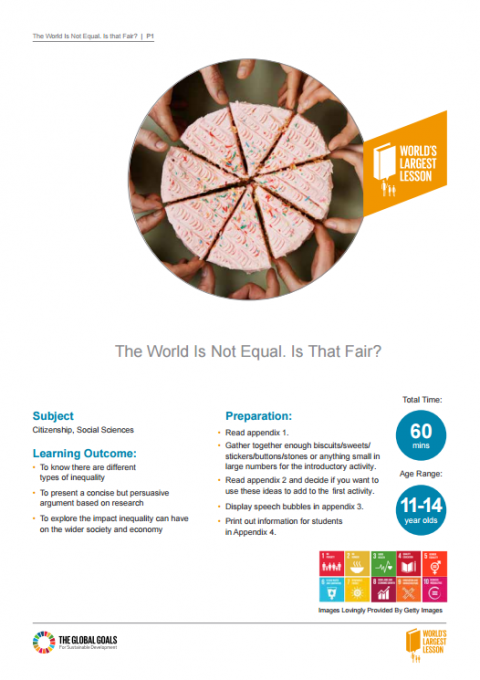 The World Is Not Equal. Is That Fair? Corporate author: United Nations Children's Fund (UNICEF) World’s Largest Lesson is a collaborative education project to support the announcement of the United Nations Global Goals for Sustainable Development. Learning outcomes of the project: • To know there are different types of inequality • To present a concise but persuasive argument based on research • To explore the impact inequality can have on the wider society and economy
  From Justice for the Past to Peace and Inclusion for the Future: A Development Approach to Transitional Justice Year of publication: 2020 Author: Lorena Mellado | Chelsea Shelton | Aparna Basnyat | Krishna Velupillai | Chris Mahoney | Djordje Djordjević Corporate author: United Nations Development Programme (UNDP) Comprehensive transitional justice processes supports the achievement of Agenda 2030, by promoting justice, peace, quality education and gender equality as a vehicle towards for more inclusive justice systems.Through more than 10 years, UNDP has been supporting transitional justice processes with an integrated approach to support sustaining peace. This strategic report covers a wide range of UNDP’s support to transitional justice processes providing good practices, country cases and key strategic alliances with UN partners, such as OHCHR, UN Women, and UN peace missions.The report looks to: Outline the main areas of UNDP’s work in transitional justice Share successful experiences and current challenges from countries around the world Offer recommendations for strategic transitional justice programmingThe key areas highlighted in the report are participatory processes, institutional transformation for proper accountability, reparations programmes and conflict prevention and sustaining peace to promote resilience and social cohesion for affected communities.Key lessons and recommendations are also outlined for practitioners to consider when designing and implementing transitional justice programmes and to draw out key findings and recommendations as well as identifies opportunities for more investment in transitional justice moving forward.
  Global Citizenship: Whitepaper About an Emerging Concept Year of publication: 2021 Corporate author: Melton Foundation The Melton Foundation is an active part of a larger community aiming to develop and promote the understanding of global citizenship as an overarching framework for thought and action. In this context, the Melton Foundation has developed this Whitepaper. This material aims to: Familiarize communities with the concept of Global Citizenship and provide an honest, clear picture of it. Analyze the current state of Global Citizenship, evaluate issues preventing its widespread adoption and put forward suggestive remedies.
 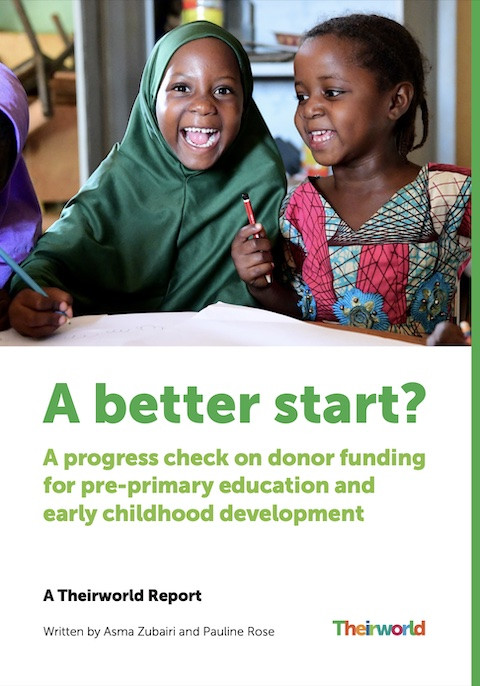 A Better Start?: A Progress Check on Donor Funding for Pre-Primary Education and Early Childhood Development Year of publication: 2021 Author: Asma Zubairi | Pauline Rose Corporate author: Theirworld This report focuses on aid trends to pre-primary education using data reported by donors to the Organisation for Economic Cooperation and Development (OECD) as Overseas Development Assistance. It updates our analysis from our 2019 Leaving the Youngest Behind report, which ranked donors’ performance on pre-primary education and looked at data from 2002 to 2016. The new report tracks whether donors are meeting Theirworld’s recommended target of investing at least 10% of their education aid budget on pre-primary education.
  Indigenous Peoples and the United Nations Human Right System Year of publication: 2013 Corporate author: UN Human Rights Council The United Nations general assembly approved the United Nations declaration on the rights of indigenous peoples on September 13, 2007. The rights of indigenous peoples have evolved based on current international law, including human rights treaties, and depending on the circumstances in which the communities found themselves and their priorities, such as the rights to their lands, territories, resources and self-determination. Unfortunately, many indigenous peoples continue to encounter problems in the field of human rights. Some of the greatest difficulties they face stem from the pressure on their lands, territories and resources as a result of their activities related to development and resource extraction. Los pueblos indigenas y el sistema de derechos humanos de las naciones unidas Year of publication: 2013 Corporate author: UN Human Rights Council La asamblea general de Las Naciones Unidas aprobó la declaración de Las Naciones Unidas sobre los derechos de los pueblos indigenas el 13 de septiembre de 2007. Los derechos de los pueblos indígenas han evolucionado partiendo del derecho internacional vigente, inlcuidos los tratados de derechos humanos, en función de las circunstacias en que se encontraban los pueblos y sus prioridades, como los derechos a sus tierras, territorios, recursos y a la libre determinación. Lamentablemente, muchos pueblos indigenas siguen encontrando problemas en la esfera de los derechos humanos. Algunas de las mayores dificultades a las que hacen frente derivan de la presión de que son objeto sus tierras, territorios y recursos como consecuencia de sus actividades relacionadas con el desarrollo y la extracción de recursos.