
Resources
Explore a wide range of valuable resources on GCED to deepen your understanding and enhance your research, advocacy, teaching, and learning.
1,407 Results found
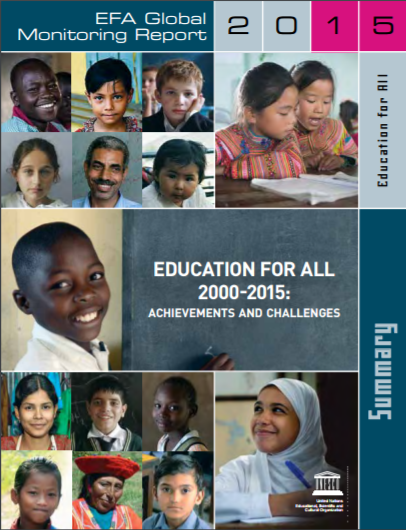 L'Education pour tous 2000-2015: progrès et enjeux, rapport mondial de suivi sur l'EPT, 2015, résumé Year of publication: 2015 Corporate author: Organisation des Nations Unies pour l'éducation, la science et la culture (UNESCO) At the World Education Forum in Dakar, Senegal, in 2000, governments from 164 countries, together with representatives of regional groups, international organizations, donor agencies, non-government organizations (NGOs) and civil society, adopted a Framework for Action to deliver Education for All (EFA) commitments. The Dakar Framework comprised 6 goals and their associated targets to be achieved by 2015, and 12 strategies to which all stakeholders would contribute. The EFA Global Monitoring Report (GMR) has monitored progress on an almost annual basis towards the EFA goals and the two education-related Millennium Development Goals (MDGs). The 2015 GMR provides a complete assessment of progress since 2000 towards the target date for reaching the Dakar Framework’s goals. It takes stock of whether the world achieved the EFA goals and stakeholders upheld their commitments. It explains possible determinants of the pace of progress. Finally, it identifies key lessons for shaping the post-2015 global education agenda.
 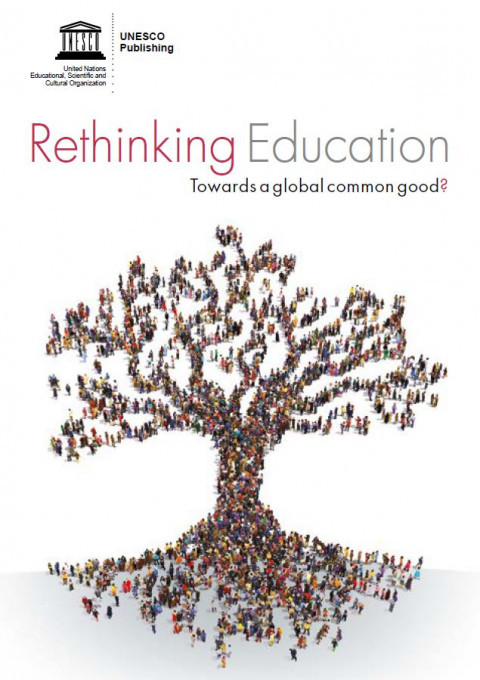 Rethinking Education: Towards a Global Common Good? Year of publication: 2015 Corporate author: UNESCO The changes in the world today are characterized by new levels of complexity and contradiction. These changes generate tensions for which education is expected to prepare individuals and communities by giving them the capability to adapt and to respond. This publication contributes to rethinking education and learning in this context. It builds on one of UNESCO’s main tasks as a global observatory of social transformation with the objective of stimulating public policy debate.It is a call for dialogue among all stakeholders. It is inspired by a humanistic vision of education and development, based on respect for life and human dignity, equal rights, social justice, cultural diversity, international solidarity, and shared responsibility for a sustainable future. These are the fundamentals of our common humanity. This book enhances the vision provided by the two landmark UNESCO publications: Learning to Be: The world of education today and tomorrow (1972), the ‘Faure Report’, and Learning: The treasure within (1996), the ‘Delors Report’.
  All human beings... a manual for human rights education Year of publication: 1998 Author: Kaisa Savolainen | Francine Best | Patrice Meyer-Bisch | Betty Reardon Corporate author: UNESCO The World Conference on Human Rights (Vienna, 1993) took the position that human rights education, training and public information were essential in order to create and promote stable and harmonious relations among different communities and to foster mutual understanding, tolerance and peace.UNESCO has prepared this Manual for Human Rights Education as a contribution to the fiftieth anniversary of the Universal Declaration of Human Rights on 10 December 1998 and to the United Nations Decade for Human Rights Education (1995–2004). While intended mainly for educators, it may also be useful to secondary-school students and in the context of non-formal education.The Manual is the result of teamwork, with participation by numerous educators and experts from various regions of the world. A preliminary version was submitted to the delegates of UNESCO Member States at the 29th session of the Organization’s General Conference and has since been tested in several schools throughout the world.The Manual is addressed to primary- and secondary-school teachers and to instructors in non-formal education for children and adults. It is a teaching aid providing both theory and practical advice. However, parts of it can be used directly, without any teacher, by young people from the age of 14 upwards.Part 1 sets out an approach to the concepts essential if human rights education is to be rigorous, have a scientific basis, expand knowledge and promote thought. This part is to be read by teachers who wish to impart human rights education. It can be understood by secondary students aged 14 and over. It incorporates the basic components of the Declaration and Integrated Framework of Action on Education for Peace, Human Rights and Democracy (1994).Part 2 is addressed to schoolteachers and those in positions of responsibility. It is essentially a tool for teaching. It opens up avenues, makes suggestions and gives advice on how all educational disciplines can embrace the objectives inherent in human rights education. Obviously all teachers are free, in the light of their own cultures and individual pedagogical choices, to invent and create approaches and situations different from those suggested here.Part 3 presents a number of pedagogical examples that have been tried out and that provide an approach for educational work concerning a specific right. The plan follows that of the Universal Declaration of Human Rights, which is quoted and referred to at length. This part may be regarded as an educational demonstration of the features of this declaration, the fiftieth anniversary of which is being celebrated by UNESCO and the United Nations in 1998.All teachers and organizers can be guided by the experiments presented here to encourage information, training and reflection. There is no need to follow any particular order. As the need arises, a particular right (such as the right to health care or the right to live in a well-balanced environment) can be introduced before or after another right, or the focus may be on a single right.The Manual does not seek to be exhaustive but rather to propose material which can be developed and supplemented in an ongoing process. It will be for educators and learners, in their own cultural contexts, to discover how human rights can acquire meaning in their daily lives. Tous les êtres humains ... un manuel pour l'éducation aux droits de l'homme Year of publication: 1998 Author: Kaisa Savolainen | Francine Best | Patrice Meyer-Bisch | Betty Reardon Corporate author: Organisation des Nations Unies pour l'éducation, la science et la culture (UNESCO) La Conférence Mondiale sur les Droits de l'Homme (Vienne, 1993) a pris la position que l'éducation aux droits de l'homme, la formation et l'information du public sont essentiels afin de créer et de promouvoir des relations stables et harmonieuses entre les différentes communautés et de favoriser la compréhension mutuelle, la tolérance et la paix. L'UNESCO a préparé ce manuel pour l'éducation aux droits de l'homme en tant que contribution au cinquantième anniversaire de la Déclaration Universelle des Droits de l'Homme, le 10 Décembre,1998 et à la Décennie des Nations Unies pour l'Éducation aux Droits Humains (1995-2004). Bien que destiné principalement aux éducateurs, il peut également être utile pour les élèves du secondaire et dans le cadre de l'éducation non formelle. Le manuel est le résultat du travail d'équipe, avec la participation de nombreux éducateurs et experts de différentes régions du monde. Une version préliminaire a été soumis aux délégués des Etats membres de l'UNESCO à la 29e session de la Conférence générale de l'Organisation et a depuis été testé dans plusieurs écoles à travers le monde. Le manuel est adressé au primaire et les enseignants du secondaire et aux instructeurs dans l'éducation non formelle pour les enfants et les adultes. Il est un outil pédagogique fournissant à la fois la théorie et des conseils pratiques. Toutefois, certaines parties peuvent être utilisées directement, sans enseignant, par les jeunes dès l'âge de 14 vers le haut. Partie 1 énonce une approche des concepts essentiels si l'éducation aux droits de l'homme est d'être rigoureux, ont une base scientifique, développer les connaissances et promouvoir la pensée. Cette partie doit être lu par les enseignants qui souhaitent donner une éducation aux droits de l'homme. Il peut être compris par les élèves du secondaire âgés de 14 ans et plus. Il intègre les composants de base de la Déclaration et Cadre d'action intégré concernant l'éducation pour la paix, droits de l'homme et la démocratie (1994). Partie 2 est adressée aux enseignants et ceux des postes de responsabilité. Il est essentiellement un outil pour l'enseignement. Il ouvre des pistes, fait des suggestions et donne des conseils sur la façon dont toutes les disciplines d'enseignement peuvent embrasser les objectifs inhérents à l'éducation des droits de l'homme. Il est évident que tous les enseignants sont libres, à la lumière de leurs propres cultures et les choix pédagogiques individuels, d'inventer et de créer des approches et des situations différentes de celles suggérées ici. Partie 3 présente un certain nombre d'exemples pédagogiques qui ont été expérimentées et qui fournissent une approche pour le travail éducatif concernant un droit spécifique. Le plan suit celle de la Déclaration universelle des droits de l'homme, qui est cité et renvoyé à la longueur. Cette partie peut être considérée comme une démonstration éducative des caractéristiques de cette déclaration, le cinquantième anniversaire de ce qui est célébrée par l'UNESCO et l'Organisation des Nations Unies en 1998. Tous les enseignants et les organisateurs peuvent être guidés par les expériences présentées ici pour encourager l'information, la formation et de réflexion. Il n'y a pas besoin de suivre un ordre particulier. Comme le besoin, un droit particulier (tel que le droit aux soins de santé ou le droit de vivre dans un environnement bien équilibré) peut être introduit avant ou après un autre droit, ou la mise au point peut être sur une seule droite. Le manuel ne cherche pas à être exhaustive, mais plutôt de proposer du matériel qui peut être développée et complétée en un processus continu. Ce sera pour les éducateurs et les apprenants, dans leurs propres contextes culturels, de découvrir comment les droits humains peuvent acquérir un sens dans leur vie quotidienne.
  A Decade of progress on education for sustainable development: reflections from the UNESCO Chairs Programme Year of publication: 2017 Author: Michelsen, Gerd | Wells, Peter J. Corporate author: UNESCO The UNITWIN/UNESCO Chairs Programme, launched in 1992, today forms an extensive network of inter-university cooperation involving more than 700 higher education institutions in 128 countries worldwide. Through knowledge sharing and collaborative research in the priority areas of UNESCO’s work in education, the natural and social sciences, culture, communication and information, the Chairs provide a vital contribution to the Organization’s mission. The current volume focuses on the activities undertaken by UNESCO Chairs dedicated to the field of Education for Sustainable Development (ESD) within the context of the UN Decade of ESD which culminated in the UNESCO World Conference on ESD, held in AichiNagoya, Japan, 2014. The case studies included, showcase the good practices, applied research and curricula innovations pioneered by the individual UNESCO Chairs, as well as highlighting the challenges and lessons learned both for the new follow-up Global Action Programme (GAP) on ESD and the wider Education 2030 Agenda.
  Education 2030: Incheon Declaration and Framework for Action for the Implementation of Sustainable Development Goal 4: Ensure Inclusive and Equitable Quality Education and Promote Lifelong Learning Opportunities for All Year of publication: 2016 Corporate author: UNESCO The Incheon Declaration articulates the collective vision and commitment of the international community on global education. The 2030 Framework for Action provides guidance for the implementation of Sustainable Development Goal 4.
 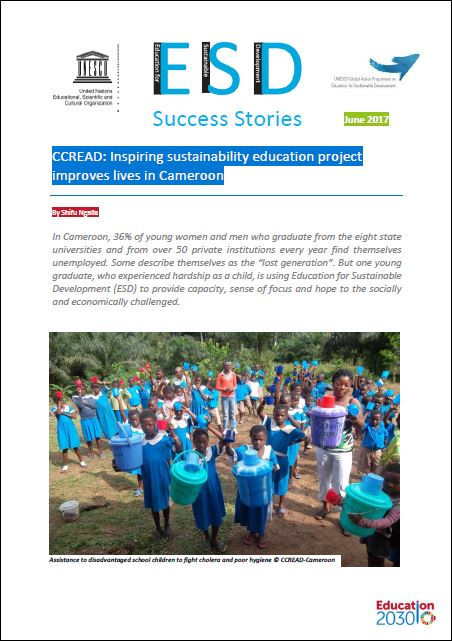 CCREAD: Inspiring Sustainability Education Project Improves Lives in Cameroon Year of publication: 2017 Author: Shifu Ngalla Corporate author: UNESCO This article is about sustainability education project in Cameroon. In Cameroon, 36% of young women and men who graduate from the eight state universities and from over 50 private institutions every year find themselves unemployed. Some describe themselves as the “lost generation”. But one young graduate, who experienced hardship as a child, is using Education for Sustainable Development (ESD) to provide capacity, sense of focus and hope to the socially and economically challenged. CCREAD: Un Projet d’éducation au Développement Durable Améliore des Vies au Cameroun Year of publication: 2017 Author: Shifu Ngalla Corporate author: Organisation des Nations Unies pour l'éducation, la science et la culture (UNESCO) Ceci est un article sur le projet d'éducation à la durabilité au Cameroun.Chaque année au Cameroun, 36% des jeunes femmes et hommes qui obtiennent leur diplôme dans l’une des huit universités d’État et dans plus de 50 institutions privées se retrouvent sans-emploi. Certains d'entre eux se décrivent comme une « génération perdue ». Cependant, un jeune diplômé qui a vécu une expérience douloureuse pendant son enfance utilise l’Éducation au Développement Durable (EDD) afin de former et redonner de l’espoir aux jeunes défavorisés au niveau social et économique. CCREAD: Un Estimulante Proyecto Sobre Educación para la Sostenibilidad Mejora la Vida en el Camerún Year of publication: 2017 Author: Shifu Ngalla Corporate author: Organización de las Naciones Unidas para la Educación, la Ciencia y la Cultura (UNESCO) Este es un artículo acerca de proyecto sobre el educación para la sostenibilidad en Camerún.En el Camerún, 36% de las mujeres y de los hombres jóvenes que se gradúan anualmente en alguna de las ocho universidades estatales o en alguna de las 50 instituciones privadas se encuentran sin empleo. Algunos se describen a sí mismos como la “generación perdida”. Pero un joven diplomado que experimentó dificultades cuando era niño está utilizando la educación para el desarrollo sostenible (EDS) como un medio para proporcionar capacidades, centrar mejor las prioridades y dar esperanza a las personas social y económicamente desfavorecidas. Education 2030: Déclaration d'Incheon et Cadre d'action pour la mise en oeuvre de l'Objectif de développement durable 4: Assurer à tous une éducation équitable, inclusive et de qualité et des possibilités d'apprentissage tout au long de la vie Year of publication: 2016 Corporate author: Organisation des Nations Unies pour l'éducation, la science et la culture (UNESCO) La Déclaration d’Incheon présente la vision collective et l’engagement de la communauté internationale envers l’éducation mondiale. Le Cadre d’action 2030 fournit des directives pour l’attente de l’Objectif de développement durable 4.