
Resources
Explore a wide range of valuable resources on GCED to deepen your understanding and enhance your research, advocacy, teaching, and learning.
874 Results found
 Peace Education Toolkit Year of publication: 2013 Author: Luz Marfa Chapela Corporate author: UNESCO The Peace Education Toolkit is made up of a series of recommended materials for basic education students and teachers. It includes books, stories and various pedagogical tools. Caja de herramientas en educación para la paz Year of publication: 2013 Author: Luz Marfa Chapela Corporate author: Organización de las Naciones Unidas para la Educación, la Ciencia y la Cultura (UNESCO) La caja de herramientas en educación para la paz se compone de una seria de materiales recomendados para estudiantes y maestros de educación básica. Incluye libros, historias y diversas herramientas pedagógicas.
  Homophobic and Transphobic Bullying in Educational Centers: Awareness Workshop for its Prevention; Facilitation Guide Year of publication: 2015 Corporate author: UNESCO This publication presents strategies for teachers and educational authorities with the aim of addressing homophobic and transphobic violence from a Human Rights perspective. Through lessons that incorporate concepts, activities and reflections, it underlines the importance of respect for sexual diversity through the acquisition of knowledge, and the strengthening of teaching skills to overcome stigmas and prejudices. El Bullying Homofóbico y Transfóbico en los Centros Educativos: Taller de Sensibilización Para Su Prevención; Guía de Facilitación Year of publication: 2015 Corporate author: Organización de las Naciones Unidas para la Educación, la Ciencia y la Cultura (UNESCO) Esta publicación formula estrategias de apoyo a los docentes y las autoridades educativas con el objetivo de abordar la violencia homofóbica y transfóbica desde un enfoque de Derechos Humanos. A través de lecciones que incorporan conceptos, actividades y reflexiones, subraya la importancia del respeto a la diversidad sexual mediante la adquisición de conocimientos, y el fortalecimiento de competencias docentes para superar estigmas y prejuicios.
  Textbooks and Inclusive Education: Background Paper Prepared for the 2020 Global Education Monitoring Report, Inclusion and Education Year of publication: 2020 Author: Eckhardt Fuchs | Marcus Otto | Simiao Yu Corporate author: UNESCO | Global Education Monitoring Report Team This report, based on an analysis of a sample of textbooks from 28 countries, shows that the subject of inclusion has become increasingly significant in terms of both structure and subject matter, and particularly in the contexts of human rights and citizenship. Social diversity is also increasingly taken into account and reflected upon, albeit with varying emphasis on the differing dimensions of diversity, given that genuinely intersectional perspectives via which these are linked only occur in isolated and rudimentary cases. With regard to inclusiveness in the gender-related dimension, the overall picture of the textbook sample under analysis here is a heterogeneous one; further, the incorporation of LGTBQIA+ perspectives remains insufficient. Nevertheless, the textbooks examined here do show increasing critical reflection on the social discrimination of different groups, and, ultimately, we do observe a significant trend towards a more pronounced consideration and representation of different social groups and minorities.
  Dialogue for Prevention Year of publication: 2025 Corporate author: UNESCO In an era where geopolitical power struggles disrupt traditional peacebuilding, where identity and misinformation fuel divisions, and where trust in institutions is eroding, UNESCO’s Intercultural Dialogue for Conflict Transformation briefs series presents an adaptable, culturally grounded, and people-centred approach to peacebuilding. With 1.5 billion people living in contexts with low intercultural dialogue where global challenges such as absolute poverty, terrorism and forced displacement are more prevalent, this four-part series draws on firsthand experience, country case studies, and expert analysis to demonstrate the transformative potential of dialogue in fragile and conflict-sensitive settings. The Dialogue for Prevention brief, developed with the Auschwitz Institute for the Prevention of Genocide and Mass Atrocities, explores the powerful role intercultural dialogue can play in preventing large-scale identity-based violence, particularly in the upstream and downstream phases of conflict. Grounded in the idea that dialogue can bridge divides and foster mutual understanding, the brief argues that enabling environments for intercultural dialogue—marked by stability, inclusive governance, freedom of expression, horizontal equality, and social cohesion—also mitigate key risk factors for atrocity violence. Drawing on diverse examples from Cambodia, Colombia, Italy, and Kenya, it showcases creative, context specific applications of dialogue. Through practical guidance, the brief equips policymakers, practitioners and civil society seeking to embed dialogue into prevention strategies.
  Hydro Resilience: Citizen and Open Science for Climate Adaptation Year of publication: 2024 Corporate author: UNESCO Human-induced climate change is affecting weather and climate extremes worldwide and causing changes in the atmosphere, ocean, cryosphere and biosphere leading to widespread adverse impacts on people and nature. These conditions have exposed people to reduced water security and negatively affected food security and ecosystem services. Despite advances in climate and water sciences, there is still a significant gap between information availability and its uptake by stakeholders. Although there is abundant data and information available on the potential impacts of climate change, there is a lack of expert knowledge on the user side, which limits the development and implementation of effective adaptation strategies at the local level. There is also an opportunity to bring communities more on board to manage their climate risk through citizen engagement and to ensure that vulnerable communities can benefit from climate science foresight. To address these challenges, a new project was developed called ‘Hydro Resilience: Citizen and Open Science for Climate Adaptation’ to pilot citizen and open science applications for climate risk management and to support water management under climate change uncertainty.
  Assessment for Advocacy to Transform Communities, Programmes and Policies in the Global South Year of publication: 2024 Corporate author: UNESCO | Global Education Monitoring Report Team | PAL Network This paper was commissioned by the Global Education Monitoring Report as background information to assist in drafting the 2024 Spotlight Report on basic education completion and foundational learning in Africa. It has not been edited by the team. The views and opinions expressed in this paper are those of the author(s) and should not be attributed to the Global Education Monitoring Report or to UNESCO. The papers can be cited with the following reference: “Paper commissioned for the 2024 Spotlight Report on basic education completion and foundational learning in Africa”.
 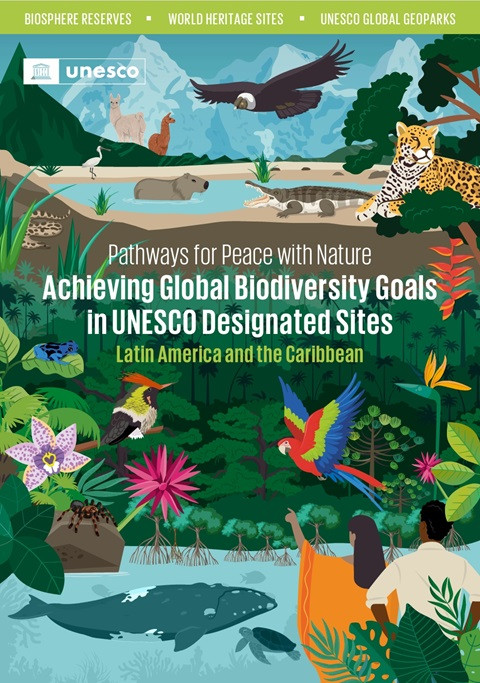 Pathways for Peace with Nature: Achieving Global Biodiversity Goals in UNESCO Designated Sites; Latin America and the Caribbean Year of publication: 2024 Corporate author: UNESCO UNESCO designated sites in Latin America and the Caribbean harbour over 60% of the region’s mapped species richness, i.e. over 14,000 species of mammals, reptiles, amphibians, birds, and fishes. They are also important for strengthening culture and nature linkages. However, biodiversity in these sites is threatened by human pressures and climate change and countries should take urgent action to halt and reverse biodiversity loss.This publication provides a regional overview of the status and trends of species in UNESCO designated sites, as well as key information to facilitate dialogue among all stakeholders. Additionally, it promotes the development of effective actions aimed at achieving global biodiversity goals.
  Inaugural Meeting of the GCED Actors' Platform: Final Report Year of publication: 2020 Corporate author: APCEIU This final report gives an overview of discussions and outcomes from the “Inaugural Meeting of the GCED Actors’ Platform” on 2 September 2019 in Seoul, Republic of Korea, held back-to-back with the 4th International Conference on GCED (3-4 September 2019, Seoul) In line with the call for closer collaboration on GCED inter-regionally, the GCED Actors’ Platform was launched by UNESCO Headquarters and APCEIU in 2019. Convening regional coordinators and different partners working on GCED, the “Inaugural Meeting of the GCED Actors’ Platform” provided an open space for the participants to discuss ways to coordinate activities and promote synergies.The regional representatives have imparted their own experiences and challenges on the ground and shared best practices of facilitating GCED.