
Resources
Explore a wide range of valuable resources on GCED to deepen your understanding and enhance your research, advocacy, teaching, and learning.
124 Results found
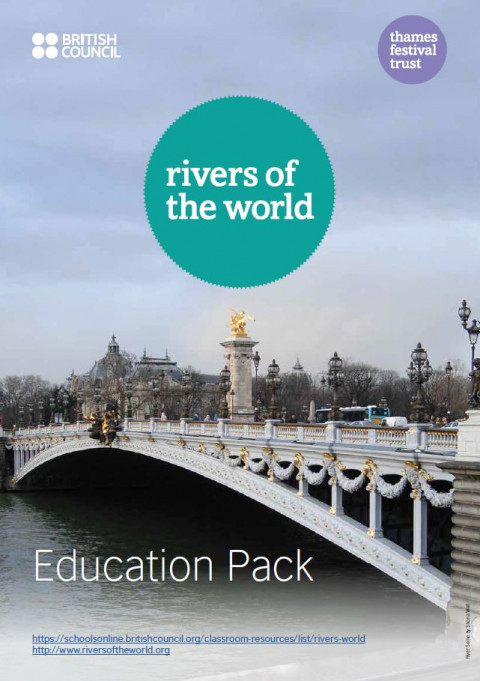 Rivers of the World Education Pack Year of publication: 2015 Author: Alison Willmott Corporate author: British Council This education resource pack extends the project’s reach to a much greater number of schools and provides a wealth of exciting cross-curricular activities for pupils aged 7–14. It is designed to expand knowledge and understanding, help your pupils to develop core skills and encourage them to explore and reflect on local and global issues. It also contains examples of artwork from the project and illustrations of how schools around the world have used the resources with their students.
  Learning the lessons of the Holocaust? A critical consideration of the antiracist and citizenship potential of Holocaust education in English secondary schools Year of publication: 2010 Author: Alice Pettigrew In this paper I draw upon data collected as part of a national study of current practice in Holocaust education within English secondary schools. The paper emphasises the importance placed by teachers from a variety of subject backgrounds upon study of the Holocaust as an opportunity to explore citizenship related and antiracist concerns. However, the paper also identifies and discusses a number of potential challenges and possible limitations apparent in this approach. (By the author) Tirer les leçons de l'Holocauste? Un examen critique du racisme et de la citoyenneté potentiel anti enseignement de l'Holocauste dans les écoles secondaires anglaises Year of publication: 2010 Author: Alice Pettigrew Dans cet article, je dessine sur les données recueillies dans le cadre d'une étude nationale de la pratique actuelle dans l'enseignement de l'Holocauste dans les écoles secondaires anglaises. Le document met l'aCECnt sur l'importance accordée par les enseignants à partir d'une variété de sujets d'horizons sur l'étude de l'Holocauste comme une occasion d'explorer la citoyenneté préoccupations connexes et antiracistes. Toutefois, le document identifie et examine un certain nombre de défis potentiels et les limites possibles apparentes dans cette approche également. (Par l'auteur) Securitisation, Counterterrorism and the Silencing of Dissent: The Educational Implications of Prevent Year of publication: 2016 Author: Aislinn O'Donnell Corporate author: Society for Educational Studies | Taylor & Francis This paper outlines some of the implications of counterterrorist legislation, including Prevent, for the pedagogical relationship and for educational institutions. The concept of ‘radicalization’, central to the Prevent Strategy, is one that is contested in the field of counterterrorism, yet educators are now expected to identify and refer students ‘at risk of radicalization’. Based on the experience of teaching IRA and INLA prisoners in the Republic of Ireland, the author outlines a set of philosophical and ethical principles that ought to underpin education. It is argued that education must not be subordinated to security and intelligence agendas on pragmatic, educational and ethical grounds. Securitisation, Counterterrorism and the Silencing of Dissent: The Educational Implications of Prevent Year of publication: 2016 Author: Aislinn O'Donnell Corporate author: Society for Educational Studies | Taylor & Francis Le présent document décrit quelques impacts de la législation antiterroriste, y compris la prévention, sur l’approche pédagogique et les établissements d'enseignement. Le concept de « radicalisation » qui figure au cœur de la stratégie « Prévenir » est contesté dans le domaine de la lutte contre le terrorisme. Toutefois, les éducateurs sont maintenant en mesure d'identifier et d’orienter les élèves « en voie de radicalisation ». Sur la base de l'expérience de l'enseignement dispensé aux prisonniers de l'IRA et de l'INLA dans la République d'Irlande, l'auteur décrit un ensemble de principes philosophiques et éthiques qui devraient soutenir l'éducation. On fait valoir l’idée que l'éducation ne doit pas être subordonnée aux questions de sécurité et de renseignement pour des raisons pragmatiques, éducatives et éthiques.
  Resilience, violent extremism and religious education Year of publication: 2013 Author: Joyce Miller This article is an attempt to provide an educational justification for the British Government-funded project REsilience, on addressing contentious issues through religious education (RE), which was carried out by the RE Council of England and Wales. A number of issues relating to the inclusion of religiously inspired violent extremism in the curriculum are raised – definitional, political and educational.
 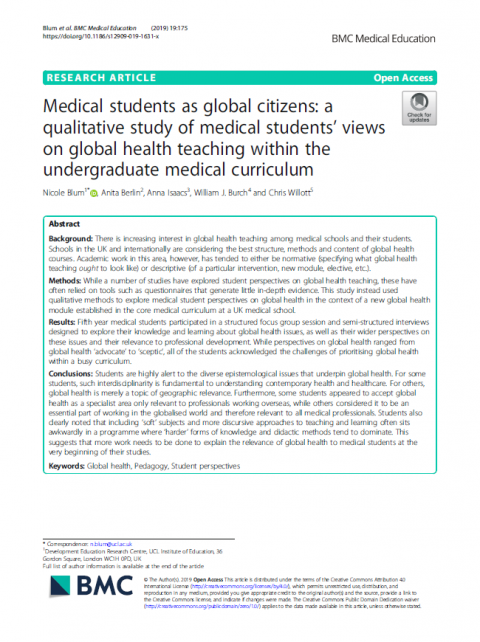 Medical students as global citizens: a qualitative study of medical students’ views on global health teaching within the undergraduate medical curriculum Year of publication: 2019 Author: Nicole Blum | Anita Berlin | Anna Isaacs | William J. Burch | Chris Willott The paper, entitled "Medical students as global citizens: a qualitative study of medical students’ views on global health teaching within the undergraduate medical curriculum", is based on a small-scale qualitative study with UCL(University College London) medical students. It aimed to explore Year 5 medical students’ knowledge and learning about global health issues, as well as their wider perspectives on its relevance to their professional development. The work builds on DERC(Development Education Research Centre)’s long-term interest in global issues within the initial training and professional development of a number of key global professions, such as teaching, medicine and engineering.
 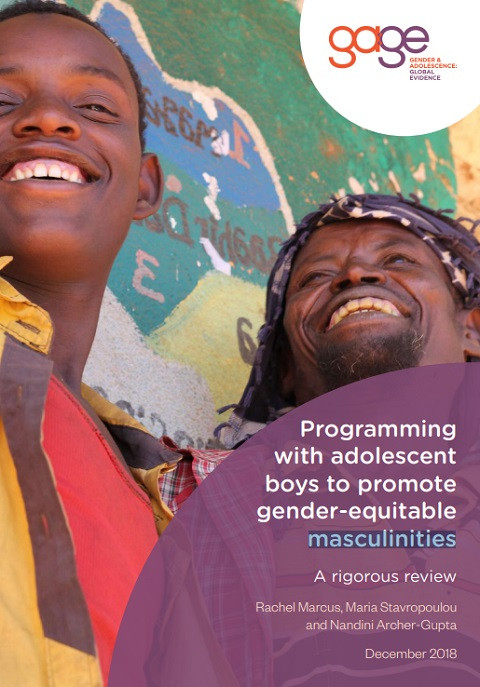 Programming with Adolescent Boys to Promote Gender-Equitable Masculinities: A Rigorous Review Year of publication: 2018 Author: Rachel Marcus | Maria Stavropoulou | Nandini Archer-Gupta Corporate author: Gender and Adolescence: Global Evidence (GAGE) | UK aid This review brings evidence from 36 studies of 34 programmes working with adolescent boys and young men to promote more gender-equitable masculinities. It draws on studies with a range of evaluation designs; the key requirements were adequate description of methodology and a valid comparison between participants and non-participants, or of attitudes and behaviour before and after participation.
 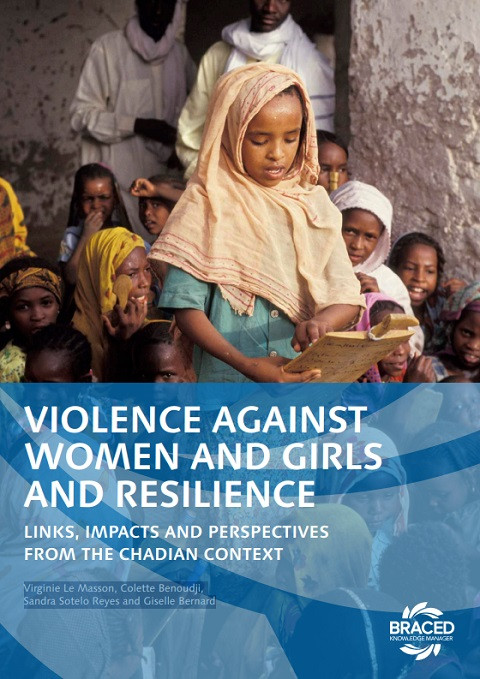 Violence against Women and Girls and Resilience: Links, Impacts and Perspectives from the Chadian Context Year of publication: 2017 Author: Virginie Le Masson | Colette Benoudji | Sandra Sotelo Reyes | Giselle Bernard Corporate author: Building Resilience and Adaptation to Climate Extremes and Disasters (BRACED) This report explores the links between gender-based violence (GBV), and the resilience shown by survivors, their households and the wider community. The purpose of this study is to explore two main questions: 1. How does violence against women and girls (VAWG) impact the processes of social change required to build resilience? 2. How can resilience programmes address VAWG? Les violences contre les femmes et les filles et la résilience: Quels liens ? quels enjeux ? quels impacts ? perspectives du contexte tchadien Year of publication: 2017 Author: Virginie Le Masson | Colette Benoudji | Sandra Sotelo Reyes | Giselle Bernard Corporate author: Building Resilience and Adaptation to Climate Extremes and Disasters (BRACED) Ce rapport explore les liens entre les violences basées sur le genre (VBG) qui affectent principalement les femmes et les filles, et la résilience des survivant(e) s, de leur foyer et de leur communauté. L’objectif de cette étude vise à explorer deux questions principales : 1. Comment les violences contre les femmes et les filles impactent-t-elles les processus de changements sociaux nécessaires au développement des capacités de résilience? 2. Comment les programmes de résilience peuvent-ils prendre en compte les violences perpétrées contre les femmes et les filles?