
Resources
Explore a wide range of valuable resources on GCED to deepen your understanding and enhance your research, advocacy, teaching, and learning.
1,450 Results found
 Las universidades públicas y el sentido común neoliberal: siete tesis iconoclastas Year of publication: 2014 Author: Carlos Alberto Torres Corporate author: Universidad Nacional de Tres de Febrero (UNTREF) El neoliberalismo ha fracasado completamente como un modelo viable de desarrollo económico, sin embargo, la política de la cultura asociada con el neoliberalismo sigue en vigor, convirtiéndose en el nuevo sentido común definiendo el rol del gobierno y de la educación. Este “sentido común“ se ha convertido en una ideología que juega un papel importante en la construcción de un liderazgo moral e intelectual hegemónico en las sociedades contemporáneas. La globalización neoliberal, basada en el predominio del mercado sobre el Estado y en modelos desregulados de gobierno, ha afectado profundamente a la universidad en el contexto del “capitalismo académico“. Las reformas resultantes, justificadas como avances en la competitividad internacional, han afectado a las universidades públicas en cuatro áreas principales: la eficiencia y la rendición de cuentas, la acreditación y universalización, la competitividad internacional y la privatización. También hay una creciente resistencia a la globalización y a las reformas impuestas de arriba hacia abajo reflejadas en los debates públicos sobre la reforma de la escolaridad, el currículo y la instrucción, la formación de docentes y la gestión escolar. Muchos se preguntan si las reformas neoliberales intentan limitar la eficacia de las universidades como lugares de disputa del orden nacional y global y así socavar los objetivos últimos de la educación. Las reformas neoliberales brindan un acceso y oportunidades limitadas según las clases y grupos raciales, incluyendo la restricción del acceso a la educación superior a través de la imposición de matrículas más costosas y la reducción del apoyo gubernamental a instituciones e individuos.
  Couleur? Quelle couleur? Rapport sur la lutte contre la discrimination et le racisme dans le football Year of publication: 2015 Author: Albrecht Sonntag | David Ranc Football has been shown to be a mirror of society, it may also be viewed as providing a temporary suspension of reality for an interlude of high emotion and idealized hopes and dreams. Football’s public transcends differences of age, gender, culture, religion, and socioeconomic status to unite in support of their team. The broad diversity of backgrounds of football players represents tangible evidence of equal opportunity and meritocracy. The sport itself has team solidarity, fair play and mutual respect among members and for opponents ingrained within its rules and practices. Yet, the ‘beautiful game’ is one with an imbedded paradox. Football is also a game that may in many vaguely resemble war, where opponents face each other in a struggle to win over the other side, with the noisy and emphatic support of the spectators. An ‘us’ and ‘them’ mentality is an integral part of trying to help a team reach the objective, which is to win the game. This setting naturally produces a desire by supporters to intimidate the other side by encouraging their team and expressing both confidence and superiority through their words and actions. When the ‘us’ and ‘them’ mentality turns into symbolic exclusion of others, language of disparagement and insult based on racism or discrimination, or physical confrontation, the ‘beautiful game’ is debased. The existence of racism and discrimination in football is not a secret, but it is a shame on the game. Although much is already being done, both observers and experts feel too many problems persist and measures to tackle them have not been effective enough. This report was commissioned by UNESCO within the framework of UNESCO’s partnership with Juventus. It focuses on discrimination and racism in professional football and to some extent the amateur clubs that funnel into the leagues. It provides an overview of the historic and theoretical background. It reports on the state of affairs on the ground. It summarizes what has been done and is being done to mitigate racism and discrimination in domestic and international football, how the effects of these actions may be evaluated, and which new avenues for further, complementary action are promising. The report is based on a literature review, desk research, regional reports from the Unesco network and a field survey among a purposive sample of experts and actors in a number of countries. The report has a somewhat European focus, in its sources and examples. Europe has a unique position Executive Summary in the world of football, with its leading competitions, championships and clubs. It is the region where racism and discrimination in football has been most intensively researched. A number of civil society organisations from Europe have played a pioneering role in the fight against racism and discrimination in football. Moreover, the pressure that comes with the money invested in and generated by western European football, as well as its exposure in the media, has also made clubs, federations and UEFA particularly sensitive to the negative impact that discrimination can have on the game and its image, within Europe and worldwide. Europe must therefore occupy a central role in a study of the fight against discrimination in professional football and in determined policies to mitigate racism and discrimination related to football wherever they occur. The examples of incidents of discrimination and racism, as well as of existing measures to combat them have been selected to be as wide-ranging as possible. The authors do not, however, claim the report to be a comprehensive listing. Similarly, the examples of best practice have been collected through extensive reading and contacts, but must be looked at as an overview rather than as a directory. They are chosen by the authors to illustrate types of actions and institutions with the potential for greatest impact. The report also does not deal with the methods of allocation of resources to football, with issues of employment, or with womens’ football. While these are significant topics on which concerns can be expressed, the necessary focus of a report of this type means that they are alluded to without being treated in depth. ¿Color?¿Qué color? Informe sobre la lucha contra el racismo y la discriminación en el fútbol Year of publication: 2015 Author: Albrecht Sonntag | David Ranc Football has been shown to be a mirror of society, it may also be viewed as providing a temporary suspension of reality for an interlude of high emotion and idealized hopes and dreams. Football’s public transcends differences of age, gender, culture, religion, and socioeconomic status to unite in support of their team. The broad diversity of backgrounds of football players represents tangible evidence of equal opportunity and meritocracy. The sport itself has team solidarity, fair play and mutual respect among members and for opponents ingrained within its rules and practices. Yet, the ‘beautiful game’ is one with an imbedded paradox. Football is also a game that may in many vaguely resemble war, where opponents face each other in a struggle to win over the other side, with the noisy and emphatic support of the spectators. An ‘us’ and ‘them’ mentality is an integral part of trying to help a team reach the objective, which is to win the game. This setting naturally produces a desire by supporters to intimidate the other side by encouraging their team and expressing both confidence and superiority through their words and actions. When the ‘us’ and ‘them’ mentality turns into symbolic exclusion of others, language of disparagement and insult based on racism or discrimination, or physical confrontation, the ‘beautiful game’ is debased. The existence of racism and discrimination in football is not a secret, but it is a shame on the game. Although much is already being done, both observers and experts feel too many problems persist and measures to tackle them have not been effective enough. This report was commissioned by UNESCO within the framework of UNESCO’s partnership with Juventus. It focuses on discrimination and racism in professional football and to some extent the amateur clubs that funnel into the leagues. It provides an overview of the historic and theoretical background. It reports on the state of affairs on the ground. It summarizes what has been done and is being done to mitigate racism and discrimination in domestic and international football, how the effects of these actions may be evaluated, and which new avenues for further, complementary action are promising. The report is based on a literature review, desk research, regional reports from the Unesco network and a field survey among a purposive sample of experts and actors in a number of countries. The report has a somewhat European focus, in its sources and examples. Europe has a unique position Executive Summary in the world of football, with its leading competitions, championships and clubs. It is the region where racism and discrimination in football has been most intensively researched. A number of civil society organisations from Europe have played a pioneering role in the fight against racism and discrimination in football. Moreover, the pressure that comes with the money invested in and generated by western European football, as well as its exposure in the media, has also made clubs, federations and UEFA particularly sensitive to the negative impact that discrimination can have on the game and its image, within Europe and worldwide. Europe must therefore occupy a central role in a study of the fight against discrimination in professional football and in determined policies to mitigate racism and discrimination related to football wherever they occur. The examples of incidents of discrimination and racism, as well as of existing measures to combat them have been selected to be as wide-ranging as possible. The authors do not, however, claim the report to be a comprehensive listing. Similarly, the examples of best practice have been collected through extensive reading and contacts, but must be looked at as an overview rather than as a directory. They are chosen by the authors to illustrate types of actions and institutions with the potential for greatest impact. The report also does not deal with the methods of allocation of resources to football, with issues of employment, or with womens’ football. While these are significant topics on which concerns can be expressed, the necessary focus of a report of this type means that they are alluded to without being treated in depth.
 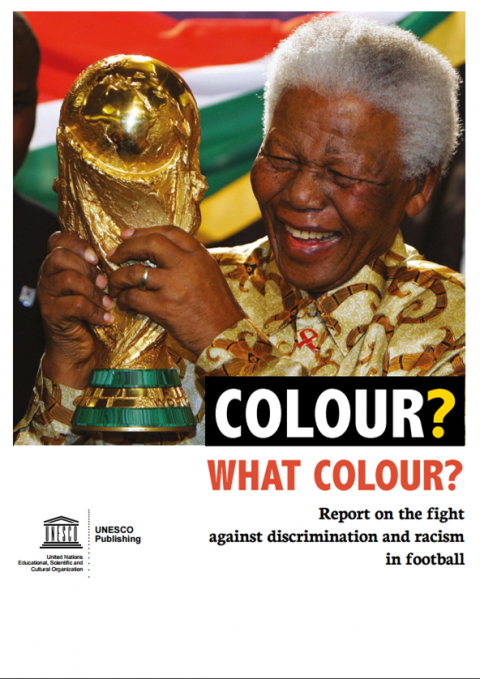 Colour? What colour? Relazione sulla lotta contro la discriminazione e il razzismo nel calcio Year of publication: 2015 Author: Albrecht Sonntag | David Ranc Football has been shown to be a mirror of society, it may also be viewed as providing a temporary suspension of reality for an interlude of high emotion and idealized hopes and dreams. Football’s public transcends differences of age, gender, culture, religion, and socioeconomic status to unite in support of their team. The broad diversity of backgrounds of football players represents tangible evidence of equal opportunity and meritocracy. The sport itself has team solidarity, fair play and mutual respect among members and for opponents ingrained within its rules and practices. Yet, the ‘beautiful game’ is one with an imbedded paradox. Football is also a game that may in many vaguely resemble war, where opponents face each other in a struggle to win over the other side, with the noisy and emphatic support of the spectators. An ‘us’ and ‘them’ mentality is an integral part of trying to help a team reach the objective, which is to win the game. This setting naturally produces a desire by supporters to intimidate the other side by encouraging their team and expressing both confidence and superiority through their words and actions. When the ‘us’ and ‘them’ mentality turns into symbolic exclusion of others, language of disparagement and insult based on racism or discrimination, or physical confrontation, the ‘beautiful game’ is debased. The existence of racism and discrimination in football is not a secret, but it is a shame on the game. Although much is already being done, both observers and experts feel too many problems persist and measures to tackle them have not been effective enough. This report was commissioned by UNESCO within the framework of UNESCO’s partnership with Juventus. It focuses on discrimination and racism in professional football and to some extent the amateur clubs that funnel into the leagues. It provides an overview of the historic and theoretical background. It reports on the state of affairs on the ground. It summarizes what has been done and is being done to mitigate racism and discrimination in domestic and international football, how the effects of these actions may be evaluated, and which new avenues for further, complementary action are promising. The report is based on a literature review, desk research, regional reports from the Unesco network and a field survey among a purposive sample of experts and actors in a number of countries. The report has a somewhat European focus, in its sources and examples. Europe has a unique position Executive Summary in the world of football, with its leading competitions, championships and clubs. It is the region where racism and discrimination in football has been most intensively researched. A number of civil society organisations from Europe have played a pioneering role in the fight against racism and discrimination in football. Moreover, the pressure that comes with the money invested in and generated by western European football, as well as its exposure in the media, has also made clubs, federations and UEFA particularly sensitive to the negative impact that discrimination can have on the game and its image, within Europe and worldwide. Europe must therefore occupy a central role in a study of the fight against discrimination in professional football and in determined policies to mitigate racism and discrimination related to football wherever they occur. The examples of incidents of discrimination and racism, as well as of existing measures to combat them have been selected to be as wide-ranging as possible. The authors do not, however, claim the report to be a comprehensive listing. Similarly, the examples of best practice have been collected through extensive reading and contacts, but must be looked at as an overview rather than as a directory. They are chosen by the authors to illustrate types of actions and institutions with the potential for greatest impact. The report also does not deal with the methods of allocation of resources to football, with issues of employment, or with womens’ football. While these are significant topics on which concerns can be expressed, the necessary focus of a report of this type means that they are alluded to without being treated in depth.
  Discussing Terrorism: a pupil-inspired guide to UK counter-terrorism policy implementation in religious education classroom in England Year of publication: 2016 Author: Angela Quartermaine Corporate author: Christian Education | Taylor & Francis Religious education (RE) in England is affected by the challenging of terrorist ideologies and improving community cohesion, but many RE teachers feel ill-equipped in dealing with the issues that might arise from terrorism discussions. Therefore, I suggest that clarification could help alleviate some of the teacher’s concerns and help provide routes by which critical RE teaching and learning can take place. Discussing Terrorism: a pupil-inspired guide to UK counter-terrorism policy implementation in religious education classroom in England Year of publication: 2016 Author: Angela Quartermaine Corporate author: Christian Education | Taylor & Francis L’éducation religieuse en Angleterre est affectée par les idéologies terroristes et le renforcement des liens communautaires. Dans ce contexte, de nombreux professeurs d’éducation religieuse se sentent insuffisamment équipés pour traiter des sujets qui peuvent découler de discussions relatives au terrorisme. Ainsi, une clarification permettrait de soulager leurs inquiétudes et d’offrir des pistes pour mettre en place une pédagogie adaptée.
  PREVENT: creating “radicals” to strengthen anti-Muslim narratives Year of publication: 2015 Author: Asim Qureshi Corporate author: Critical Studies on Terrorism The use of de-radicalization narratives in schools, universities and hospitals has led to the criminalization of large sections of the various Muslim communities in the UK. Based on different experiences we hope to present a view of how an aggressive anti-Muslim narrative that is based on assumptions subverts the political expression/identity of individuals by turning them into potential threats. By understanding the everyday interactions with PREVENT, a picture can be formed of the way that a false presentation of narratives can lead to a person becoming an “extremist” or “terrorist”, while the truth may lie in a completely alternative place. PREVENT: creating “radicals” to strengthen anti-Muslim narratives Year of publication: 2015 Author: Asim Qureshi Corporate author: Critical Studies on Terrorism L'utilisation des récits de déradicalisation dans les écoles, les universités et les hôpitaux a conduit à la criminalisation d’une fraction importante des différentes communautés musulmanes au Royaume-Uni. En se basant sur des expériences différentes, nous espérons montrer comment un récit agressif antimusulman qui se fonde sur des hypothèses bouleverse les opinions /l’identité des individus et les transforment en des menaces potentielles. Chercher à comprendre comment se font les interactions quotidiennes avec PREVENT permet de saisir comment une présentation erronée des récits de vie peut conduire à présenter une personne comme un « extrémiste » ou un « terroriste », alors que la réalité est tout à fait différente.
  It's about us!: reflections on education for active citizenship within the European Union Year of publication: 2013 Author: Milana Marcella, Tarozzi Massimiliano The article is structured in three main parts. Grounded in the scientific literature, the authors unpack the notion of citizenship as key educational concept based on multiple and diverse identities. Then, they outline the major steps undertaken at EU level to formalise and expand citizenship rights and to endorse citizenship education across the Union’s nationals, by showing that citizenship education is promoted more as a strategy for legitimising the Union rather than a participatory practice aimed at fostering democratic processes within Europe. Finally, they discuss the implications of these policy advancements from a social justice perspective, by advancing a critique of their political assumptions and, to some extent, the pedagogical approach they suggest.
  Global Citizenship Education in Canada and the U.S.: From Nation-Centric Multiculturalism to Youth Engagement Year of publication: 2020 Author: Sarah Ranco | Alexis Gilmer | Colleen Loomis Corporate author: Cham Springer This chapter examines the historical and current uses of global citizenship education (GCE) in Canada and the U.S. in public schools from primary through secondary levels, with attention to Canada as well as similarities and differences within and across the two countries. The authors assess how social and political contexts have influenced the definition and operationalization of multiculturalism, civic studies, and global studies in curricula, noting that the neo-liberal perspective has focused on making people an economic powerhouse rather than socially concerned global citizens. In their examination of educational approaches that relate to GCE, the authors present decolonizing pedagogies, the multiculturalism approach in Canada, as well as culturally responsive and anti-racist pedagogies. To illustrate these issues, the authors offer an example in the Canadian context and raise the need to prevent GCE from becoming yet another tool for hegemony by the Global North on the Global South, as dominant groups have long defined citizenship. They conclude by proposing that to realize GCE in these two countries, teacher/practitioner and local, national, and international actors must engage youth, and in doing so, power imbalances that prohibit becoming global citizens will be addressed.