
Resources
Explore a wide range of valuable resources on GCED to deepen your understanding and enhance your research, advocacy, teaching, and learning.
3,433 Results found
 Discours de Mme Irina Bokova, Directrice générale de l'UNESCO, à l'occasion de l'ouverture de l'Education Worldconférenceon UNESCO pour le développement durable; Aichi-Nagoya, au Japon, le 10 Novembre 2014 Year of publication: 2014 Author: UNESCO. Director-General, 2009-2017 (Bokova, I.G.) Corporate author: UNESCO. Director-General, 2009-2017 (Bokova, I.G.) Cette adresse par Irina Bokova, Directrice générale de l'UNESCO a été présenté à l'occasion de l'ouverture de la conférence mondiale de l'UNESCO sur l'éducation pour le développement durable.
  Guardians of Planet Earth: Gamification in Early Childhood Education Year of publication: 2020 Corporate author: Instituto Nacional de Tecnologías Educativas y de Formación del Profesorado (INTEF) The project "Inspiring Educational Experiences" is part of the Educational Digital Transformation Plan launched by INTEF, specifically "Guardians of planet Earth" whose main objective is the internalization by students of the importance of caring for our planet around three fundamental axes: recycling and treatment of waste, care of flora and fauna. With this, it intends to impregnate the students and their families with solid values that are internalized and endure over time and for this it uses different methodologies and active and participatory teaching strategies, in turn, favors the development of creativity and imagination in all activity of the project and explains how ICTs are a transversal element, offering the youngest population a variety of opportunities to use and enjoy technology. Guardian@s del planeta Tierra: Gamificación en Educación Infantil Year of publication: 2020 Corporate author: Instituto Nacional de Tecnologías Educativas y de Formación del Profesorado (INTEF) The project "Inspiring Educational Experiences" is part of the Educational Digital Transformation Plan launched by INTEF, specifically "Guardians of planet Earth" whose main objective is the internalization by students of the importance of caring for our planet around three fundamental axes: recycling and treatment of waste, care of flora and fauna. With this, it intends to impregnate the students and their families with solid values that are internalized and endure over time and for this it uses different methodologies and active and participatory teaching strategies, in turn, favors the development of creativity and imagination in all activity of the project and explains how ICTs are a transversal element, offering the youngest population a variety of opportunities to use and enjoy technology.
 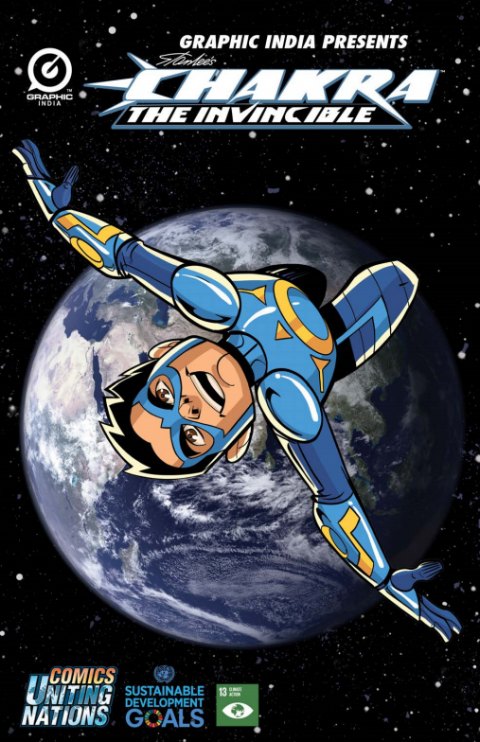 Chakra the Invincible: Climate Change Year of publication: 2015 Author: Stan Lee | Sharad Devarajan | Gotham Chopra | Ashwin Pande | Thiago Vale | Sesha Sainan Devarajan | Aditya Bidikar | Nilesh S. Mahadik | Rakesh B. Mahadik Corporate author: Graphic India Pte. ltd | POW Entertainment The legendary Stan Lee and Sharad Devarajan bring their character Chakra the Invincible to teach children about the global goals! Chakra and Mighty Girl learn from other children around the world how climate change is doing damage and spring into action!
 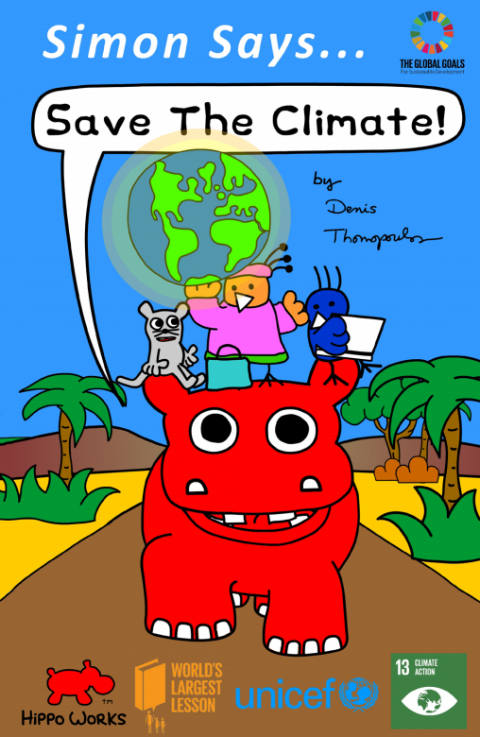 Simon says "Save the Climate" Author: Denis Thomopoulos Corporate author: Hippo Works | United Nations Girls' Education Initiative (UNGEI) Creator Hippo-Works, invites children to go on a song-filled cartoon adventure with Simon the Hippo and friends as they learn about the world's changing climate, the role that carbon dioxide and methane play, and the good eco habits we can all develop to help. Along their way the animals find out about topics such as the Greenhouse Effect, the Food Chain, the "Three Rs" (Reducing, Reusing, Recycling), Composting, and Carbon Offsetting.
 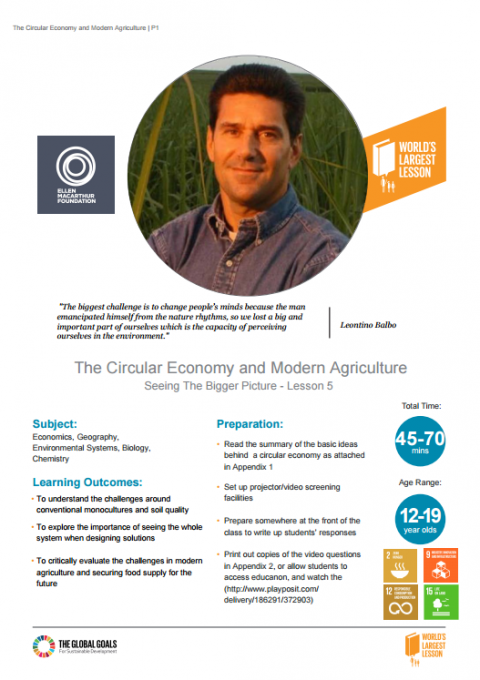 The Circular Economy and Modern Agriculture: Seeing The Bigger Picture - Lesson 5 Corporate author: United Nations Children's Fund (UNICEF) World’s Largest Lesson is a collaborative education project to support the announcement of the United Nations Global Goals for Sustainable Development. Learning outcomes of the project: • To understand the challenges around conventional monocultures and soil quality • To explore the importance of seeing the whole system when designing solutions • To critically evaluate the challenges in modern agriculture and securing food supply for the future
 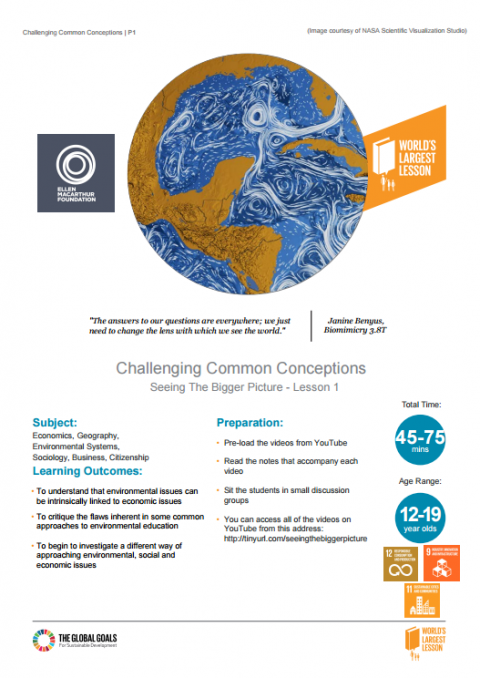 Challenging Common Conceptions: Seeing The Bigger Picture - Lesson 1 Corporate author: United Nations Children's Fund (UNICEF) World’s Largest Lesson is a collaborative education project to support the announcement of the United Nations Global Goals for Sustainable Development. Learning outcomes of the project: • To understand that environmental issues can be intrinsically linked to economic issues • To critique the flaws inherent in some common approaches to environmental education • To begin to investigate a different way of approaching environmental, social and economic issues
 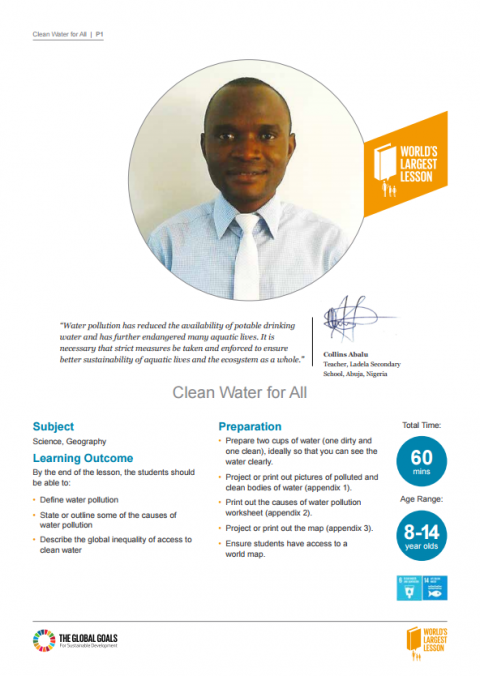 Clean Water for All Corporate author: United Nations Children's Fund (UNICEF) World’s Largest Lesson is a collaborative education project to support the announcement of the United Nations Global Goals for Sustainable Development. Learning outcome of the project: • Define water pollution • State or outline some of the causes of water pollution • Describe the global inequality of access to clean water Предлагаемая тематическая программа по образованию в области водных ресурсов в рамках Десятилетия образования в интересах устойчивого развития ООН (ДОУР, 2005-2014 ГГ.) Year of publication: 2006 Corporate author: International Hydrological Programme (IHP) Water education is a very important component of UNESCO’s overall effort in water, including within the International Hydrological Programme. The UNESCO Executive Board has called for a UNESCO-wide strategy for water education at all levels. This document reviews the evolution of water education within UNESCO, and draws attention to the Draft Action Plan for the UN Decade on Education for Sustainable Development (DESD), which includes 12 Thematic Programmes one of which would be devoted to “Education for Sustainable Water Management”. The IHP would be expected to play an important role in such a UNESCO-wide effort for water education.
  Status of water education in the context of the UN Decade of Education for Sustainable Development (DESD, 2005-2014) Year of publication: 2007 Corporate author: International Hydrological Programme (IHP) This document reports on the thematic programme “Education for Sustainable Water Management” of the UN Decade of Education for Sustainable Development (DESD), which is to be implemented under the leadership of UNESCO-IHP. As a follow-up to 166 EX/Decision 3.6.1 of the Executive Board of UNESCO and Resolution XVII-12 of the Intergovernmental Council of IHP, an intersectoral Working Group on Water Education was constituted and is operational. The Working Group developed a draft Work Plan, which is presented in Annex V for the endorsement of the Bureau.