
Resources
Explore a wide range of valuable resources on GCED to deepen your understanding and enhance your research, advocacy, teaching, and learning.
1,443 Results found
 Lessons Learned from Mental Health and Education: Identifying Best Practices for Addressing Violent Extremism Year of publication: 2015 Author: Stevan Weine | B. Heidi Ellis | Ron Haddad | Alisa B. Miller | Rebecca Lowenhaupt | Chloe Polutnik Corporate author: National Consortium for the Study of Terrorism and Responses to Terrorism (START) The overall purpose of this research was to identify assets from the mental health and education fields that could contribute to best practices for preventing and intervening against violent extremism. Specifically we aimed to address the following questions:1) What prior knowledge, programmes or interventions within the mental health and education fields could contribute to best practices and other strategies that could help stop violent extremism? 2) How can professionals from the mental health and education fields best become involved in stopping violent extremism? Lessons Learned from Mental Health and Education: Identifying Best Practices for Addressing Violent Extremism Year of publication: 2015 Author: Stevan Weine | B. Heidi Ellis | Ron Haddad | Alisa B. Miller | Rebecca Lowenhaupt | Chloe Polutnik Corporate author: National Consortium for the Study of Terrorism and Responses to Terrorism (START) Il s’agit dans cette recherche d'identifier des ressources dans le domaine de l'éducation à la santé mentale qui pourraient contribuer aux meilleures pratiques dans la prévention et l'intervention contre l'extrémisme violent. Plus précisément, les auteurs ont cherché à répondre aux questions suivantes : 1) Quelles sont les connaissances, les programmes ou les interventions requis dans le domaine de l'éducation à la santé mentale pouvant contribuer aux meilleures pratiques et autres stratégies dans la lutte contre l'extrémisme violent ? 2) Comment les professionnels de l'éducation à la santé mentale peuvent s’impliquer davantage dans la lutte contre l'extrémisme violent ?
  Education Reform in Pakistan Year of publication: 2014 Corporate author: International Crisis Group In April 2010, the eighteenth constitutional amendment committed Pakistan to free and compulsory education for all children between the ages of five and sixteen. Yet millions are still out of school, and the education system remains alarmingly impoverished. The madrasa (religious school) sector flourishes, with no meaningful efforts made to regulate the seminaries, many of which propagate religious and sectarian hatred. Militant violence and natural disasters have exacerbated the dismal state of education. The public education system needs to foster a tolerant citizenry, capable of competing in the labour market and supportive of democratic norms within the country and peace with the outside world. Education Reform in Pakistan Year of publication: 2014 Corporate author: International Crisis Group En Avril 2010, le Pakistan s’est engagé, l'amendement constitutionnel XVIII, à mettre en place une éducation gratuite et obligatoire pour tous les enfants âgés de cinq à seize ans. Pourtant, des millions d’enfants ne sont encore à l'école et le système éducatif s’appauvrit d’une façon alarmante. Le secteur de la madrasa (école religieuse) fleurit, sans que des efforts significatifs soient déployés pour réglementer les séminaires, qui propagent souvent la haine religieuse et le sectarisme. La violence militante et les catastrophes naturelles ont aggravé l'état lamentable de l'éducation. Le système public de l'éducation doit favoriser une citoyenneté tolérante, compétitive sur le marché du travail et apportant son soutien aux normes démocratiques dans le pays et à la paix avec le monde extérieur.
  Programa Mundial para Educação em Direitos Humanos: terceira fase, plano de ação Year of publication: 2015 Corporate author: UNESCO Brasilia | UN. Office of the United Nations High Commissioner for Human Rights (UN. OHCHR) De acordo com a Resolução 24/15 do Conselho de Direitos Humanos, o Escritório do Alto Comissariado das Nações Unidas para os Direitos Humanos (ACNUDH) elaborou, no primeiro trimestre de 2014, um esboço de plano de ação para a terceira fase (2015-2019) do Programa Mundial para Educação em Direitos Humanos (PMEDH) tomando como base, entre outros, importantes instrumentos e documentos das Nações Unidas, os planos de ação da primeira (2005- 2009) e da segunda (2010-2014) fases do PMEDH e outros materiais publicados pelo ACNUDH e pelas Nações Unidas. Em abril e maio, o esboço de plano de ação foi submetido à análise dos Estados, organizações intergovernamentais relevantes, incluindo a Organização das Nações Unidas para a Educação, a Ciência e a Cultura (UNESCO), instituições nacionais de direitos humanos e sociedade civil. Em 4 de julho, o ACNUDH recebeu 30 respostas com os comentários, os quais foram levados em consideração no texto final e que constituem as Seções de II a V do presente relatório.
  2023 Asia-Pacific Regional Global Citizenship Education (GCED): Network Activities Summary Report Year of publication: 2023 Author: Seek Ling Tan Corporate author: UNESCO Bangkok This is a summary report from the Global Citizenship Education (GCED) network activities in Asia-Pacific in 2023. The Asia-Pacific Regional Global Citizenship Education Network, spearheaded by UNESCO Bangkok and the Asia-Pacific Centre of Education for International Understanding (APCEIU), has illuminated the path to empower learners to become global citizens since its inception in 2018. In 2023, their journey was punctuated by significant milestones and a revitalized commitment to propel GCED across the region. This commitment is particularly evident in the key priority areas of advocacy, capacity building, learning/teaching materials, policy and research and the synergizing of regional collaboration towards Education 2030.
  Training of Trainers Report: For the Project on: Teacher Training and Development for Peace-Building in the Horn of Africa and Surrounding Countries Year of publication: 2017 Corporate author: UNESCO International Institute for Capacity-Building in Africa (IICBA) The overall framework of this project is to create a critical mass of teachers who can implement effective teaching and learning, producing economically productive and peace-loving youth. The project has a shortterm objective of training at least 8,000 young teachers through the Training of Trainers (TOT) model. The medium-term objectives will contribute to the 2030 SDGS. The long-term objectives are in line with AU’s Agenda 2063, which promotes increased regional integration, peace and stability, and equitable economic development. Training of Trainers Report: For the Project on: Teacher Training and Development for Peace-Building in the Horn of Africa and Surrounding Countries Year of publication: 2017 Corporate author: UNESCO International Institute for Capacity-Building in Africa (IICBA) The overall framework of this project is to create a critical mass of teachers who can implement effective teaching and learning, producing economically productive and peace-loving youth. The project has a shortterm objective of training at least 8,000 young teachers through the Training of Trainers (TOT) model. The medium-term objectives will contribute to the 2030 SDGS. The long-term objectives are in line with AU’s Agenda 2063, which promotes increased regional integration, peace and stability, and equitable economic development. Training of Trainers Report: For the Project on: Teacher Training and Development for Peace-Building in the Horn of Africa and Surrounding Countries Year of publication: 2017 Corporate author: UNESCO International Institute for Capacity-Building in Africa (IICBA) The overall framework of this project is to create a critical mass of teachers who can implement effective teaching and learning, producing economically productive and peace-loving youth. The project has a shortterm objective of training at least 8,000 young teachers through the Training of Trainers (TOT) model. The medium-term objectives will contribute to the 2030 SDGS. The long-term objectives are in line with AU’s Agenda 2063, which promotes increased regional integration, peace and stability, and equitable economic development.
 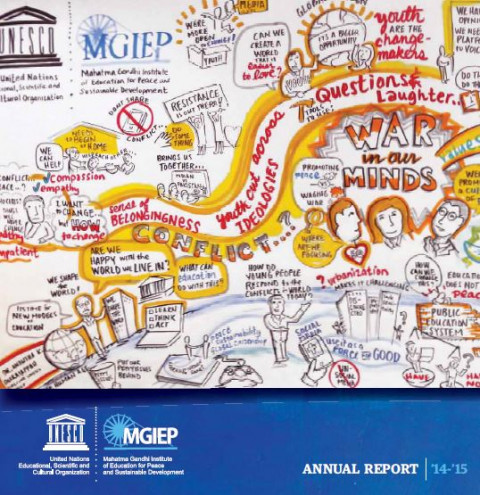 MGIEP Annual Report '14-'15 Year of publication: 2016 Corporate author: Mahatma Gandhi Institute of Education for Peace and Sustainable Development (MGIEP) The Mahatma Gandhi Institute of Education for Peace and Sustainable Development (MGIEP) is UNESCO’s first Category I institute in the Asia-Pacific region, established with the generous support of the Government of India. UNESCO MGIEP focuses on transforming current education policies and practices by developing innovative teaching and learning methods.Their objective is to build generations of young people equipped to create peaceful and sustainable societies. This annual report describes MGIEP’s main works and various educational programmes for peace and sustainable development.