
Resources
Explore a wide range of valuable resources on GCED to deepen your understanding and enhance your research, advocacy, teaching, and learning.
3,451 Results found
 Addressing language of instruction issues in education: recommendations for documenting progress Year of publication: 2016 Author: Carol Benson Corporate author: Columbia University (USA). Teachers College This paper offers evidence-based recommendations for documenting international progress towards addressing language issues in education. The focus is on adapting the school language(s) of instruction to the home language(s) of learners. The paper begins by defining terms like L1 and explaining the concepts underlying multilingual education (MLE). Next there is a discussion of how to capture relevant linguistic and educational information from policy documents and linguistic sources, with examples from lowincome countries. This is followed by a set of questions that can and should be asked of any program to evaluate progress in addressing instructional language issues, focusing on the approach/methodology, teacher languages and skills, learner assessment, and program management, monitoring and evaluation. The paper concludes with some possible global indicators and suggestions for further research.
  SDG Good Practices: A Compilation of Success Stories and Lessons Learned in SDG Implementation (1st Edition) Year of publication: 2020 Corporate author: UN. Department of Economic and Social Affairs (UN. DESA) This publication presents 16 SDG Good Practices from across the globe, received in response to the first open call for good practices, success stories and lessons learned in SDG implementation, promoted by UN DESA between 2018 and 2019.Sorted by geographical region, this publication describes the diverse examples in detail, featuring updates and reflections on the impact and adaptations to the COVID-19 pandemic and showcasing results and impact.As the world pursues a transformative recovery from COVID-19 and embarks on the Decade of Action for accelerating the implementation of the SDGs, it is hoped that these examples provide inspiration to Governments and stakeholders in their efforts to address crisis, reduce the risk of future potential emergencies and deliver on the ambitious and inclusive vision of the 2030 Agenda.
 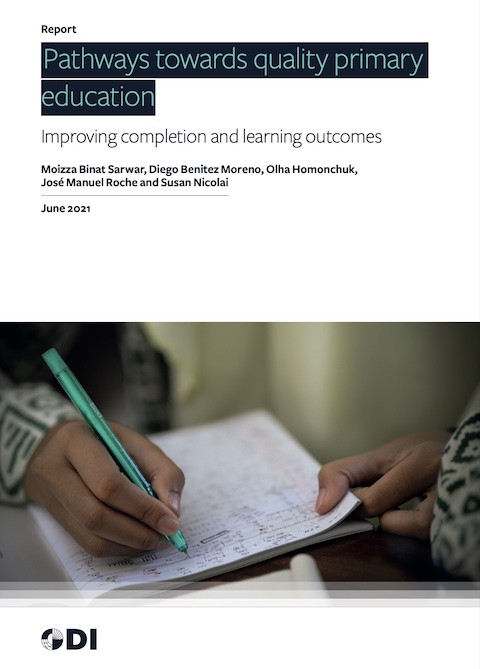 Pathways Towards Quality Primary Education: Improving Completion and Learning Outcomes Year of publication: 2021 Author: Moizza Binat Sarwar | Susan Nicolai | Diego Benitez Moreno | Olha Homonchuk | Jose Manuel Roche Corporate author: ODI Global This paper explores pathways towards quality primary education by identifying and analysing strategies used in 38 countries that have made faster progress in primary completion rates (PCR) – and, where discernible, learning outcomes – between 2000 and 2017. It further considers which social and economic groups within these countries are being left behind or excluded from the rise in completion rates, why that may be happening and what governments are doing to address those gaps.
 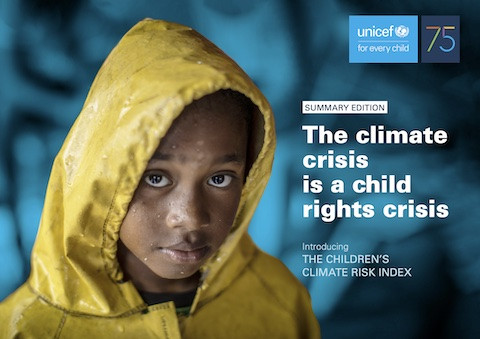 [Résumé] La crise climatique est une crise des droits de l’enfant: Présentation de l’indice des risques climatiques pour les enfants Year of publication: 2021 Author: Nicholas Rees | Margaretha Barkhof | Jan Burdziej | Sophie Lee | Harriet Riley Corporate author: United Nations Children's Fund (UNICEF) La crise climatique est une crise des droits de l’enfant. Les canicules, les incendies et les inondations sans précédent qui viennent de frapper plusieurs pays sont annonciateurs d’une nouvelle normalité climatique particulièrement hostile. L’impact des changements climatiques est connu de tous. Les solutions le sont également. Il est inadmissible que les enfants et les jeunes d’aujourd’hui soient confrontés à un avenir aussi incertain. Partout dans le monde, à travers des manifestations, des interventions sur les réseaux sociaux et un engagement communautaire et citoyen, les enfants et les jeunes revendiquent haut et fort le changement. Les modi operandi classiques ont fait long feu. Le présent rapport s’appuie sur l’Indice des risques climatiques pour les enfants (IRCE) pour fournir un premier aperçu de l’exposition et de la vulnérabilité des enfants aux effets des changements climatiques.
 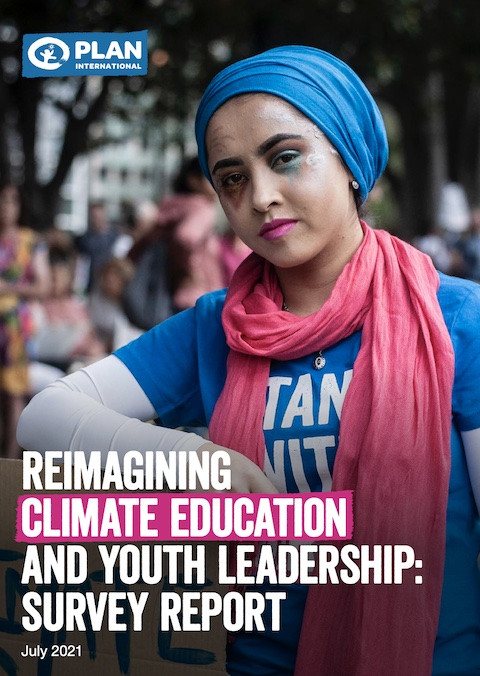 Reimagining Climate Education and Youth Leadership: Survey Report Year of publication: 2021 Author: Lucia Rost | Jessica Cooke | Isobel Fergus Corporate author: Plan International Climate change is a social, intergenerational, gender, and racial injustice. Plan International aims to support children and youth to meaningfully and safely engage in climate policy processes and to reduce the barriers preventing them from engaging in and influencing climate policy and advocacy.With this in mind, Plan International conducted a global online survey to capture the opinions and experiences of young people on climate change education and their participation in climate policy processes. The survey was available in seven languages and was open to 15 to 24-year- olds in all 77 countries where Plan International operates. Over 1,800 adolescents and youth, between the ages of 15 to 24, from 37 countries, participated: more than half (54 per cent) were 15 to 18 years old and 72 per cent were girls. Reimagining Climate Education and Youth Leadership: Survey Report Year of publication: 2021 Author: Lucia Rost | Jessica Cooke | Isobel Fergus Corporate author: Plan International El cambio climático es una injusticia social, intergeneracional, racial y de género. Plan International tiene como objetivo ayudar a las niñas, niños y jóvenes a involucrarse de manera significativa y segura en los procesos de formulación de políticas climáticas, así como eliminar los obstáculos que les impiden participar e influir en las políticas y las actividades de promoción relacionadas con el cambio climático. Plan International realizó una encuesta on line a nivel mundial para recopilar las opiniones y las experiencias de jóvenes sobre la educación en materia de cambio climático y su participación en los procesos de formulación de políticas climáticas. La encuesta se ofreció en siete idiomas y estuvo abierta a jóvenes de 15 a 24 años en los 77 países donde trabaja Plan International. En esta encuesta, participaron más de 1800 adolescentes y jóvenes, con edades comprendidas entre los 15 y los 24 años, y procedentes de 37 países: más de la mitad de las personas (54 %) tenían entre 15 y 18 años, y el 72 % eran niñas. Réinventer l’éducation au climat et le leadership des jeunes : Rapport d’enquête Year of publication: 2021 Author: Lucia Rost | Jessica Cooke | Isobel Fergus Corporate author: Plan International Le changement climatique est une injustice sociale, intergénérationnelle, de genre et raciale. Plan International vise à aider les enfants et les jeunes à participer de manière significative et en toute sécurité aux processus de politique climatique et à réduire les obstacles qui les empêchent de participer et d’influencer la politique et le plaidoyer climatiques.Dans ce cadre, Plan International a mené une enquête mondiale en ligne pour recueillir les opinions et les expériences des jeunes sur l’éducation au changement climatique et leur participation aux processus politiques climatiques. L’enquête était disponible en sept langues et était ouverte aux jeunes de 15 à 24 ans dans les 77 pays où Plan International intervient. Plus de 1800 adolescent.e.s et jeunes, âgés de 15 à 24 ans, originaires de 37 pays, y ont participé : plus de la moitié (54 %) avaient entre 15 et 18 ans et 72 % étaient des filles.
  School-Related Gender-Based Violence Measurement Toolkit Year of publication: 2020 Author: Dexis Consulting Group Corporate author: United States Agency for International Development (USAID) This toolkit delivers practical guidance and resources for measuring the prevalence and extent of students’ experiences of school-related gender-based violence (SRGBV), and provides methods for assessing key risk factors and drivers of SRGBV. This toolkit contains a conceptual framework for measuring SRGBV, a school- based survey for measuring experiences of SRGBV, risk factors, and drivers, as well as practical guidance for implementing the survey.
 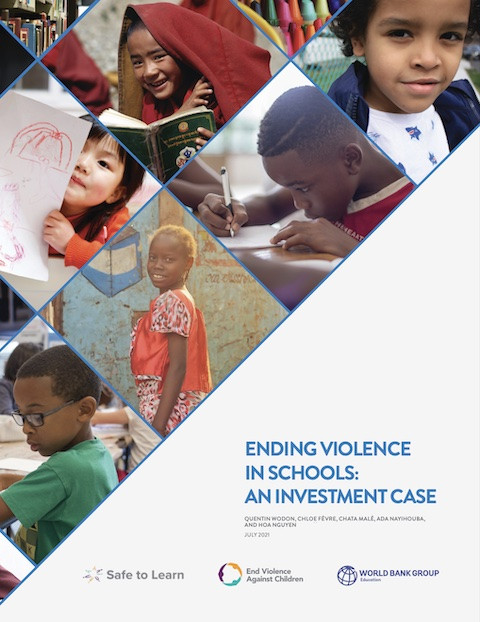 Ending Violence in Schools : An Investment Case Year of publication: 2021 Author: Quentin Wodon | Chloë Fèvre | Chata Malé | Ada Nayihouba | Hoa Nguyen Corporate author: World Bank Preventing violence in and through school is a prerequisite for girls and boys getting the education they need and deserve, and acquiring the skills, knowledge and values that provide the foundations for strong and inclusive societies. This report demonstrates that violence in and around schools negatively impacts educational outcomes, and society pays a heavy price as a result (with an estimate of $11 trillion in lost lifetime earnings). Cost-benefit analyses suggest that implementing interventions to prevent violence in and through schools from early childhood to secondary education is a smart economic investment. Rigorously evaluated programs and policies aimed at preventing violence at different levels of the education system show that action is feasible. The benefits of investing in preventing violence in and through schools is likely to far outweigh the costs.
 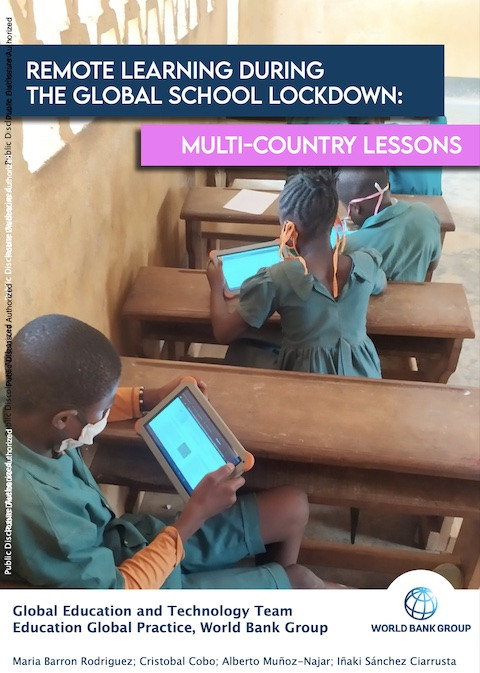 Remote Learning During the Global School Lockdown: Multi-Country Lessons Year of publication: 2020 Author: Maria Barron Rodriguez | Cristobal Cobo | Alberto Muñoz-Najar | Iñaki Sánchez Ciarrusta Corporate author: World Bank This study includes three main sections that have been organized in a chronological order within this report: the first one, “What can we learn from education emergency responses in low- and middle-income countries?” analyzes the emergency education responses to the COVID-19 pandemic of over 120 governments from April until May, 2020. The second section, “Is remote learning perceived as effective? An in-depth analysis across five countries” discusses the main national education responses deployed by Brazil, Kenya, Nigeria, Sierra Leone, and Peru, as well as the perceived effectiveness of these strategies conducted from May until August, 2020. The third section, “What works with remote and remedial strategies? an analysis across 13 countries” builds on key lessons learned during the analysis of the five multi-country experiences and presents global trends of remote learning implemented during school closures and the actions governments adopted to get ready for remedial learning, conducted from August until December 2020. The countries prioritized for the third section are IDA borrowing countries of which six are low-income countries: Afghanistan, Haiti, Malawi, Mozambique, Niger, and Rwanda; and five are lower-middle-income countries: Cambodia, Cameroon, Kenya, Nepal, and Pakistan. Additionally, two high-income countries, Estonia and Uruguay, have been included in the report. The main trends across this report are discussed below and have been grouped in five themes: (1) Adopt delivery systems with an inclusive approach; (2) Adjust the curriculum to ensure effectiveness; (3) Secure sustained teacher training and in-service support; (4) Leverage institutional capacities while ensuring sustained monitoring and evaluation; and (5) Consolidate national strategies to remediate learning losses.