
Resources
Explore a wide range of valuable resources on GCED to deepen your understanding and enhance your research, advocacy, teaching, and learning.
1,300 Results found
 Brights: Fostering Social Cohesion and Promoting Intercultural Dialogue and Democratic Values in Europe Year of publication: 2017 Corporate author: Brights Project | European Union (EU) | European Commission This leaflet presents brief information on an EU-funded project “BRIGHTS Project” implemented in Belgium, Croatia, Greece and Italy. The project aims to promote Global Citizenship Education (GCE) in formal and non-formal Educational contexts with the help of Digital Storytelling (DS) techniques, leading to more socially inclusive education and training policies and practices in Europe. BRIGHTS: Favoriser la cohésion sociale et promouvoir le dialogue interculturel et les valeurs démocratiques en Europe Year of publication: 2017 Corporate author: Brights Project | European Union (EU) | European Commission Cette brochure présente des informations succinctes sur « BRIGHTS », un projet financé par l’UE mis en œuvre en Belgique, en Croatie, en Grèce et en Italie. Ce projet vise à renforcer l’éducation à la citoyenneté mondiale (ECM) dans l’éducation formelle et non formelle à l’aide des techniques du digital storytelling (DS), ce qui mènera vers plus d’inclusion sociale dans l’enseignement et la formation en Europe.
  Youth Participation and Global Citizenship: Challenges and Recommendations for Future Youth School Forums Year of publication: 2016 Author: Anna Jarkiewicz | Joanna Leek Corporate author: Oxfam GB | University of S odz (Poland) The overall purpose of this report is to identify the needs of the Future School Youth Forums on youth participation and global citizenship education. The study synthesizes information from Cyprus, Italy, Lithuania, Poland and the United Kingdom in order to understand similarities and differences, and compare them with wider European trends to understand transversal needs across Europe. It discusses in greater detail the current application of global citizenship youth forums and global citizenship/youth participation in each of the 5 countries – and therefore across 7 national systems (as Wales and Scotland have their own systems), and also transversally across Europe. The report will help Partners to better understand the project’s needs, so that they can design project outputs more effectively.
 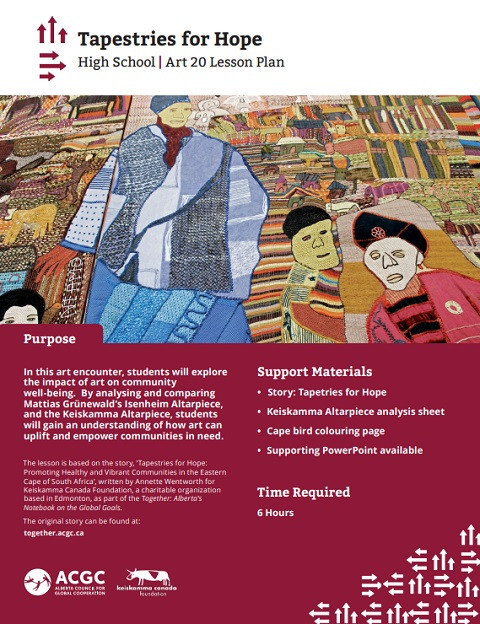 Tapestries for Hope: High School Art 20 Lesson Plan Year of publication: 2018 Corporate author: Alberta Council for Global Cooperation (ACGC) | Keiskamma Canada Foundation In this art encounter, students will explore the impact of art on community well-being. By analysing and comparing Mattias Grünewald’s Isenheim Altarpiece, and the Keiskamma Altarpiece, students will gain an understanding of how art can uplift and empower communities in need. The lesson is based on the story, ‘Tapestries for Hope: Promoting Healthy and Vibrant Communities in the Eastern Cape of South Africa’, written by Annette Wentworth for Keiskamma Canada Foundation, a charitable organization based in Edmonton, as part of the Together: Alberta’s Notebook on the Global Goals.
  Pointed: High School Poetry Lesson Plan Year of publication: 2019 Corporate author: Alberta Council for Global Cooperation (ACGC) In this lesson, students will read and analyse the poem “Pointed” by Edmonton-based poet and scientist, Nermeen Youssef. Students will extend their learning through creating their own piece exploring inequities they see or face in health care services locally and globally.
 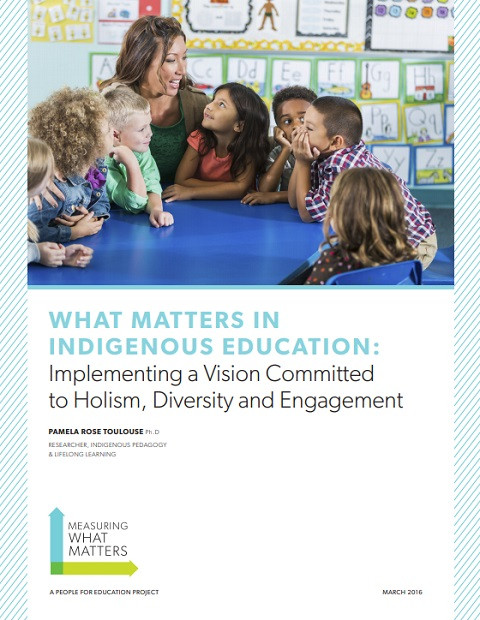 What Matters in Indigenous Education: Implementing a Vision Committed to Holism, Diversity and Engagement Year of publication: 2016 Author: Pamela R.Toulouse Corporate author: Measuring What Matters | People for Education This paper, What Matters In Indigenous Education: Implementing A Vision Committed To Holism, Diversity And Engagement, explores an Indigenous approach to quality learning environments and relevant competencies/skills. It focuses on select work from People for Education and draws out the research, concepts and themes that align with Indigenous determinants of educational success. This paper also expands on this work by offering perspectives and insights that are Indigenous and authentic in nature.
 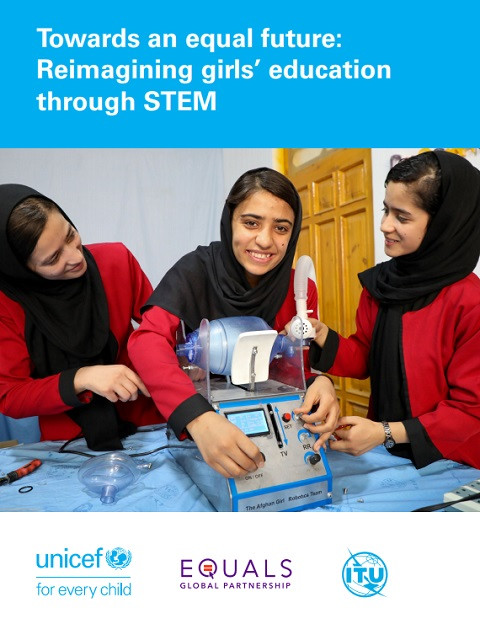 Towards an Equal Future: Reimagining Girls’ Education Through STEM Year of publication: 2020 Corporate author: United Nations Children's Fund (UNICEF) | International Telecommunication Union (ITU) This document seeks to call attention to the potential of STEM education to transform gender norms in the education system, to improve quality learning opportunities for girls, and to highlight key actions that can accelerate girls’ transition between education and technical expert jobs in STEM industries. Critically, STEM education also has the potential to contribute to personal empowerment, transformation of communities and nations, and building economies for the future.The evidence presented here provides a foundation for a call to action for global, national and regional actors. All stakeholders are called to work together to dismantle the barriers that girls face to develop the skills they need to become users, shapers and creators of scientific knowledge and new technologies. This will allow girls to choose the skills they want to learn and how to apply them, empowering them to contribute to a gender-equal world.
  지역아동센터 관리자·교사가 알아야 할 디지털 시민성과 교육 Year of publication: 2019 Author: 김양은 | 최숙 | 김형태 | 배은주 | 박상호 | 장준영 | 박정원 Corporate author: 방송통신위원회 | 한국정보화진흥원 본 자료는 지역아동센터와 같은 지역사회 돌봄서비스 내에서 디지털시민성 교육을 진행할 수 있도록 제작된 가이드북이다.
  International Principles of Practice for Educators Year of publication: 2020 Corporate author: Childhood Education International This document is a unique tool for educators that outlines how universally accepted beliefs about education can guide them in their work to help young people reach their full potential. By emphasizing the responsibilities and challenges that educators around the world share, it also helps to inspire them as members of a professional community that has inestimable value for promoting positive transformation.
 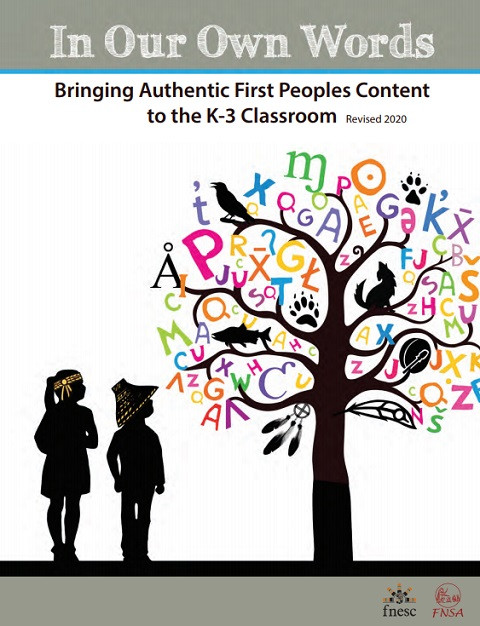 In Our Own Words: Bringing Authentic First Peoples Content to the K-3 Classroom Year of publication: 2020 Author: Jo Chrona | Heather Froste | Nadine McSpadden | Trena Lynn Sutton | Heidi Wood Corporate author: First Nations Education Steering Committee (FNESC) | First Nations Schools Association (FNSA) This teacher resource guide has been developed to offer teachers information and guidance about how to incorporate authentic First Peoples materials into their instruction and assessment practices. Inside, you will find lesson plans, curriculum connections, assessment resources and suggested texts.