
Resources
Explore a wide range of valuable resources on GCED to deepen your understanding and enhance your research, advocacy, teaching, and learning.
2,776 Results found
 Aportaciones de Paulo Freire a la educación intercultural: Un estudio de caso en la Educación Secundaria Obligatoria (Revista Iberoamericana De Educación; vol.76) Year of publication: 2018 Author: Maria Verdeja Muniz | Xose Anton Gonzalez Riano La finalidad general de esta investigación es sintetizar las aportaciones de la pedagogía de Paulo Freire a la educación intercultural y estudiar las posibilidades de aplicación al sistema educativo. La investigación está planteada desde una perspectiva cualitativa y completada con un estudio de caso. En un primer momento se realizó un análisis de una parte seleccionada de la obra escrita de Freire y se establecen las líneas básicas de lo que sería su sensibilidad intercultural. En otro plano de análisis se realiza un estudio de las materias del currículo de la ESO en Asturias en su dimensión intercultural. El estudio de caso en el centro educativo pone de manifiesto que, para llevar a cabo verdaderas propuestas de educación intercultural, sería necesario que existieran unas condiciones previas que se describen en el artículo.
  Anti-racist, Inclusive and Rights Education in the Development of Professional Competencies for School Staff and Student Abilities (Éthique en éducation et en formation; no. 3) Year of publication: 2017 Author: Maryse Potvin Corporate author: Université du Québec à Montréal (UQAM) This article examines the differences and convergences that emerge from the major theoretical trends in the area of education for ethnocultural (inter/multicultural, anti-racist/critical, civic, inclusive) diversity regarding the professional skills school personnel must acquire to achieve the major objectives of equity, effectiveness of rights, harmonious living and the development of students’ capabilities. The article is based on a review of the national and international literature, which aimed to identify the skills (knowledge, expertise, soft skills) that are essential for knowing how to act in the context of diversity and that, according to theoreticians, should be developed in all teacher training programs. These issues are discussed from a crosscutting perspective rather than from a disciplinary angle related to the Quebec curriculum (ethics and religious culture, history and education for citizenship). The article begins by providing some background on these trends in order to identify their common objectives and convergence toward an integrated and inclusive global approach. It then examines two objectives supported by all theoreticians in terms of the core professional skills needed by school personnel for developing students’ capabilities: 1) taking into account the realities, needs and rights of students, particularly those in minority or vulnerable groups, and 2) preparing students to live together in a pluralistic and democratic society. As well, it identifies the key challenges involved in the consideration and implementation of these two goals. L’éducation antiraciste, inclusive et aux droits dans le développement des compétences professionnelles du personnel scolaire et des capabilités des élèves (Éthique en éducation et en formation; no. 3) Year of publication: 2017 Author: Maryse Potvin Corporate author: Université du Québec à Montréal (UQAM) Cet article porte un regard sur les différences et convergences qui se dégagent des grands courants théoriques dans le champ de l’éducation à la diversité ethnoculturelle (inter/multiculturel, antiraciste /critique, civique, inclusif) quant aux compétences professionnelles à développer par le personnel scolaire pour atteindre les grandes finalités de l’équité, de l’effectivité des droits, du vivre-ensemble et du développement des capabilités des élèves. L’article s’appuie sur une revue de la littérature nationale et internationale, qui visait à dégager les éléments de compétences (savoirs, savoir-faire, savoir-être essentiels) pour savoir-agir en contexte de diversité, et qui, selon les théoriciens, devraient être développés dans tous les programmes de formation à l’enseignement. Il n’aborde pas ces enjeux sous un angle disciplinaire, lié au curriculum québécois (éthique et culture religieuse, histoire et éducation à la citoyenneté), mais dans une perspective transversale. L’article présente d’abord quelques fondements de ces courants afin de dégager leurs objectifs communs et leur convergence vers une approche globale et inclusive intégrée. Il porte ensuite une attention particulière aux deux finalités centrales qui font consensus parmi les théoriciens et qui sont au coeur des compétences professionnelles du personnel scolaire pour développer les capabilités des élèves : 1) prendre en compte les réalités, besoins et droits des élèves, particulièrement ceux des groupes minoritaires ou vulnérables, pour développer leurs capabilités, et 2) les préparer à vivre ensemble dans une société pluraliste et démocratique. Il dégage aussi les principaux défis liés à la prise en compte et à la mise en oeuvre de ces deux finalités.
  Reaching Out to All Learners: A Resource Pack for Supporting Inclusion and Equity in Education Year of publication: 2021 Corporate author: UNESCO International Bureau of Education (IBE) The Reaching Out to All Learners resource materials tackle the practicalities of addressing these challenges in schools and other education centres, including early years and further education provision. More specifically, the materials focus on three strategic questions:How can schools be developed in order to respond positively to student diversity?How can classroom practices be developed that will ensure that lessons are inclusive?How can practitioners engage families, partner schools and the wider community in their efforts to become inclusive and equitable? Llegando a todos los estudiantes: Una caja de recursos de la UNESCO-OIE para apoyar la inclusión y la equidad en la educación Year of publication: 2021 Corporate author: UNESCO International Bureau of Education (IBE) El material de recursos LLEGANDO A TODOS LOS ESTUDIANTES aborda los aspectos prácticos de la solución a estos problemas. En concreto, estos recursos se centran en tres cuestiones estratégicas:¿Cómo pueden crecer las escuelas para responder positivamente a la diversidad de los estudiantes?¿Cómo pueden desarrollarse prácticas docentes en el aula que garanticen que las lecciones sean inclusivas?¿Cómo pueden las escuelas involucrar a las familias, a las escuelas asociadas y a la comunidad en general en sus esfuerzos por ser inclusivas y equitativas? Atteindre tous les apprenants: Outils pour soutenir l’inclusion et l’équité dans l’éducation Year of publication: 2021 Corporate author: UNESCO International Bureau of Education (IBE) Les supports de référence du dossier ouvert Atteindre tous les apprenants abordent les aspects pratiques de la résolution de ces problèmes dans les écoles et autres centres d’éducation, et notamment dans l’enseignement préscolaire et supérieur. Ces supports se concentrent plus précisément sur trois questions stratégiques :Comment développer les écoles afin de s’adapter positivement à la diversité des élèves ?Comment développer des pratiques de classe qui garantissent que les cours sont inclusifs ?De quelle manière les écoles peuvent-elles impliquer les familles, les écoles partenaires et la communauté au sens large dans leurs efforts pour devenir inclusives et équitables ?
  Sociolinguistic and Intercultural Training for SFL Teachers in the Context of Linguistic Diversity: A Case Study on the Brazil-Bolivia Border(Revista Iberoamericana De Educación; vol.81, no.1) Year of publication: 2019 Author: Vivianne Ferreira Martins Sociolinguistically complex contexts, such as border areas with languages in contact, demand language teaching in accordance with their specificities. In this sense, the study is a sociolinguistic and intercultural teacher training proposal for teachers of Spanish as a foreign language (SFL) from the Brazilian-Bolivian border, specifically the Brazilian city of Cáceres. The languages in the area, Portuguese, Spanish, Portuñol and indigenous languages, occupy hierarchical positions that respond to relations of inequality and prejudice between individuals of different ethnic origins or different nationalities. The proposed training can be an important factor for the development of interculturality and multilingualism in the region and, in addition, can serve as a model for the teaching of foreign languages in other contexts of linguistic diversity. Formación sociolingüística e intercultural para profesores de ELE en contexto de diversidad lingüística: un estudio de caso en la frontera Brasil-Bolivia Year of publication: 2019 Author: Vivianne Ferreira Martins Los contextos sociolingüísticamente complejos, como son las zonas de frontera con lenguas en contacto, demandan una enseñanza de lenguas acorde con sus especificidades. En este sentido, el estudio es una propuesta de formación docente de base sociolingüística e intercultural para los profesores de español como lengua extranjera (ELE) de la frontera de Brasil con Bolivia, en concreto la ciudad brasileña de Cáceres. Las lenguas en la zona, el portugués, el español, el portuñol y lenguas indígenas, ocupan posiciones jerárquicas que responden a las relaciones de desigualdad y prejuicios entre los individuos de diferentes orígenes étnicos o de diferentes nacionalidades. La formación propuesta puede ser un importante factor para el desarrollo de la interculturalidad y del plurilingüismo en la región y, además, puede servir como modelo para la enseñanza de lenguas extranjeras en otros contextos de diversidad lingüística.
 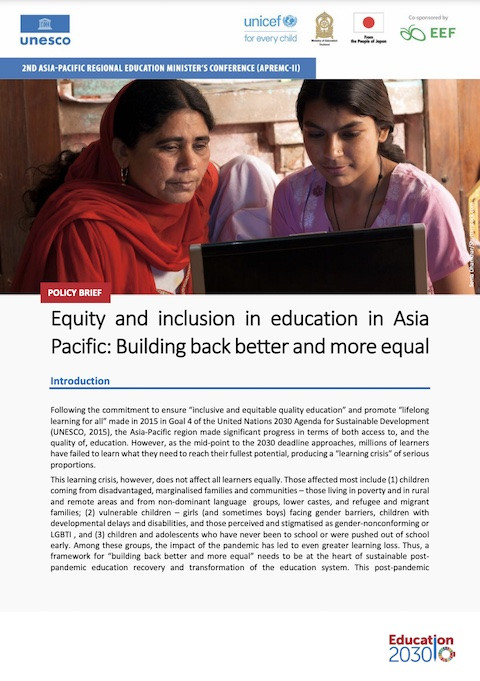 Equity and Inclusion in Education in Asia Pacific: Building Back Better and More Equal; Policy Brief Year of publication: 2022 Corporate author: UNESCO Bangkok Following the commitment to ensure “inclusive and equitable quality education” and promote “lifelong learning for all” made in 2015 in Goal 4 of the United Nations 2030 Agenda for Sustainable Development (UNESCO, 2015), the Asia-Pacific region made significant progress in terms of both access to, and the quality of, education. However, as the mid-point to the 2030 deadline approaches, millions of learners have failed to learn what they need to reach their fullest potential, producing a “learning crisis” of serious proportions. This learning crisis, however, does not affect all learners equally. Those affected most include (1) children coming from disadvantaged, marginalised families and communities – those living in poverty and in rural and remote areas and from non-dominant language groups, lower castes, and refugee and migrant families; (2) vulnerable children – girls (and sometimes boys) facing gender barriers, children with developmental delays and disabilities, and those perceived and stigmatised as gender-nonconforming or LGBTI , and (3) children and adolescents who have never been to school or were pushed out of school early. Among these groups, the impact of the pandemic has led to even greater learning loss. Thus, a framework for “building back better and more equal” needs to be at the heart of sustainable postpandemic education recovery and transformation of the education system. This post-pandemic framework calls for decisive action to protect the right to education of good quality and for measures – as spelled out below – to improve learning outcomes, especially for marginalized children made more vulnerable because of the pandemic.
 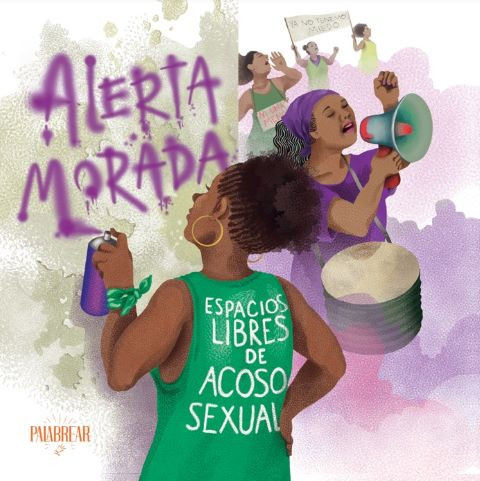 Purple Alert: Spaces Free of Sexual Harassment Year of publication: 2021 Author: Yohandra Iriarte | Yuliet Lopez Moreno | Adriana Moreno | Danish Market | Maria Fernanda Mace Caraballo | Natalia Torres Lopez | Veronica Fernandez | Wendy Nunez | Monica Manotas Dager | Juliet Nieto Flowers | Yarimar Melendez | Leidy Laura Diaz Rooms | Joyce Trivino | Olga Batista | Roslin Puello | Yacira Branch | Dawn Arias | Stephanny Galeano Urzola | Carmen Yepez | Judith Medina | Denis Deulufeut Flour | Ladies Guard | Johassandy Ortega Susa | Schild Julius White | Adriana of La Ossa | Leidy Laura Perneth Couple Corporate author: Center for Research and Popular Education / Program for Peace (CINEP/PPP) This document shares the experience of a meeting between a group of women from popular sectors of the city of Cartagena, to reflect on their right to a life free of violence. These meetings took place from the Circle of the Word of Women, developed by the Center for Research and Popular Education/Program for Peace (Cinep/Ppp) in the south of La Guajira, Sierra Nevada de Santa Marta and Cartagena, in within the framework of the project Intercultural Education for the Defense of the Rights of Ethnic Groups.