
Resources
Explore a wide range of valuable resources on GCED to deepen your understanding and enhance your research, advocacy, teaching, and learning.
1,447 Results found
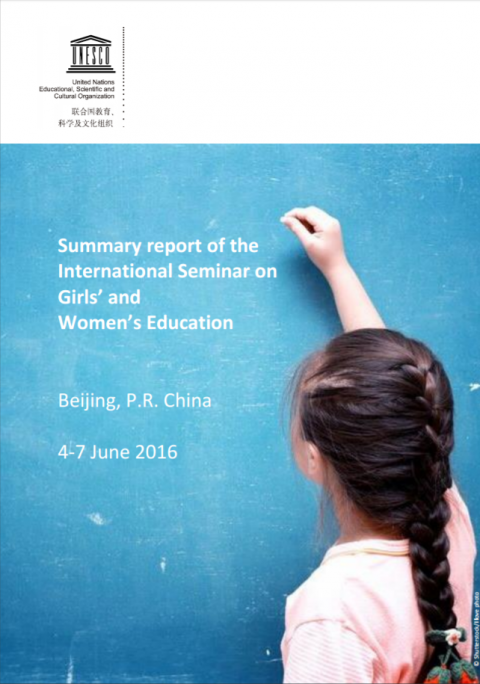 Rapport du Séminaire international sur l'éducation des filles et des femmes, Beijing, République populaire de Chine, 4-7 juin 2016 Year of publication: 2016 Corporate author: National Commission of the People's Republic of China for UNESCO | UNESCO Beijing The International Seminar on Girls’ and Women’s Education, held 4-6 June 2016 in Beijing, explored benefits of education on girls and women along with barriers to the achievement of gender equality in education. It provided a platform for dialogue on the role of education for girls and women, particularly in the context of the 2030 Agenda for Sustainable Development, and specifically in reaching SDG 4 and supporting the achievement of other SDGs. The event also marked the first award ceremony of the UNESCO Prize for Girls’ and Women’s Education, which honoured two laureates for their outstanding innovation and contributions to advancing girls’ and women’s education. This publication presents a synthesis of information that was shared during the seminar’s sessions, and the findings and recommendations originating from the exchanges. Informe resumido del Seminario internacional sobre la educación de las niñas y las mujeres, Beijing, R. P. China, 4-7 de junio de 2016 Year of publication: 2016 Corporate author: National Commission of the People's Republic of China for UNESCO | UNESCO Beijing The International Seminar on Girls’ and Women’s Education, held 4-6 June 2016 in Beijing, explored benefits of education on girls and women along with barriers to the achievement of gender equality in education. It provided a platform for dialogue on the role of education for girls and women, particularly in the context of the 2030 Agenda for Sustainable Development, and specifically in reaching SDG 4 and supporting the achievement of other SDGs. The event also marked the first award ceremony of the UNESCO Prize for Girls’ and Women’s Education, which honoured two laureates for their outstanding innovation and contributions to advancing girls’ and women’s education. This publication presents a synthesis of information that was shared during the seminar’s sessions, and the findings and recommendations originating from the exchanges.
  2019 꿈다락 토요문화학교 드림 아트랩 4.0 'Everyday is Playful Media' 결과자료집 Year of publication: 2019 Corporate author: 한국예술종합학교 융합예술센터 2019 꿈다락 토요문화학교 드림 아트랩 4.0 프로그램 관련, 한국예술종합학교 융합예술센터가 운영하고 성북구립미술관, N15가 협력하여 진행한 'Everyday is Playful Media' 프로그램 결과자료집으로 자료집은 Playful Thinking, Playful Learning, Playful Making 3개의 세부 프로그램 운영 내용 및 결과 전시 등의 과정이 기록되어있다. 본 저작물은 한국예술종합학교 융합예술센터에서 2019년 작성하여 공공누리 제4유형으로 개방한 ‘2019 꿈다락 토요문화학교 드림 아트랩 4.0 'Everyday is Playful Media' 결과자료집’을 이용하였으며 해당 저작물은 한국문화예술교육진흥원 arte 라이브러리 홈페이지(lib.arte.or.kr)에서 무료로 다운받으실 수 있습니다.
  国連持続可能な開発のための教育の10年中間年レビューESDの文脈と構造 Year of publication: 2009 Corporate author: UNESCO This document suggests key findings and ways forward in review of the contexts and strctures of education for sustainable development. 审查可持续发展教育的背景和结构,2009年:重要发现与前行之路 2009 Year of publication: 2009 Corporate author: 联合国教科文组织 (UNESCO) This document suggests key findings and ways forward in review of the contexts and strctures of education for sustainable development. Review of contexts and structures for education for sustainable development 2009: key findings & ways forward Year of publication: 2009 Corporate author: UNESCO This document suggests key findings and ways forward in review of the contexts and strctures of education for sustainable development. Examen des contextes et des structures de l'éducation pour le développement durable 2009: principales découvertes et perspectives Year of publication: 2009 Corporate author: Organisation des Nations Unies pour l'éducation, la science et la culture (UNESCO) Ce document propose des conclusions et des pistes essentielles pour l'examen des contextes et des structures de l'éducation pour le développement durable.
  The UN Decade of Education for Sustainable Development (DESD 2005-2014): the first two years Year of publication: 2007 Corporate author: UNESCO The implementation of the DESD has made considerable progress since its international launch in March 2005. Apart from regional and national launches, progress has been achieved in both institutional and programmatic areas at international, regional and national levels. The objective of this report is not solely to highlight and showcase to Member States all that has been achieved in the two years since the international launch. The report also takes stock of on-going UNESCO initiatives, established prior to the Decade, which are providing major contributions to the implementation of the DESD, and thus cannot be by-passed. Equally important are the recommendations to remedy problems in the implementation of the DESD and strengthen those measures that are working efficiently. Forjar la educación del mañana: decenio de las Naciones Unidas de la educación para el dessarollo sostenible: informe 2012, abreviado Year of publication: 2012 Corporate author: Organización de las Naciones Unidas para la Educación, la Ciencia y la Cultura (UNESCO) As the lead agency for the UN Decade of Education for Sustainable Development (DESD, 2005 – 2014), UNESCO is responsible for monitoring and evaluating progress during the DESD. UNESCO is publishing three reports during the DESD – in 2009, 2012 and 2014. This second report focuses specifically on processes and learning in the context of Education for Sustainable Development (ESD). What kinds of learning processes have emerged in the course of the DESD? What is the role of ESD in supporting them? What changes in ESD have occurred since the early years of the Decade? The report is informed by a broad consultation process that includes input from hundreds of policy makers, scholars and practitioners engaged in ESD around the world. Shaping the education of tomorrow: 2012 report on the UN decade of education for sustainable development, abridged Year of publication: 2012 Corporate author: UNESCO As the lead agency for the UN Decade of Education for Sustainable Development (DESD, 2005 – 2014), UNESCO is responsible for monitoring and evaluating progress during the DESD. UNESCO is publishing three reports during the DESD – in 2009, 2012 and 2014. This second report focuses specifically on processes and learning in the context of Education for Sustainable Development (ESD). What kinds of learning processes have emerged in the course of the DESD? What is the role of ESD in supporting them? What changes in ESD have occurred since the early years of the Decade? The report is informed by a broad consultation process that includes input from hundreds of policy makers, scholars and practitioners engaged in ESD around the world.