
Resources
Explore a wide range of valuable resources on GCED to deepen your understanding and enhance your research, advocacy, teaching, and learning.
1,367 Results found
 Be a buddy, not a bully: experiences of sexual and gender minority youth in Tamil Nadu schools Year of publication: 2019 Author: Menon C. Sunil, Chakrapani. Venkatesan, Jadav. Sarita Corporate author: UNESCO New Delhi We at UNESCO recognize that no country can achieve Sustainable Development Goal 4 - to ensure inclusive and equitable quality education and promote lifelong learning opportunities for all - if students are discriminated against or experience violence because of their actual or perceived sexual orientation and gender identity. This study conducted under the overall guidance of the School Education Department, Government of Tamil Nadu highlights our shared commitment to prevent and address bullying in educational institutions. We are confident that this report will be an effective tool for evidence based advocacy with school education departments and go a long way in promoting a comprehensive education sector response to SOGIE-based bullying, which includes enabling policy environments; inclusive curriculum and learning materials; professional development programmes for teachers and other school staff; support for learners including awarenessraising activities; and an overall school environment that is safe, nonviolent and that understands and appreciates diversity.
  Innovative Educational Reforms in Uzbekistan Year of publication: 2019 Author: Kh. Khakimjonova The article reveals the most important stages of reforming the education system of the Republic of Uzbekistan. The structure of the education system and the basic principles on which state reforms in the educational sphere are based are revealed. Describes the changes taking place in the education system of Uzbekistan in the light of recent government decrees and the challenges facing ministries and departments whose activities are directly or partially related to the education system of the Republic of Uzbekistan. Инновационные образовательные реформы в Узбекистане Year of publication: 2019 Author: Kh. Khakimjonova В статье раскрываются важнейшие этапы реформирования системы образования Республики Узбекистан. Раскрывается структура системы образования и основные принципы, на которых основываются государственные реформы в образовательной сфере. Описываются изменения, происходящие в системе образования Узбекистана в свете последних правительственных указов и задачи, стоящие перед министерствами и ведомствами, деятельность которых связана непосредственно или частично соприкасается с системой образования Республики Узбекистан.
  National Reforms of the Higher Education in Uzbekistan Year of publication: 2019 Author: G. Burkhonova This article addresses the issues of national reform of higher education in Uzbekistan. The author of the article believes that the reforms will lead to the further development of the education system as an important factor in the country's prosperity, sustainable economic growth, and employment. Национальные реформы высшего образования Узбекистана Year of publication: 2019 Author: G. Burkhonova Данная статья рассматривает вопросы национальных реформ высшего образования Узбекистана. Автор статьи считает, что реформы приведут к дальнейшему развитию системы образования как важнейшего фактора процветания страны, устойчивого роста экономики, обеспечения занятости населения.
 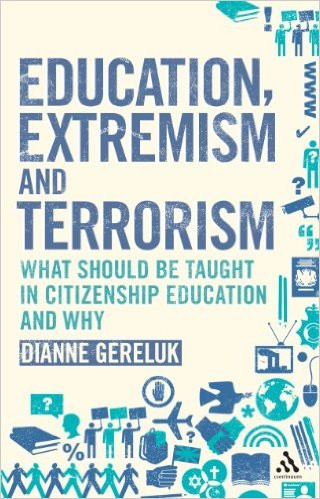 Education, Extremism and Terrorism: What should be Taught in Citizenship Education and Why Year of publication: 2012 Author: Dianne Gereluk Should educators be exploring terrorism and extremism within their classrooms? If so, what should they be teaching, and how? Dianne Gereluk draws together the diverging opinions surrounding these debates, exploring and critiquing the justifications used for why these issues should be addressed in schools. She goes on to consider the ways in which educators should teach these topics, providing practical suggestions. Education, Extremism and Terrorism: What should be Taught in Citizenship Education and Why Year of publication: 2012 Author: Dianne Gereluk Les enseignants doivent-il aborder les questions du terrorisme et de l'extrémisme au sein des salles de classe ? Dans ce cas, que doivent-ils enseigner, et comment ? Dianne Gereluk réunit au sein d'un même ouvrage les opinions divergentes autour de ces débats, elle explore et interroge les arguments mis en avant pour démontrer de l’importance du traitement de ces thèmes par les écoles. Elle envisage la façon dont ces sujets devraient être enseignés, et propose quelques conseils pratiques.
  Evaluating the Link between Conflict and Education Year of publication: 2005 Author: Lynn Davies Corporate author: SAGE Publishing This paper examines two areas of important evaluation: the impact of education on peace and the impact of education on conflict, and argues that they are not necessarily the same type of evaluation. Evaluating the Link between Conflict and Education Year of publication: 2005 Author: Lynn Davies Corporate author: SAGE Publishing Cet article examine deux domaines importants d’évaluation : l'impact de l'éducation sur la paix et l'impact de l'éducation sur les conflits ; il démontre ensuite que le même type d'évaluation ne s’applique pas nécessairement au deux.
 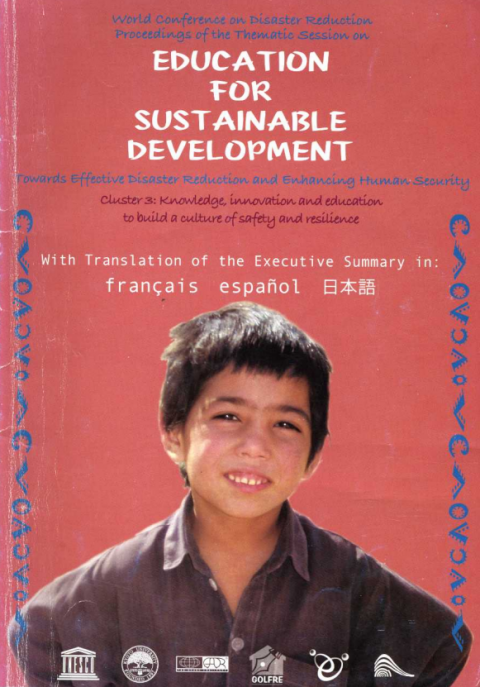 Proceedings of the thematic session on education for sustainable development: towards effective disaster reduction and enhancing human security; cluster 3: knowledge, innovation and education to build a culture of safety and resilience Year of publication: 2005 Author: Rajib Shaw | Badaoui Rouhban Corporate author: Kyoto University. Graduate School of Global Environmental Studies | Global Alliance for Disaster Reduction | Global Open Learning Forum on Risk Education | Disaster Reduction Alliance | International Institute of Earthquake Engineering and Seismology Ten years ago, the city of Kobe and its adjoining areas in Hyogo prefecture of Japan were hit by a strong earthquake, leaving behind a trail of death and destruction. This earthquake was a turning point in disaster reduction initiatives in Japan, resulting in two prominent changes: 1) a blending of technological and social issues in the field of research and application, and 2) an enhanced participation of civil society in disaster reduction Initiatives. Since Japan had long been one of the most developed countries in the field of earthquake engineering, the tragedy in Kobe posed a daunting question: 'how to fill the gap between knowledge and practice?' This question is not only for Japan, but is pertinent to many other countries. With the advancement of technology, the knowledge base is growing, and it is now time to tackle this question in order to save lives and properties from natural disasters. The World Conference on Disaster Reduction (WCDR), at the 10th anniversary of the Kobe earthquake, is therefore of special significance, providing an excellent platform to share experiences, expertise, and lessons from different parts of the world. The year 2005 is also the beginning of the United Nations Decade of Education for Sustainable Development (DESD: 2005-2014) which is led by UNESCO.