
Resources
Explore a wide range of valuable resources on GCED to deepen your understanding and enhance your research, advocacy, teaching, and learning.
1,180 Results found
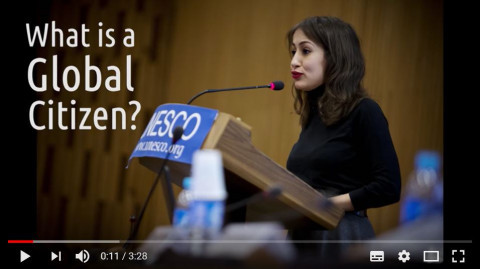 [Video] Global citizenship is ... Year of publication: 2015 Corporate author: UNESCO Participants of the Second UNESCO Forum on Global Citizenship Education (GCED) Building peaceful and sustainable societies: preparing for post-2015 (28-30 January 2015,UNESCO HQ, Paris) reflect on what Global Citizenship is. The Forum was organized by the Division for Teaching, Learning and Content, Education Sector, UNESCO, with the support of Austria, the Sultanate of Oman and the Republic of Korea, and the UN Secretary-General’s Global Education First Initiative (GEFI). La citoyenneté mondiale est ... Year of publication: 2015 Corporate author: UNESCO Les participants du deuxième Forum de l'UNESCO sur l’éducation à la citoyenneté mondiale (ECM) Construire des sociétés pacifiques et durables: la préparation pour l'après-2015 (28-30 Janvier 2015, Siège de l'UNESCO, Paris) à réfléchir sur ce que la citoyenneté mondiale est. Le Forum a été organisé par la Division de l'enseignement, l'apprentissage et du contenu, Secteur de l'éducation, l'UNESCO, avec le soutien de l'Autriche, le Sultanat d'Oman et la République de Corée, et First Éducation Mondiale Initiative du Secrétaire général de l'ONU (GEFI).
  글로벌시민교육: 21세기 새로운 인재 기르기 Year of publication: 2014 Corporate author: 유네스코 이 보고서는 글로벌시민교육을 주제로 열렸던 두 차례의 국제회의 - 글로벌시민교육 전문가회의(2013년 9월 9-10일, 대한민국 서울)와 제1차 유네스코 글로벌시민교육 포럼(2013년 12월 2-4일, 태국 방콕) - 결과를 토대로 교육정책 입안자, 교육 실천가, 시민사회단체 및 청소년 리더들을 위해 만들어졌다. 글로벌시민교육을 처음 접하거나 이미 실천하고 있는 모든 독자들에게 유용한 지침서가 될 것이다. 머리말감사의 말약어개요배경1. 글로시민교육의 기본 개념과 논의 1.1 글로벌시민교육이란 무엇인가 1.2 글로벌시민교육의 개념을 둘러싼 갈등 1.3 글로벌시민교육을 가능케 하는 요소2. 글로벌시민교육의 실제 2.1 교과과정을 통한 접근 2.2 정보통신기술의 활용 2.3 스포츠나 예술에 기초한 접근법 2.4 공동체에 기초한 접근법 2.5 교사 훈련 2.6 청소년 주도의 창의적 활동 2.7 글로벌시민교육 모니터링과 측정3. 앞으로의 과제 참고문헌
  Global Citizenship Education: An Emerging Perspective Year of publication: 2014 Corporate author: UNESCO This document draws on inputs to, and common perspectives emerging from, a Technical Consultation on Global Citizenship Education organized by UNESCO and the Republic of Korea (i.e., the Ministries of Foreign Affairs and of Education, and the Asia-Pacific Centre of Education for International Understanding) in Seoul on 9-10 September 2013 . Informing this draft document are: a) responses from the expert participants to a questionnaire circulated by UNESCO in advance of the consultation; b) presentations from experts during the consultation; c) discussions during the consultation; and d) reference material contributing to, and prepared for, the consultation. The final draft of this document was prepared by UNESCO’s Division of Education for Peace and Sustainable Development at Headquarters in Paris, with the assistance of a drafting team. Éducation à la Citoyenneté Mondiale:Nouveaux sujets de discussions éducatifs Year of publication: 2014 Corporate author: UNESCO Ce document se fonde sur les entrées et les perspectives communes qui sortent d'une Consultation Technique sur l'Éducation à la Citoyenneté Mondiale organisée par l'UNESCO et la République de Corée (ie, les Ministères des Affaires Étrangères et de l'Éducation, et le Centre Asie-Pacifique de l'Éducation pour la Comprendre) à Séoul les 9-10 Septembre 2013. Informer ce projet de document sont: a) les réponses des participants d'experts à un questionnaire diffusé par l'UNESCO à l'avance de la consultation; b) des présentations d'experts lors de la consultation; c) des discussions au cours de la consultation; et matériel d) de référence contribuant à, et préparé pour la consultation. La version finale de ce document a été préparé par la Division de l'Éducation pour la Paix et le Développement Durable au Siège de l'UNESCO à Paris, avec l'aide d'une équipe de rédaction.
  Repensar l'educacio: vers un bé comú mundial? Year of publication: 2015 Corporate author: UNESCO The changes in the world today are characterized by new levels of complexity and contradiction. These changes generate tensions for which education is expected to prepare individuals and communities by giving them the capability to adapt and to respond. This publication contributes to rethinking education and learning in this context. It builds on one of UNESCO’s main tasks as a global observatory of social transformation with the objective of stimulating public policy debate. It is a call for dialogue among all stakeholders. It is inspired by a humanistic vision of education and development, based on respect for life and human dignity, equal rights, social justice, cultural diversity, international solidarity, and shared responsibility for a sustainable future. These are the fundamentals of our common humanity. This book enhances the vision provided by the two landmark UNESCO publications: Learning to Be: The world of education today and tomorrow (1972), the ‘Faure Report’, and Learning: The treasure within (1996), the ‘Delors Report’. Shaping the future we want: UN decade of education for sustainable development; final report Year of publication: 2014 Author: Carolee Buckler | Heather Creech Corporate author: UNESCO The United Nations Decade of Education for Sustainable Development (2005 –2014) (DESD) aimed at integrating the principles and practices of sustainable development into all aspects of education and learning, to encourage changes in knowledge, values and attitudes with the vision of enabling a more sustainable and just society for all. The mandate of the DESD has energized a vast number of stakeholders – across Member States, UN agencies, the education sector, the private sector and civil society – to work in partnership to reorient education systems towards sustainable development. This final DESD Global Monitoring and Evaluation Report (GME) provides an assessment of progress towards embedding Education for Sustainable Development (ESD) into education systems and into sustainable development efforts. Building on the findings of the past two DESD GME reports, and based upon Member States’ and other stakeholders’ assessments of the current state of ESD, this report maps the achievements and challenges of a decade of progress and action on ESD at the global, regional, national and local levels – and within all areas and levels of education. Shaping the future we want: UN decade of education for sustainable development; final report Year of publication: 2014 Author: Carolee Buckler | Heather Creech Corporate author: Organisation des Nations Unies pour l'éducation, la science et la culture (UNESCO) La Décennie de l’ONU pour l'Éducation pour le Développement Durable (2005 -2014) (DEDD) visant à intégrer les principes et pratiques du développement durable dans tous les aspects de l'éducation et de l'apprentissage, afin d'encourager les changements dans les connaissances, les valeurs et les attitudes avec la vision de permettre à un plus durable et plus juste pour tous. Le mandat de la DEDD a stimulé un grand nombre de parties prenantes - dans tous les États Membres, les organismes de l’ONU, le secteur de l'éducation, le secteur privé et la société civile – pour travailler en partenariat afin de réorienter les systèmes d'éducation vers un développement durable. Cette dernière DEDD Suivi Mondiale et le Rapport d'Évaluation (SME) fournit une évaluation des progrès accomplis vers l'intégration Éducation pour le Développement Durable (EDD) dans les systèmes d'éducation et dans les efforts de développement durable. Se fondant sur les conclusions des deux dernières DEDD SME rapports, et basées sur des États membres et d'autres parties prenantes et les évaluations de l'état actuel de l'EDD, ce rapport maps les réalisations et les défis d'une décennie de progrès et d'action sur l'EDD à l'échelle mondiale, niveaux régional, national et local - et dans tous les domaines et niveaux d'éducation. Façonner l'avenir que nous voulons: décennie des Nations Unies pour l'éducation au service du développement durable (2005-2014), rapport final, résumé Year of publication: 2014 Author: Carolee Buckler | Heather Creech Corporate author: Organisation des Nations Unies pour l'éducation, la science et la culture (UNESCO) This summary for policy- and decision-makers provides a brief overview of the key findings and trends, a synopsis of highlights, challenges and actions across all levels and areas of education, and steps for scaling up actions presented in the UNESCO 2014 Global Monitoring and Evaluation Final Report, Shaping the Future We Want – UN Decade of Education for Sustainable Development (2005-2014). The Final Report provides an assessment of progress towards embedding education for sustainable development (ESD) into education systems and into sustainable development efforts. Building on the findings of the past two DESD Global Monitoring and Evaluation reports, and based upon Member States’ and other stakeholders’ assessments of the current state of ESD, the Final Report maps the achievements and challenges of a decade of progress and action on ESD at the global, national, regional and local levels, and within all areas and levels of education. The Final Report concludes that a solid foundation has been laid for ESD at the end of the DESD, achieved by raising awareness, influencing policies and generating significant numbers of good practice projects in all areas of education and learning. At the end of 10 years of work, 10 key findings and trends have emerged that will guide ESD into the future. The report also shows that despite the successes, a full integration of ESD into education systems has yet to take place in most countries.
  反思教育:向 “全球共同利益” 的理念转变? Year of publication: 2015 Corporate author: UNESCO 当今世界的错综复杂和矛盾冲突,达到了前所未有的程度。这些变化引发了紧张不安,人们寄希望于教育能够培养个人和社会掌握适应变化并做出反应的能力。本出版物有助于在这一背景下反思教育与学习。本书立足于教科文组织作为全球社会变革观测站的主要任务,目的是促进公共政策辩论。本书呼吁所有利益攸关方开展对话。这是一部在人文主义教育观和发展观的启迪下完成的作品,以尊重生命和人类尊严、权利平等、社会正义、文化多样性、国际团结和为创造可持续的未来承担共同责任为基础,而这些正是人性的基本共同点。本书彰显了教科文组织具有里程碑意义的两部出版物提出的愿景——《学会生存:教育世界的今天和明天》(《富尔报告》,1972年)和《学习:内在的财富》(《德洛尔报告》,1996年)。