
Resources
Explore a wide range of valuable resources on GCED to deepen your understanding and enhance your research, advocacy, teaching, and learning.
882 Results found
 تقرير المديرة العامة لمنظمة الأمم المتحدة للتربية والعلم والثقافة عن متابعة تنفيذ الإعلان وبرنامج العمل المتعلقين بثقافة السلام Year of publication: 2013 Corporate author: United Nations. Secretary-General, 2007-2016 (Ban, Ki-moon) | UNESCO. Director-General, 2009-2017 (Bokova, I.G.) هذا هو تقريـر مقـدم مـن المـديرة العامـة لمنظمـة الأمـم المتحـدة للتربيـة والعلم والثقافة عملاً بقرار الجمعية العامة ٦٧/١، لمتابعة تنفيذ الإعلان وبرنامج العمل المتعلقين بثقافة السلام. وقد استعرضت المديرة العامة لمحة عامة عن الأنشطة المنفذة لترويج ثقافة السلام واللاعنف، بالاشتراك مع منظمة الأمم المتحدة للتربية والعلم والثقافة (اليونيسكو) باعتبارها الوكالة الرائدة في منظومة الأمم المتحدة المعنية بهذا الموضوع.
  Backtalk: The Participatory Film and Its Residency in the Space of Cultural Violence and Creative Education towards a Conceptual Understanding of Peace Year of publication: 2017 Author: Ruchika Gurung Corporate author: Mahatma Gandhi Institute of Education for Peace and Sustainable Development (MGIEP) Cultural violence is defined as the beliefs, attitudes and values that justify structural and direct violence (Galtung 1990). It dulls us into seeing exploitation and repression as normal or in not actively witnessing it, and the media plays a vital role in its dissemination. Media and in particular film studies occupies a space through which notions of culture, ideology, peace and violence are negotiated.While the observational approach to film is well established in education, participatory filmmaking as an educational tool is what this paper addresses, with reference to concepts of cultural violence and peace education.This paper uses Brantmeier’s (2011) five stage model, that encourages social and cultural change towards a future that is nonviolent, sustainable and renewable, and Bery’s (2003) conceptualisation of empowerment to propose that participatory film functions as a transformative creative process and challenges notions of identity and culture while helping learners describe the world around them (Zembylas & Bekerman 2013).Through analysing existing cases in the field of participatory video (Schwab-Cartas & Mitchell 2014), the author argue that participatory film functions as a tool for creative education practices that promotes a more hands-on approach to raising awareness about cultural violence and engaging with identity formation, and as a creative tool for knowledge creation and dissemination.
  Final Report: 2nd Youth Leadership Workshop on Global Citizenship Education Year of publication: 2016 Corporate author: APCEIU This report provides an overview of the activities carried out during the 2nd Youth Leadership Workshop on Global Citizenship Education (GCED) held in Busan, Republic of Korea, from 11 - 16 July 2016. As an APCEIU's 2nd youth workshop, this programme gathered 49 youth activists from 38 countries around the world to exchange their ideas and identify GCED leadership strategies in order to mobilize young people for GCED in local and national contexts and advance the agenda globally. This report also aims to convey the voice of the youth on GCED: their thoughts and reflections on GCED and its priority areas. The workshop was co-organized by APCEIU and UN Secretary General’s Global Education First Initiative (GEFI); it was sponsored by Busan University of Foreign Studies and the Geum-jeong District of Busan Metropolitan City. For more information, please contact APCEIU's Office of Education and Training at ent@unescoapceiu.org. 제2차 세계시민교육 청년리더십 워크숍 최종보고서 Year of publication: 2016 Corporate author: 유네스코 아시아태평양 국제이해교육원 본 보고서는 2016년 7월 11일부터 16일까지 부산에서 열린 ‘제2차 세계시민교육 청년리더십 워크숍(2nd Youth Leadership Workshop on GCED)’에서 이루어진 활동 개요를 제공한다. 이 워크숍은 유네스코 아태교육원과 유엔 사무총장의 글로벌교육우선구상(GEFI)가 공동주최하고 부산외국어대학교와 부산광역시 금정구가 후원하였다.이 프로그램에 전세계 38개국 49명의 청년활동가들이 참가하여 세계시민교육에 대한 아이디어를 교환하며, 세계시민교육을 전 세계적으로 확산하고 지역·국가적 차원의 청년활동을 증진하기 위한 리더십 전략을 논의하였다. 본 보고서는 6일간의 워크숍 활동들에 대한 기록과 더불어 세계시민교육의 주체로서 청년들의 세계시민교육의 의미와 우선 과제들에 대한 목소리를 담고자 했다. 문의: 유네스코 아태교육원 교육연수실(ent@unescoapceiu.org)
 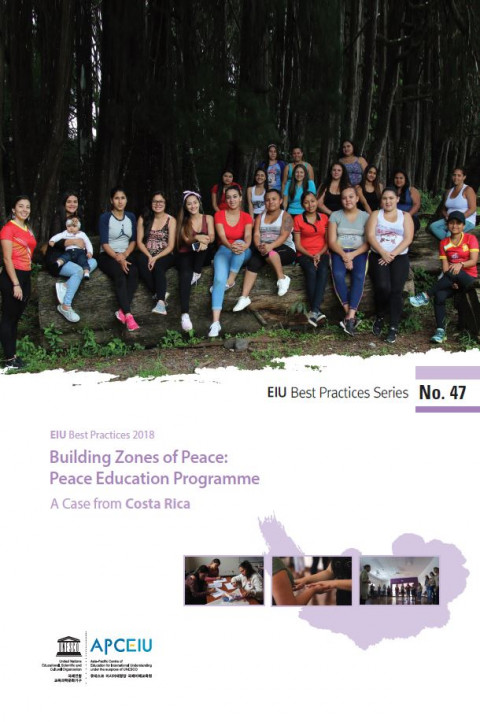 EIU Best Practices Series No. 47: Building Zones of Peace: Peace Education Programme; A Case from Costa Rica Year of publication: 2018 Corporate author: APCEIU Building Zones of Peace (BZP) is a non-formal peace and global citizen education programme created to promote peace and prevent violence in vulnerable urban communities in Costa Rica. The programme aims to encourage participants to develop a critical view of their contexts and explore different ways of taking action to transform the world we live in, and by recognizing how individual and collective efforts have a positive and direct impact in our personal, family and community spheres as well as nationally and globally.In 2017, BZP was conducted to a group of secondary education students ages 13 to 17. This year (2018), participants are young women, ages 18 to 22, all of the mothers who live in extreme poverty. These women have been selected by a governmental office whose aim is to reduce poverty by empowering them. Several resources and networks of support have been created in different areas such as health, employment, childcare and education to achieve this goal. In this sense, our programme was chosen to contribute significantly in this process.
 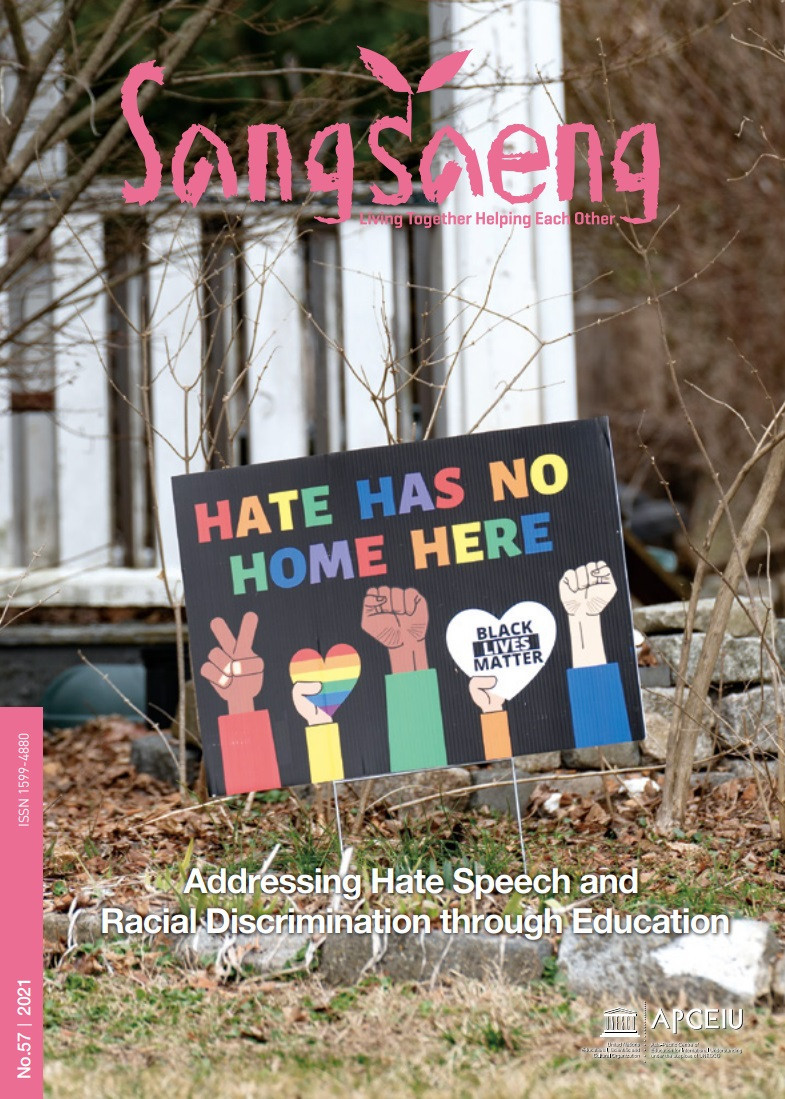 Addressing Hate Speech and Racial Discrimination through Education (SangSaeng no.57, 2021) Year of publication: 2023 Corporate author: APCEIU Today, humanity is faced with various multifaceted challenges such as climate change, increasing inequality, hate speech and racial discrimination. Moreover, the COVID-19 pandemic has crudely manifested those problems and further highlighted the acute need for concerted efforts to address them. In this context, SangSaeng No. 57 focuses on “Addressing Hate Speech and Racial Discrimination through Education” to provide readers with opportunities to reflect on these salient issues. Contents 03 Editor’s Note 04 Special ColumnFrom Hatred to Reconciliation - Learning from Rwanda / Freddy Mutanguha 08 FOCUS: Addressing Hate Speech and Racial Discrimination through Education08 Confronting Hate Speech - Thoughts, Challenges, Proposals from Educational Perspective / Gabriela Martini Armengol12 Missing Link in Global Citizenship Education – Taking into Account Identities, Alterities and Citizenships Hurt by Systemic and Chronic Racism / Gina Thesee16 Moving from Hate and Discrimination to Greater Humanity – Increasing Need for Empathy Education / Pat Dolan19 But What Can I Do? - Educational Responses to Hate Speech / Felisa Tibbitts 23 Best Practices23 Learning Democracy at Utoya - Young People’s Response to Hate and Extremism / Ingrid Aspelund26 Combatting Hate Speech – Experiences and Lessons from South Sudan / Marina Modi 29 Special Report29 Setting out Priorities for Addressing Hate Speech Through Educationt - Highlights of the Multi-Stakeholder Forum and Global Education Ministers Conference on Addressing Hate Speech through Education / UNESCO 32 Call for Global Action towards Transforming the World through Education - Highlights of the 5th UNESCO Forum on Transformative Education / APCEIU and UNESCO 35 Story TimeGrandfather’s Funeral / Sudipa Charkraverty 38 Peace in My MemoryPeace Turned into Pain / An anonymous contributor from Afghanistan 42 Understanding the Asia and the PacificMha Puja, Practicing Respect / Sharareh Bajracharya and Sanjeev Maharjan 45 Youth Network Youth Tackling Hate Speech and Racial Discrimination / GCED Youth Network Core Team 48 LetterReflections on Hate Speech and GCED / Sengpapah Holanouphab 50 APCEIU in Action
  Report of the Sub-Saharan Africa Regional GCED Network Meeting: Perspectives, Strategies and Actions for GCED Year of publication: 2017 Author: Gertie Steukers | Carolyn Medel-Añonuevo | Abdoul Wahab Coulibaly Corporate author: UNESCO Harare | APCEIU An increasingly globalized world has raised questions about what constitutes meaningful citizenship as well as about its global dimensions. Global Citizenship Education (GCED) aims to empower learners to assume active roles to face and resolve global challenges and to become proactive contributors to a more peaceful, tolerant, inclusive and secure world.Education is the most important tool for equipping young people, our future generation of leaders, with the knowledge, skills and attitudes to tackle prejudice and hostility, and to build more peaceful, tolerant and equitable societies. While there are different understandings and manifestations of GCED in different countries, GCED in its various forms is fast becoming an important and necessary component of education systems in sub-Saharan Africa and across the world.The commitment of actors around the world to promoting GCED has contributed highly to the development of GCED, including raising awareness and catalysing action. Furthermore, this has led to the incorporation of GCED in the Sustainable Development Goals (SDGs) through Target 4.7, which captures the clear call for an education that addresses the needs of the twenty-first century, empowering learners to act towards a more peaceful, just, inclusive and sustainable world.GCED reflects the aim of education to go beyond just access and ‘ensure inclusive and equitable quality education and promote lifelong opportunities for all’ in the next fifteen years.UNESCO Regional Office for Southern Africa (ROSA) and the Asia-Pacific Centre of Education for International Understanding (APCEIU) invited partners across Africa for the 2017 Sub-Saharan Africa GCED Regional Network Meeting on 6–7 April 2017 in Johannesburg. The meeting was designed to jumpstart the formation of the Africa Regional GCED Network, map different GCED programmes in the region, and explore areas of possible collaboration in light of solidifying regional action on GCED.
  3rd Global Capacity-Building Workshop on GCED: Final Report Year of publication: 2018 Corporate author: APCEIU This report provides an overview of the activities and outcomes of the 3rd Global Capacity-Building Workshop on GCED held in Seoul, Republic of Korea from 29 August - 11 September 2018.APCEIU organized the 3rd Global Capacity-Building Workshop on GCED with the aim of enhancing the capacities of teacher educators in developing countries on utilizing GCED. This 2-week intensive workshop provided participants opportunities to better understand the concept and principles of GCED, while engaging in meaningful dialogues and sharing experiences with educators from different countries, cultures, and contexts, and to develop their own action plans.
  How Can GCED Promote Gender Equality? (SangSaeng no. 51 Winter 2018) Year of publication: 2018 Corporate author: APCEIU The 51th issue of SangSaeng, under the theme of “How Can GCED Promote Gender Equality?,” explores the role of GCED to bolster gender equality. In this issue, readers are reminded that GCED is not an abstract idea- rather, it is connected to real-life issues such as questioning gendered roles, expectations and stereotypes that are prevalent in many societies; and therefore, it can be a vital accelerator in building a more equitable world. 3 Director’s Message 4 Special ColmunTools that Promote Gender Equality 8 Focus : How Can GCED Promote Gender Equality?8 Bringing Gender Equality to Science World12 Women For Better World15 Setting GCED Principles to Promote Girls’ Education in Tado18 Path to Building Next Gen Men 22 Best Practice22 Using GCED to Promote Gender Equality in Senegal26 Adapting GCED into a Specific Learning Environment 29 Special ReportThe 3rd International Conference on GCED 32 InterviewGirls in GCED 35 Youth NetworkGlobal Citizenship Education in Refugee Crisis Relief 38 LetterPoetry - The Sword in Our Sheath 42 Peace In my MemoryBachcha Posh : An Inside Look 46 Understanding the Asia-Pacific RegionGrafting Human Rights Tree in Five ‘Stans’ 50 APCEIU in Action Comment l’ECM peut-elle promouvoir l’égalité des genres ? (SangSaeng N° 51 Hiver 2018) Year of publication: 2018 Corporate author: APCEIU SangSaeng (상생), mot coréen d’origine chinoise, se compose de deux caractères : Sang (相), qui signifie « mutual » (les uns les autres) et Saeng (生), qui signifie « vie ». Mis ensemble, ils signifient « vivre ensemble », « s’entraider ». C’est notre vision pour la région Asie-Pacifique. SangSaeng (相生) se veut une plateforme de débats constructifs sur les sujets, méthodes et expériences dans le domaine de l’éducation à la compréhension internationale. SangSaeng vise aussi à promouvoir l’Éducation à la citoyenneté mondiale, une des trois priorités de l’Initiative mondiale pour l’éducation avant tout, lancée par les Nations Unies en 2012. SangSaeng est publié deux fois par an par le Centre Asie-Pacifique d’éducation pour la compréhension internationale (APCEIU) sous l’égide de l’UNESCO. Version française produite par le Bureau régional de l'UNESCO pour l'Afrique de l'Ouest (Sahel) et édiitée avec l'appui de l'APCEIU. 3 MESSAGE DU DIRECTEUR4 RUBRIQUE SPECIALE Outils pour la promotion de l'égalité des genres8 FOCUS: COMMENT L'ECM PEUT-ELLE PROMOUVOIR L'ÉGALITÉ DES GENRES? 08 L'ÉGALITÉ DES GENRES DANS LE MONDE SCIENTIFIQUE 12 LES FEMMES POUR UN MONDE MEILLEUR 15 FIXER DES PRINCIPES D'ECM POUR PROMOUVOIR L'ÉDUCATION DES FILLES DES FILLES TADO 18 SUR LA VOIE DES HOMMES DE LA PROCHAINE GÉNÉRATION 22 BONNES PRATIQUES 22 Utiliser l'ECM pour promouvoir l'égalité des genres au Sénégal 26 Adapter l'ECM à un environnement d'apprentissage spécifique29 REPORTAGE SPÉCIAL La 3e Conférence internationale sur l’ECM: Une plate-forme durable et robuste pour l’ECM32 ENTRETIEN Les filles dans l'ECM35 RÉSEAU DE JEUNES L'éducation à la citoyenneté mondiale dans l'aide au réfugiés en situation de crise38 LETTRE Poésie - l'épée dans notre fourreau 42 LA PAIX DANS MA MÉMOIRE Bachcha Posh : Un regard intérieur46 COMPRENDRE LA REGION ASIE-PACIFIQUE Greffer l'arbre des droits de l'homme dans les cinq « Stans »50 APCEIU EN ACTION