
Resources
Explore a wide range of valuable resources on GCED to deepen your understanding and enhance your research, advocacy, teaching, and learning.
1,407 Results found
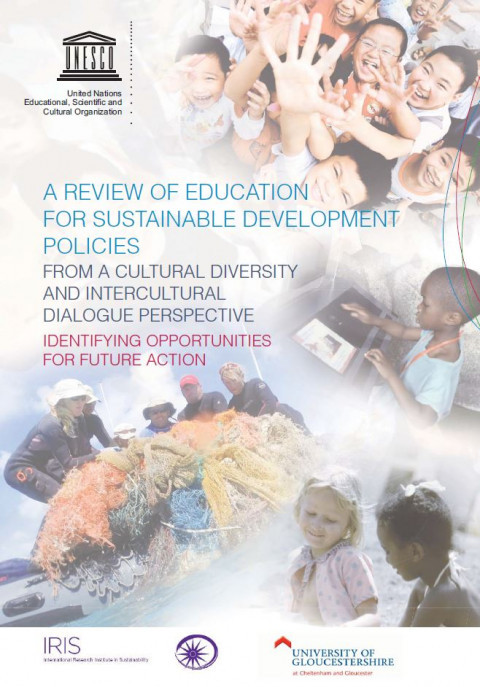 Un examen de l'éducation pour les politiques de développement durable à partir d'une diversité culturelle et de la perspective d'un dialogue interculturel: l'identification des possibilités d'action future Year of publication: 2009 Author: Daniella Tilbury | I. Mulà Corporate author: Organisation des Nations Unies pour l'éducation, la science et la culture (UNESCO) Cet avis met en évidence l'absence frappante de la culture dans l'EDD, un écart aussi reconnu par les participants auconférencemondial de l'UNESCO sur l'éducation pour le développement durable tenu à Bonn, en Allemagne, du 31 Mars au 2 Avril 2009. La déclaration finale souligne que l'EDD est sur ' approches créatives et critiques, la pensée à long terme, l'innovation et l'autonomisation pour faire face à l'incertitude », et pour résoudre des problèmes complexes, en soulignant en particulier l'interdépendance de l'environnement, l'économie, la société et la diversité culturelle du niveau local au niveau mondial. L'examen et sa méthodologie fournissent un exemple instructif de façons d'articuler les liens entre la diversité culturelle, le dialogue interculturel et EDD, nécessaire pour un avenir durable.
  Innovative practices of youth participation in media: a research study on twelve initiatives from around the developing and underdeveloped regions of the world Year of publication: 2006 Author: Sanjay Asthana Corporate author: UNESCO This book will be useful as a research and reference guide to community-based media centres, media education practitioners, non-governmental organizations, policy-makers, planners, media professionals, social activists, researchers, etc. A direct contribution of the book are the several examples that can be adapted and/or replicated by various initiatives as they embark on building youth media programmes around the world. Les pratiques innovantes de la participation des jeunes dans les médias: une étude de recherche sur les douze initiatives du monde en développement et régions sous-développées du monde Year of publication: 2006 Author: Sanjay Asthana Corporate author: Organisation des Nations Unies pour l'éducation, la science et la culture (UNESCO) Ce livre sera utile en tant que guide de recherche et de référence aux centres communautaires multimédias, les professionnels des médias de l'éducation, les organisations non-gouvernementales, les décideurs, les planificateurs, les professionnels des médias, des activistes sociaux, des chercheurs, etc. Une contribution directe du livre sont les quelques exemples qui peuvent être adaptés et / ou reproduits par diverses initiatives qui se lancent dans la création de programmes de médias de la jeunesse dans le monde entier. Promover una asociación mundial con miras al Decenio de las Naciones Unidas de la educación para el desarrollo sostenible (2005-2014): el plan de aplicación internacional del decenio en pocas palabras Year of publication: 2006 Corporate author: Organización de las Naciones Unidas para la Educación, la Ciencia y la Cultura (UNESCO) Through the International Implementation Scheme governments and other partners, especially potential donors, are urged to assess existing ESD resources and needs in countries, reallocate existing resources and find means of mobilizing new resources to ensure that ESD will not be a mere slogan but actual reality. Promouvoir un partenariat mondial pour la décennie des Nations Unies pour l'éducation en vue du développement durable (2005-2014): le plan international de mise en oeuvre de la décennie en bref Year of publication: 2006 Corporate author: Organisation des Nations Unies pour l'éducation, la science et la culture (UNESCO) Through the International Implementation Scheme governments and other partners, especially potential donors, are urged to assess existing ESD resources and needs in countries, reallocate existing resources and find means of mobilizing new resources to ensure that ESD will not be a mere slogan but actual reality. Promotion of a global partnership for the UN decade of education for sustainable development (2005-2014): the international implementation scheme for the decade in brief Year of publication: 2006 Corporate author: UNESCO Through the International Implementation Scheme governments and other partners, especially potential donors, are urged to assess existing ESD resources and needs in countries, reallocate existing resources and find means of mobilizing new resources to ensure that ESD will not be a mere slogan but actual reality. International symposium of the international network for reorienting teacher education towards sustainability, 19-21 May 2010, UNESCO Headquarters, Paris: meeting summary and next steps Year of publication: 2010 Corporate author: UNESCO A symposium for members of the International Network of Teacher Education Institutions was held at UNESCO Headquarters on 19 – 21 May 2010. Approximately 100 participants, who were teacher educators, representatives from ministries of education and UNESCO staff, attended. The participants, coming from 50 countries, met for a combination of professional development related to education for sustainable development and teacher education and to share experiences related to these two topics. The participants also discussed how to create and maintain national or regional networks of teacher education institutions that are working to reorient teacher education to address sustainability. The symposium was organized by the Section for DESD Coordination at UNESCO in collaboration with the UNESCO Chair on Reorienting Teacher Education to Address Sustainability at York University in Canada. Symposium international du réseau international pour la réorientation de la formation des enseignants vers le développement durable, 19-21 mai 2010, Siège de l'UNESCO, Paris: Résumé de la réunion et les prochaines étapes Year of publication: 2010 Corporate author: Organisation des Nations Unies pour l'éducation, la science et la culture (UNESCO) Un colloque pour les membres du Réseau international des établissements d'enseignement des enseignants a eu lieu au Siège de l'UNESCO sur les 19 au 21 mai 2010. Environ 100 participants, qui étaient des formateurs d'enseignants, des représentants des ministères de l'éducation et de personnel de l'UNESCO, ont assisté. Les participants, venant de 50 pays, se sont réunis pour une combinaison de perfectionnement professionnel lié à l'éducation pour le développement et la formation des enseignants durable et de partager des expériences liées à ces deux sujets. Les participants ont également discuté de la façon de créer et de maintenir des réseaux nationaux ou régionaux d'institutions de formation des enseignants qui travaillent à réorienter la formation des enseignants vers le développement durable. Le symposium a été organisé par la section DEDD Coordination à l'UNESCO en collaboration avec la Chaire UNESCO sur la réorientation de la formation des enseignants vers le développement durable à l'Université de York au Canada. Education sector technical notes: Education for Sustainable Development (ESD) Year of publication: 2013 Corporate author: UNESCO The Education Sector is called to implement a significant and broad mandate, covering many challenging issues in education in a diverse and fast-changing world. More than ever, we need to better focus and ensure greater cohesion in implementing this mandate. This document is part of a series of Technical Notes that have been developed by colleagues in the Education Sector in order to facilitate programme delivery in thematic areas related to the work of the Sector. The Technical Notes are meant to serve as a quick reference tool for UNESCO staff, providing a brief overview including basic knowledge, key priorities for UNESCO and future directions as well as practical information on each topic. و خارطة الطريق لتنفيذ برنامج العمل العاملي بشأن التعليم من أجل التنمية املستدامة Year of publication: 2014 Corporate author: منظمة الأمم المتحدة للتربية والعلم والثقافة (UNESCO) The Global Action Programme comes with a detailed implementation Roadmap. It is intended for all stakeholders – Governments, civil society organizations, the private sector, media, the academic and research community, intergovernmental organizations and other relevant institutions that facilitate and support learning and training, all the way to individual teachers and learners. The Roadmap explains the Programme’s goal, objectives and priority action areas in order to enable strategic focus and stakeholder commitment, together with implementation and monitoring strategies.