
Resources
Explore a wide range of valuable resources on GCED to deepen your understanding and enhance your research, advocacy, teaching, and learning.
882 Results found
 Addressing Hate Speech Through Education: A Guide for Policy-Makers Year of publication: 2023 Corporate author: UNESCO | UN. Office on Genocide Prevention and the Responsibility to Protect Hate speech is spreading faster and further than ever before as a result of social media user growth and the rise of populism. Both online and offline, hate speech targets people and groups based on who they are. It has the potential to ignite and fuel violence, spawn violent extremist ideologies, including atrocity crimes and genocide. It discriminates and infringes on individual and collective human rights, and undermines social cohesion. Education can play a central role in countering hateful narratives and the emergence of group-targeted violence. Educational responses to hate speech and all forms of hateful communication include:• Training teachers and learners on the values and practices related to being respectful global and digital citizens;• Adopting pedagogical and whole-school approaches to strengthening social and emotional learning;• Revising and reviewing curricula and educational materials to make them culturally responsive and to include content that identifies hate speech and promotes the right to freedom of expression;This policy guide developed by UNESCO and the United Nations’ Office on Genocide Prevention and the Responsibility to Protect explores these educational responses and provides guidance and recommendations to policy-makers on how to strengthen education systems to counter hate speech.
  Combatir el discurso de odio a través de la educación: una guía para los responsables de la formulación de políticas Year of publication: 2024 Corporate author: UNESCO | UN. Office on Genocide Prevention and the Responsibility to Protect Como producto de las redes sociales y del aumento del populismo, el discurso de odio se está difundiendo más rápido y con mayor alcance que nunca. Ya sea en línea o no, se dirige a las personas sobre la base de quiénes son y tiene el potencial de incitar a la violencia, así como engendrar ideologías extremistas y violentas, crímenes atroces e incluso el genocidio. Además, discrimina, infringe derechos humanos individuales y colectivos y socava la cohesión social.La educación puede cumplir un papel fundamental en la lucha contra los discursos de odio y el surgimiento de la violencia dirigida a grupos específicos. Las respuestas educativas al discurso de odio y a todas las formas de comunicación relacionadas incluyen:• La capacitación de docentes y estudiantes sobre los valores y las prácticas que necesitan para ser ciudadanos y ciudadanas respetuosos a nivel global y en el ámbito digital;• La adopción de pedagogías y enfoques escolares integrales para el fortalecimiento del aprendizaje social y emocional;• La adopción y revisión del currículo y de los materiales educativos para que sean culturalmente sensibles e incluyan contenido que identifique la presencia del discurso de odio y promueva el derecho a la libertad de expresión.Esta guía para la formulación de políticas, elaborada por la Oficina de las Naciones Unidas para la Prevención del Genocidio y la Responsabilidad de Proteger (OSAPG) y la UNESCO, analiza en detalle estas y otras respuestas educativas con la intención de brindar a las y los formuladores de políticas las orientaciones y recomendaciones sobre cómo fortalecer los sistemas educativos para combatir el discurso de odio.
  Lutter contre les discours de haine par l’éducation Year of publication: 2025 Corporate author: UNESCO | United Nations Office on Genocide Prevention and the Responsibility to Protect Lutter contre les discours de haine par l’éducationLes discours de haine se propagent plus vite et plus loin que jamais du fait de l’augmentation du nombre d’utilisateurs des médias sociaux et de la montée du populisme. En ligne comme hors ligne, les discours de haine ciblent des personnes et des groupes sur la base de ce qu’ils sont. Ces discours sont susceptibles d'inciter et d’attiser la violence et d’engendrer des idéologies extrémistes violentes, pouvant mener à des atrocités criminelles et des génocides. Ils sont discriminatoires, portent atteinte aux droits humains individuels et collectifs et menacent la cohésion sociale.L’éducation peut jouer un rôle essentiel dans la lutte contre les discours de haine et l’émergence de violences visant des groupes particuliers. Les réponses éducatives aux discours de haine et à toutes les formes de communication haineuse comprennent :• la formation des enseignants et des apprenants aux valeurs et aux pratiques permettant d’être des citoyens du monde et des citoyens numériques respectueux ;• l'adoption d'approches scolaires globales et pédagogiques pour renforcer l’apprentissage social et émotionnel ;• l'examen et la révision des programmes scolaires et des supports pédagogiques pour les rendre culturellement adaptés et inclure des contenus qui permettent d'identifier les discours de haine et promeuvent le droit à la liberté d’expression.Ce guide stratégique, élaboré par l’UNESCO et le Bureau de la prévention du génocide et de la responsabilité de protéger des Nations Unies, analyse ces réponses éducatives et fournit des conseils et des recommandations aux décideurs politiques sur la manière de renforcer les systèmes éducatifs pour lutter contre les discours de haine.
  Social Media 4 Peace Year of publication: 2021 Corporate author: UNESCO | European Union (EU) The overall objective of the UNESCO project 'Social Media 4 Peace' funded by the European Union is to strengthen the resilience of societies to potentially harmful content spread online, in particular hate speech inciting violence while protecting freedom of expression and enhancing the promotion of peace through digital technologies, notably social media. For more information, please visit:https://en.unesco.org/social-media-4-peace
 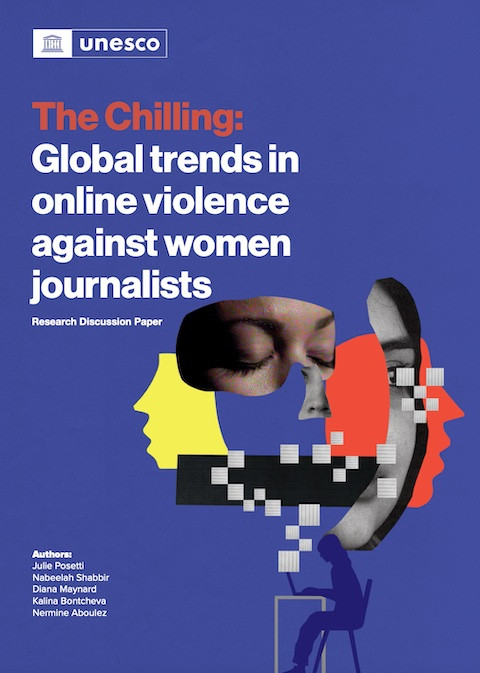 The Chilling: Global Trends in Online Violence Against Women Journalists; Research Discussion Paper Year of publication: 2021 Author: Julie Posetti | Nabeelah Shabbir | Diana Maynard | Kalina Bontcheva | Nermine Aboulez Corporate author: UNESCO This report demonstrates that online violence against women journalists is a global phenomenon, albeit one with uneven impacts that are heightened at various intersectional points, including racism, religious bigotry, sectarianism, homophobia and disinformation. There is a climate of impunity surrounding online attacks on women journalists which must be more urgently and effectively addressed because impunity emboldens the perpetrators, demoralises the victim, erodes the foundations of journalism, and undermines freedom of expression. For too long, the emphasis has been on making women journalists responsible for their own defence and protection, rather than making the perpetrators and instigators, the platform enablers, and law enforcement and media employers accountable.These methods of attack are growing more sophisticated, and they are evolving with technology. They are also increasingly networked and fuelled by political actors. This points to the need for responses to online violence to grow equally in technological sophistication and collaborative coordination. Another point highlighted by this research: most women journalists do not report or make public the online attacks they experience, in line with low levels of reporting when it comes to violence against women more broadly. Many media employers still appear reluctant to take online violence seriously. This aligns with the evident failure of the internet communications companies - whose social networks, messaging and search services facilitate much of the harassment, intimidation, abuse and threats targeting women journalists - to take effective action to address this freedom of expression and gender equality crisis.
  反击社交媒体上的仇恨言论:当代的挑战 Year of publication: 2021 Corporate author: 联合国教科文组织 (UNESCO) | Oxford Internet Institute | European Union (EU) 本文件是牛津大学互联网研究所与联合国教科文组织合作开发的一个工具包的组成部分,该工具包包含各种现有的方法、资源及研究项目,旨在监测网络仇恨言论的发生、传播和影响,以及评估反击仇恨言论的能力和做法。
  Education as a Tool for Prevention: Addressing and Countering Hate Speech (Expert Meeting: 13-18 May 2020) Year of publication: 2021 Corporate author: UNESCO Addressing and countering hate speech is a multi-layered endeavour, which includes tackling its root causes and drivers, preventing it from translating into violence and dealing with its wider societal consequences.Within the framework of the Education 2030 Agenda, and more specifically target 4.7 of Sustainable Development Goal 4 (SDG 4), as well as the United Nations Strategy and Plan of Action on Hate Speech – which places specific emphasis on the role of education as a tool for addressing hate speech – UNESCO and the United Nations Office on the Prevention of Genocide and the Responsibility to Protect (OSAPG) convened a series of virtual meetings of experts from 13 to 18 May 2020. This report highlights some of the key discussion areas and unpacks the role of education as a preventive tool. It argues that strengthening educational responses to build the resilience of learners to exclusionary rhetoric and hate speech is paramount for sustainable development and peace for all.
  Global Citizenship Education: Comoros, Djibouti, Kenya, Madagascar, Mauritius and Seychelles Year of publication: 2022 Corporate author: Organización de las Naciones Unidas para la Educación, la Ciencia y la Cultura (UNESCO) This is a collection of papers of a research project undertaken in six countries of the Eastern Africa region, namely, Comoros, Djibouti, Kenya, Madagascar, Mauritius and Seychelles to assess the Understanding and Implementation of SDG 4.7 on Global Citizenship Education (GCED) in each of the six countries.The research findings were shared by each of the six countries in a Webinar hosted by the UNESCO Nairobi Regional Office for Eastern Africa on September 23, 2021. The Webinar Agenda is contained in this publication along with the Opening and Closing Remarks made by UNESCO and Keynote Address by an affiliate UNESCO Chair in Africa.
 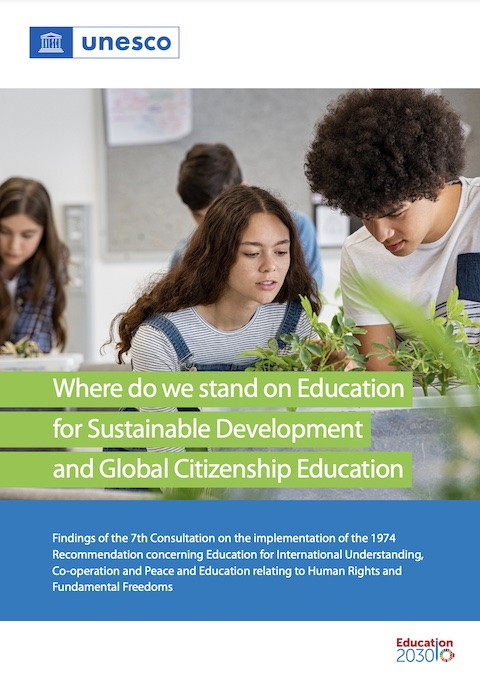 Where Do We Stand on Education for Sustainable Development and Global Citizenship Education: Findings of the 7th Consultation on the Implementation of the 1974 Recommendation Concerning Education for International Understanding, Co-operation and Peace and Education Relating to Human Rights and Fundamental Freedoms Year of publication: 2022 Corporate author: UNESCO The Recommendation concerning Education for International Understanding, Co-operation and Peace and Education relating to Human Rights and Fundamental Freedoms was adopted by the 18th session of UNESCO’s General Conference in November 1974. Every four years, Member States are invited to report on the measures they have taken to implement the Recommendation in all levels and types of education from pre-primary to tertiary, formal, non-formal and adult education. This document summarizes the results of the 7th consultation on the implementation of the 1974 Recommendation, covering the period 2017-2020. It also contains, for the first time, data for the global indicator adopted by the UN Statistical Commission and the UN General Assembly for the monitoring of Target 4.7 of Sustainable Development Goal for Education.
  UNESCO Futures of Education Report Explained by Members of the International Commission Year of publication: 2022 Corporate author: UNESCO Initiated by UNESCO, the International Commission on the Futures of Education has prepared a new report on how education can best shape the future of humanity and the planet. In this video, members of the Commission and its chair explain the main recommendations and defining features of their report, Reimagining our futures together: A new social contract for education. The report is part of UNESCO’s Futures of Education initiative which aims to rethink education and shape the future. The initiative is catalyzing a global debate on how knowledge, education and learning need to be reimagined in a world of increasing complexity, uncertainty, and precarity.