
Resources
Explore a wide range of valuable resources on GCED to deepen your understanding and enhance your research, advocacy, teaching, and learning.
1,448 Results found
 Study on measures taken by municipalities and recommendations for further action to challenge racism through education Year of publication: 2006 Author: Klaus Starl Corporate author: European Training and Research Centre for Human Rights and Democracy (Austria) Commitment 8 of the Ten-Point Plan of Action of the European Coalition of Cities against Racism requires the measures “Challenging Racism and Discrimination through Education”. This point aims to improve the access to and enjoyment of all forms of education, as well as the promotion of education in mutual tolerance and understanding. To reach this goal, the members of the coalition have been called to undertake activities, elaborate strategies and establish relevant institutions to influence society and train attitudes, behaviour and skills within the population. They are called to find out causes for racist tendencies among their population and to involve all stakeholders, particularly parents and school officials. As an external expert, the European Training and Research Centre for Human Rights and Democracy in Graz, Austria, (ETC Graz) was commissioned by UNESCO to carry out a study on the measures against racism already in place at a local level and serve as good illustration of “Commitment 8”. A major source of information was the written material provided by the selected cities. Additional or missing information could be obtained through direct exchanges and/or interviews with officers responsible for the municipalities and some NGOs. The material should not to be considered as complete. On the basis of the contributions sent in by the participating cities, the ETC assessed whether these actions/activities meet the objectives of Commitment 8. The authors used the following criteria to make this assessment: Does the action undertaken contribute to a) the improvement of access to education and promote equal opportunities; b) the impact of educational measures on individuals (potential victims and offenders) and on the atmosphere at school and in society. The following recommendations are derived from the eight selected measures documented in Chapter II, and the analysis on their “replicability” in Chapter III. The 12 recommendations explicitly or implicitly refer to the replicable documented measures. Where “replicability” requires specific conditions, or it is recommended to fulfil these conditions firstly, i.e. structural and institutional conditions, these are stated. The 12 recommendations are addressed to municipalities in Europe irrespective of their current membership in the European Coalition of Cities against Racism. As already mentioned the recommendations focus on meeting the requirements of Commitment 8, challenging racism through education.
  Building Cross-Sectoral Cooperation: Estonian Coalition for Sustainable Development Year of publication: 2020 Corporate author: Estonian Roundtable for Development Cooperation (AKÜ) | Bridge 47 | European Union (EU) This publication presents the members of Estonian Coalition for Sustainable Development, examples of their actions towards a more sustainable future and also some of the activities that the partnerships together have carried over the past few years. It is a great example of a cross-sectoral cooperation and a way of sharing knowledge.
 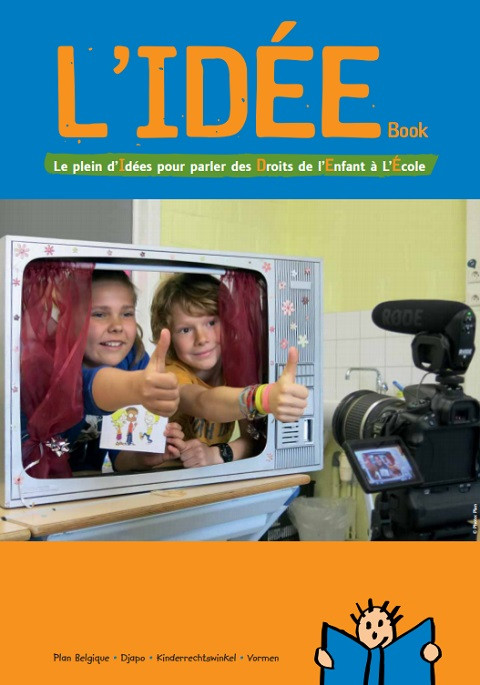 L’idée book: Le plein d’idées pour parler des droits de l’enfant à l’école Year of publication: 2019 Corporate author: Plan Belgique | Djapo | Kinderrechtswinkel | Vormen L’IDÉE Book propose de nombreuses manières d’informer les enfants sur leurs droits et ceux des autres. Ce manuel contient également de nombreuses astuces pour travailler sur les valeurs, les attitudes et les comportements de la Convention internationale des droits de l’enfant. Les activités proposées s’articulent dans une perspective Nord-Sud qui ouvrira l’esprit de vos élèves au monde extérieur. Par ailleurs, nous portons une attention particulière aux enfants de 4 à 10 ans, pour lesquels il existe peu de matériel éducatif.
 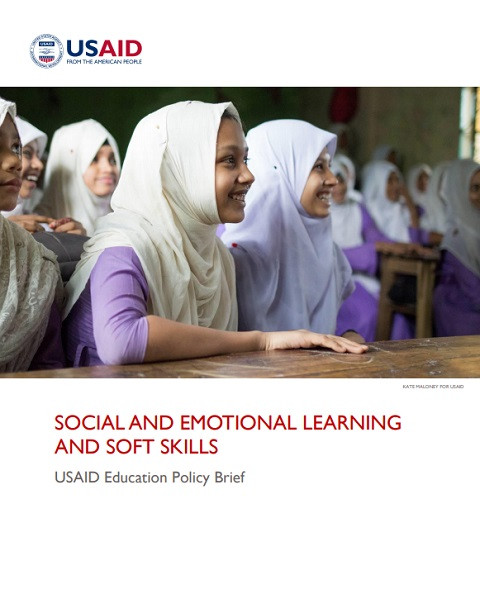 Social and Emotional Learning and Soft Skills: USAID Education Policy Brief Year of publication: 2019 Author: Kalene Resler | Anjuli Shivshanker | Samantha Alvis | Chris Capacci-Carneal | Melissa Chiappetta | Lauren Greubel | Julie Hanson Swanson | Ashley Henderson | Josh Josa | Laura Lartigue | Rebeca Martinez | Leah Maxson | Olga Merchan | Yolande Miller-Grandvaux | Sandy Oleksy-Ojikutu | Rebecca Pagel | Nancy Taggart | Nina Weisenhorn | Wendy Wheaton Corporate author: United States Agency for International Development (USAID) Both the 2018 USG Strategy on International Basic Education and the 2018 USAID Education Policy emphasize the importance of social and emotional skills or soft skills in assuring the long-term success of children and youth. Through the Strategy and Policy, USAID is providing new opportunities to systematically design, measure, implement, and understand the impact of programs that build social and emotional skills or soft skills for children and youth.To support USAID staff and implementing partners in this work, this brief: Provides an introductory understanding of what USAID means by the terms “social and emotional skills” and “soft skills” and how to communicate about them. Specifies the desired outcomes and quality standards for programming that teach social and emotional skills or soft skills. Identifies areas in which evidence and best practices still have gaps, and areas in which we should consider investing in further learning.
 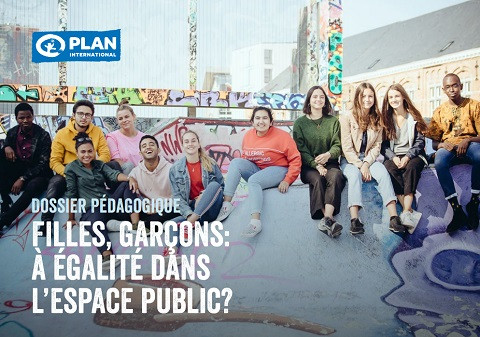 Dossier pédagogique: Filles, garçons, à égalite dans l'espace public? Year of publication: 2019 Corporate author: Plan International Ce dossier pédagogique vise à sensibiliser les adolescent-e-s à propos des inégalités entre garçons et filles et à les faire réfléchir aux conséquences. Le message global est positif: le chemin est porteur d’espoir. Les jeunes peuvent changer les choses. Ils/elles peuvent réfléchir et s’élever contre des normes inadaptées et construire leur avenir. Et nous pouvons, ensemble, briser les stéréotypes de genre, améliorer les modèles de rôles et construire à l’égalité des chances entre garçons et filles. Prendre conscience du poids des stéréotypes et les questionner constamment en les observant à travers le prisme du genre sont des étapes décisives sur la voie de l’égalité. La classe est un cadre idéal pour cette remise en question.
  Confronting White Nationalism in Schools: A Toolkit Year of publication: 2019 Author: Nora Flanagan | Jessica Acee | Lindsay Schubiner Corporate author: Western States Center This toolkit shows strategies to counter white nationalist organizing in schools through sample scenarios that schools frequently encounter. It also offers advice for parents, students, teachers, school administrators, and the wider community. Many resources currently exist that address diversity, inclusion, and bullying in schools; a few of them are listed in the resources section. This toolkit is specifically focused on responding to white nationalist targeting and recruitment of students.
  Stepping Stones for the Sustainable Development Goals: A Workbook for Community and Adult Education Practitioners Year of publication: 2020 Author: Jennifer Harris Corporate author: Development Perspectives | Irish Aid The aim of this workbook is to provide a tool for Adult and Community groups and their leaders to understand the Sustainable Development Goals (SDGs) and to take meaningful action on those Goals. It aims to support adult and community educators in integrating the SDGs into their work using the principles and methodologies embraced by Development Education (DE)and Global Citizenship Education (GCE).
 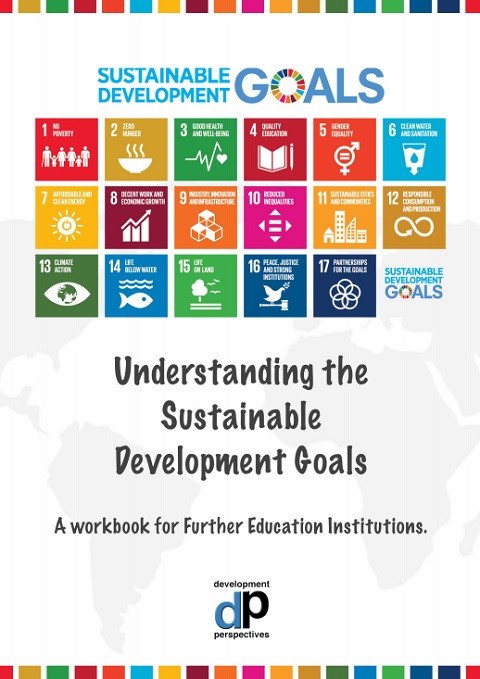 Understanding the Sustainable Development Goals: A Workbook for Further Education Institutions Year of publication: 2020 Author: Peggy Flanagan | Stephanie Kirwan Corporate author: Development Perspectives | Irish Aid This Sustainable Development Goals (SDG) workbook has been developed and produced specifically for the use of Further Education tutors. Through their partnerships, practitioners have requested that Development Perspectives develop a workbook with sessions on the SDGs specifically for adults in formal and non-formal learning contexts including groups in the community sector. This is an easy to use workbook with sessions for each of the 17 SDGs that could be delivered individually based on the interest of the adults and communities involved in each session.
 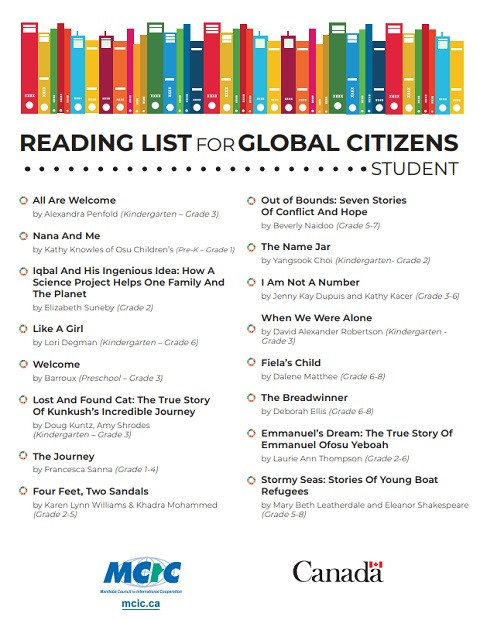 Reading List for Global Citizens: Student Year of publication: 2020 Corporate author: Manitoba Council for International Cooperation (MCIC) | Global Affairs Canada (GAC) This is a reading list for global citizens from Kindergarten to Grade 12. These books will inspire students to take action whether they are passionate about food security, ending poverty, supporting women’s rights, or protecting the environment.
 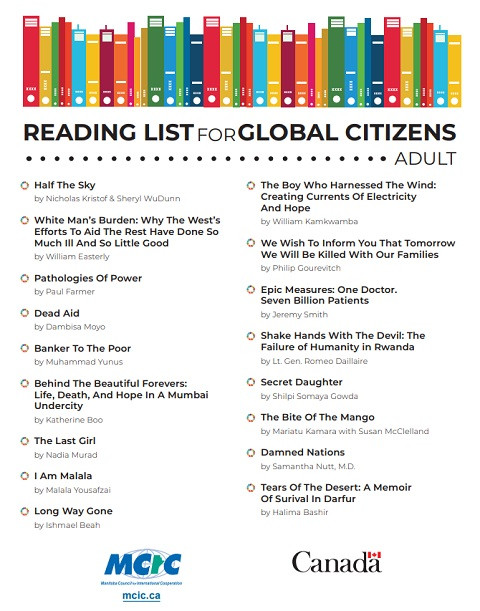 Reading List for Global Citizens: Adult Year of publication: 2020 Corporate author: Manitoba Council for International Cooperation (MCIC) | Global Affairs Canada (GAC) This reading list helps readers to be a global citizen by reading books that are informative and inspiring.