
Resources
Explore a wide range of valuable resources on GCED to deepen your understanding and enhance your research, advocacy, teaching, and learning.
1,402 Results found
 Guide pour l'évaluation d'un plan sectoriel d'éducation Year of publication: 2015 Corporate author: UNESCO International Institute for Educational Planning (IIEP) | Global Partnership for Education (GPE) At the World Education Forum, in Dakar in 2000, the international community pledged that no country with a credible plan to achieve the Education for All goals would be thwarted by a lack of resources. Since then, the development of an education sector plan (ESP) has become a priority in many countries. ESPs present the policies and strategies for national education reform, and are a powerful tool for coordinating partners and for mobilizing additional domestic and external resources. They have become a critical instrument for governments to signal to all potential investors that their education policies are credible, sustainable, and worthy of investment.The consensus on the need for credible ESPs is strong. However, what does a credible plan require in terms of government leadership, knowledge and data, institutional and human capacities, and dialogue among the education stakeholders? What are the criteria that establish the credibility of a plan? The purpose of these guidelines is to assist education stakeholders in appraising the soundness, relevance, and coherence that form the credibility of ESPs. The primary objective of an appraisal report is to support the finalization of a credible ESP. It provides a fair review of the ESP strengths and areas in need of improvement before the endorsement by partners which signifies their commitment to support the implementation of the ESP. These guidelines are meant to be adapted to national contexts and needs. The stakeholders should discuss the scope and the methodology of the appraisal to be used, and develop a common vision of the whole process. The appraisal process should be participatory, and grounded in the political and technical dialogue for ESP development. It should involve consultations, interviews with key stakeholders, and field visits, in addition to a desk review of the ESP and any other relevant documents. It is good practice to organize a validation workshop of the appraisal report’s findings, conclusions, and recommendations to feed into the ESP finalization. The appraisal process should occur early enough in the ESP development process to allow time for decision-makers to open consultations on these conclusions and recommendations in order to improve the final version of the ESP. Planning education with and for youth Year of publication: 2015 Author: Anja Hopma | Lynne Sergeant Corporate author: UNESCO International Institute for Educational Planning (IIEP) As a central stakeholder in education, young people should be involved in educational planning. This publication focuses on the rationale for and obstacles to youth involvement, as well as the efforts of ministries of education to engage youth in their planning work. It is based on discussions and recommendations that emerged from the high-level international policy forum on ‘Engaging youth in planning education for social transformation’ organized by the UNESCO International Institute for Educational Planning (IIEP) in Paris from 16 to 18 October 2012. This policy forum set out to explore the following broad themes: (i) youth engagement in planning education for conflict transformation and peace building; (ii) strengthening young people’s skills and opportunities for civic engagement within formal and non-formal education systems; and (iii) enhancing the relevance of education systems for young people in their transition to employment. This publication draws on the exchanges during the pre-forum online debates, discussions among participants during the forum, and testimonials from practitioners and youth. Planifier l'éducation avec et pour les jeunes Year of publication: 2015 Author: Anja Hopma | Lynne Sergeant Corporate author: UNESCO International Institute for Educational Planning (IIEP) En tant que partie prenante centrale dans l'éducation, les jeunes doivent être impliqués dans la planification de l'éducation. Cette publication met l'aCECnt sur les raisons et les obstacles à la participation des jeunes, ainsi que les efforts des ministères de l'éducation pour engager les jeunes dans leur travail de planification. Il est basé sur des discussions et des recommandations issues du forum de politique internationale de haut niveau sur «Engager les jeunes dans l'enseignement de la planification pour la transformation sociale» organisé par l'Institut international de l'UNESCO pour la planification de l'éducation (IIPE) à Paris du 16 au 18 Octobre 2012. Cette forum politique a entrepris d'explorer les grands thèmes suivants: (i) l'engagement des jeunes dans l'enseignement de la planification pour la transformation des conflits et de consolidation de la paix; (Ii) le renforcement des compétences et des possibilités d'engagement civique dans les systèmes formels et d'éducation non formelle des jeunes; et (iii) l'amélioration de la pertinence des systèmes d'éducation pour les jeunes dans leur transition vers l'emploi. Cette publication se fonde sur les échanges au cours de la pré-forum en ligne des débats, des discussions entre les participants lors du forum, et des témoignages de praticiens et les jeunes.
 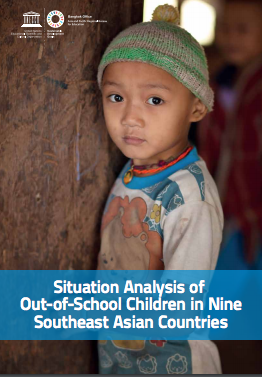 Situation analysis of out-of-school children in nine southeast Asian countries Year of publication: 2017 Corporate author: UNESCO Bangkok In a world that continually aspires for every child and youth to have access to education, there are still large numbers of out-of-school children (OOSC) who are yet to claim their right to basic education. In 2013, the number of children who are not in school, who have dropped out, and who have never been to school have risen to 124 million after seeing the numbers continuously drop for much of the first decade of the 21st century. In much of Southeast Asia, close to seven million children of both primary and lower secondary school-age find themselves in the same situation. In an effort to assist the countries in Southeast Asia to develop more robust policies and programmes for OOSC in their respective countries, this report was commissioned to map out the current legislations, policies, characteristics, and interventions on out-of-school children in nine countries across the region, which include Cambodia, Indonesia, Lao PDR, Malaysia, Myanmar, the Philippines, Thailand, Timor-Leste and Vietnam. Using a desk review of available and relevant secondary data, the study covered OOSC of primary and lower secondary school-age. Situation analysis of out-of-school children in nine southeast Asian countries Year of publication: 2017 Corporate author: UNESCO Bangkok In a world that continually aspires for every child and youth to have access to education, there are still large numbers of out-of-school children (OOSC) who are yet to claim their right to basic education. In 2013, the number of children who are not in school, who have dropped out, and who have never been to school have risen to 124 million after seeing the numbers continuously drop for much of the first decade of the 21st century. In much of Southeast Asia, close to seven million children of both primary and lower secondary school-age find themselves in the same situation. In an effort to assist the countries in Southeast Asia to develop more robust policies and programmes for OOSC in their respective countries, this report was commissioned to map out the current legislations, policies, characteristics, and interventions on out-of-school children in nine countries across the region, which include Cambodia, Indonesia, Lao PDR, Malaysia, Myanmar, the Philippines, Thailand, Timor-Leste and Vietnam. Using a desk review of available and relevant secondary data, the study covered OOSC of primary and lower secondary school-age. Situation analysis of out-of-school children in nine southeast Asian countries Year of publication: 2017 Corporate author: UNESCO Bangkok In a world that continually aspires for every child and youth to have access to education, there are still large numbers of out-of-school children (OOSC) who are yet to claim their right to basic education. In 2013, the number of children who are not in school, who have dropped out, and who have never been to school have risen to 124 million after seeing the numbers continuously drop for much of the first decade of the 21st century. In much of Southeast Asia, close to seven million children of both primary and lower secondary school-age find themselves in the same situation. In an effort to assist the countries in Southeast Asia to develop more robust policies and programmes for OOSC in their respective countries, this report was commissioned to map out the current legislations, policies, characteristics, and interventions on out-of-school children in nine countries across the region, which include Cambodia, Indonesia, Lao PDR, Malaysia, Myanmar, the Philippines, Thailand, Timor-Leste and Vietnam. Using a desk review of available and relevant secondary data, the study covered OOSC of primary and lower secondary school-age.
  Teacher Policy Development Guide Year of publication: 2019 Corporate author: UNESCO | International Task Force on Teachers for Education 2030 Countries will need to have a broad perspective on teacher issues in order to meet Sustainable Development Goal 4 and address the provisions on Teachers in the Incheon Declaration with the Framework for Action of Education 2030. A system to orient the elaboration and/or review of national teacher policies will be a useful tool. The International Teacher Task Force builds on its comparative advantage as a global multiple-stakeholder alliance joining hands to address the global teacher challenges, to offer the present Teacher Policy Development Guide.Users will find relevant definitions of concepts, description of the different dimensions of teacher issues and how they correlate, and suggestions of phases in the process of developing a national teacher policy. Of utmost importance is the involvement of all stakeholders, especially the teachers, in the process.
 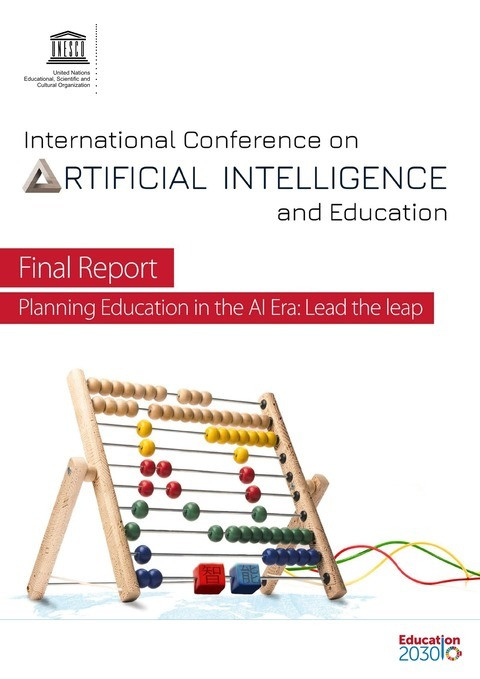 International Conference on Artificial Intelligence and Education, Planning Education in the AI Era: Lead the Leap; Final Report Year of publication: 2019 Corporate author: UNESCO The current report is an exhaustive account of the discussion and debate at the International Conference on Artificial Intelligence and Education (hereafter referred to as ‘the conference’) held in Beijing from 16 to 18 May 2019. Under the overarching theme of ‘Planning Education in the AI Era: Lead the Leap’, the conference was structured into seven plenary sessions and 16 breakout sessions complemented by a live exhibition and study tours to facilitate forwardlooking debates, share cutting-edge knowledge and AI solutions, and deliberate on sector-wide strategies.
 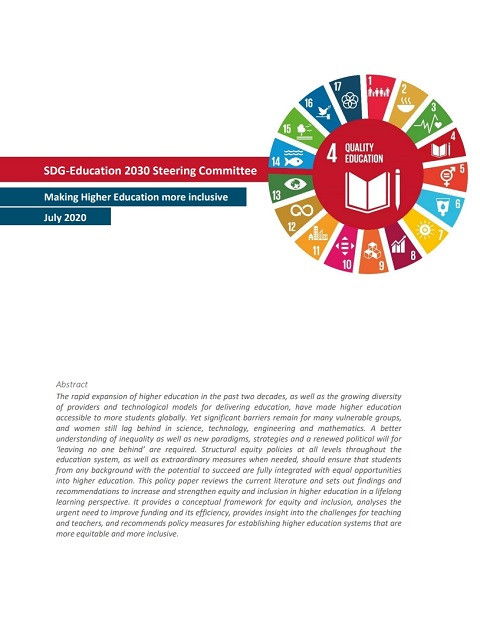 SDG-Education 2030 Steering Committee: Making Higher Education More Inclusive, July 2020 Year of publication: 2020 Corporate author: UNESCO The rapid expansion of higher education in the past two decades, as well as the growing diversity of providers and technological models for delivering education, have made higher education accessible to more students globally. Yet significant barriers remain for many vulnerable groups, and women still lag behind in science, technology, engineering and mathematics. A better understanding of inequality as well as new paradigms, strategies and a renewed political will for ‘leaving no one behind’ are required. Structural equity policies at all levels throughout the education system, as well as extraordinary measures when needed, should ensure that students from any background with the potential to succeed are fully integrated with equal opportunities into higher education. This policy paper reviews the current literature and sets out findings and recommendations to increase and strengthen equity and inclusion in higher education in a lifelong learning perspective. It provides a conceptual framework for equity and inclusion, analyses the urgent need to improve funding and its efficiency, provides insight into the challenges for teaching and teachers, and recommends policy measures for establishing higher education systems that are more equitable and more inclusive.
  Transforming Knowledge and Research for Just and Sustainable Futures: Towards a New Social Imaginary for Higher Education (Education, Research and Foresight: Working Papers; No.33, 2024) Year of publication: 2024 Author: Leon Tikly Corporate author: UNESCO The paper considers why it is important to transform knowledge and research for just and sustainable futures and discusses the role of higher education in these transformation processes. The paper sets out how knowledge, research, and knowledge systems can be understood and critiques knowledge hierarchies that have emerged in the context of colonialism, leading to the marginalization of the knowledge systems and languages of the colonized. It is argued that there is a need to create new ecologies of knowledge that value and develop synergies between ‘all of the archives of the world’ and that can revitalize and expand the knowledge commons and contribute to more just and sustainable futures. Higher education has a pivotal role to play in the creation of new ecologies of knowledge and a revitalized knowledge commons through promoting socially and ethically engaged research, the decolonization and reorientation of university curricula and pedagogy to foster sustainable futures, and the democratization of universities to better represent historically marginalized groups. Underpinning this role must be a shift from a Western modernist social imaginary of higher education to one based on a new planetary consciousness.