
Resources
Explore a wide range of valuable resources on GCED to deepen your understanding and enhance your research, advocacy, teaching, and learning.
1,471 Results found
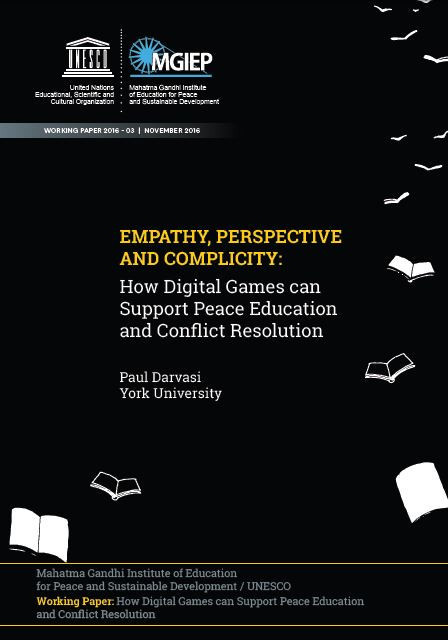 Empathy, Perspective and Complicity: How Digital Games can Support Peace Education and Conflict Resolution Year of publication: 2016 Author: Paul Darvasi Corporate author: Mahatma Gandhi Institute of Education for Peace and Sustainable Development (MGIEP) This paper will address how digital games may be uniquely suited to further the work of peace education and conflict resolution. There is a scarcity of research that specifically studies how digital games, as dynamic and interreactive learning tools, can be leveraged to support and enhance the closely related fields of peace education or conflict resolution; however, research in a number relevant sectors will be recruited to better understand the topic and expose gaps for further work. After defining basic terms, the first section will briefly discuss the aims of peace education and interactive conflict resolution and how digital games can assist in facilitating intergroup contact and collaboration. The heart of the paper will examine several serious games for their potential to cultivate perspective-taking and empathy, explore ethical dilemmas, promote intercultural understanding and encourage a sense of complicity, all crucial components in the work of peace education and conflict resolution. The final section will discuss the importance of context and reflection when implementing digital games and consider whether they can produce long-term, sustainable changes to behaviors and attitudes.
 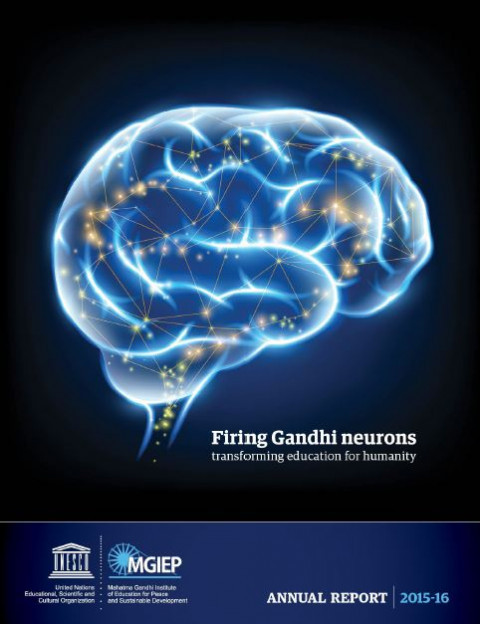 MGIEP Annual Report 2015-2016 Year of publication: 2017 Corporate author: Mahatma Gandhi Institute of Education for Peace and Sustainable Development (MGIEP) The Mahatma Gandhi Institute of Education for Peace and Sustainable Development (MGIEP) is UNESCO’s first Category I institute in the Asia-Pacific region, established with the generous support of the Government of India.UNESCO MGIEP focuses on transforming current education policies and practices by developing innovative teaching and learning methods. Their objective is to build generations of young people equipped to create peaceful and sustainable societies.This annual report describes MGIEP’s main works and various educational programmes for peace and sustainable development.
  Address by Irina Bokova, Director-General of UNESCO on the occasion of the Event on Education for Preventing Violent Extremism; Brussels, 21 March 2017 Year of publication: 2017 Corporate author: UNESCO. Director-General, 2009-2017 (Bokova, I.G.) This address was delivered by Irina Bokova, Director-General of UNESCO on the occasion of the Event on Education for Preventing Violent Extremism.
  Address by Irina Bokova, Director-General of UNESCO, on the occasion of the event organized by Albania, Jordan and the Holy See: Fighting radicalization and extremism through Education; United Nations General Assembly 2016; New York, 20 September 2016 Year of publication: 2016 Corporate author: UNESCO. Director-General, 2009-2017 (Bokova, I.G.) This address was presented by Irina Bokova, Director-General of UNESCO, on the occasion of the event organized by Albania, Jordan and the Holy See.
 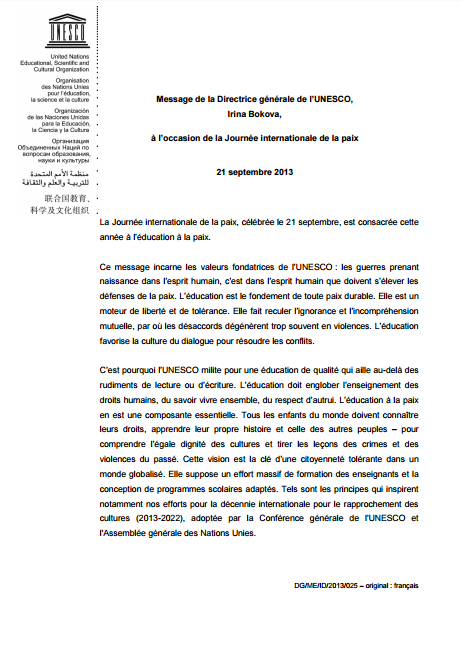 Message from Irina Bokova, Director-General of UNESCO on the occasion of the International Day of Peace, 21 September 2013 Year of publication: 2013 Corporate author: UNESCO. Director-General, 2009-2017 (Bokova, I.G.) This is the message from Irina Bokova, Director-General of UNESCO on the occasion of the International Day of Peace, 21 September 2013. Message de la Directrice générale de l'UNESCO, Irina Bokova, à l'occasion de la Journée internationale de la paix, 21 septembre 2013 Year of publication: 2013 Corporate author: UNESCO. Director-General, 2009-2017 (Bokova, I.G.) This is the message from Irina Bokova, Director-General of UNESCO on the occasion of the International Day of Peace, 21 September 2013. Mensaje de la Directora General de la UNESCO, Irina Bokova, con motivo del Día Internacional de la Paz, 21 de septiembre de 2013 Year of publication: 2013 Corporate author: UNESCO. Director-General, 2009-2017 (Bokova, I.G.) This is the message from Irina Bokova, Director-General of UNESCO on the occasion of the International Day of Peace, 21 September 2013. Послание Генерального директора ЮНЕСКО г-жи Ирины Боковой по случаю Международного дня мира, 21 сентября 2013 г. Year of publication: 2013 Corporate author: UNESCO. Director-General, 2009-2017 (Bokova, I.G.) This is the message from Irina Bokova, Director-General of UNESCO on the occasion of the International Day of Peace, 21 September 2013. رسالة من السيدة إيرينا بوكوفا، المديرة العامة لليونسكو، بمناسبة اليوم العالمي للسلام، ٢١ أيلول/سبتمبر٢٠١٣ Year of publication: 2013 Corporate author: UNESCO. Director-General, 2009-2017 (Bokova, I.G.) This is the message from Irina Bokova, Director-General of UNESCO on the occasion of the International Day of Peace, 21 September 2013. 联合国教科文组织总干事伊琳娜•博科娃在国际和平日的致辞,2013年9月21日 Year of publication: 2013 Corporate author: UNESCO. Director-General, 2009-2017 (Bokova, I.G.) This is the message from Irina Bokova, Director-General of UNESCO on the occasion of the International Day of Peace, 21 September 2013.