
Resources
Explore a wide range of valuable resources on GCED to deepen your understanding and enhance your research, advocacy, teaching, and learning.
1,443 Results found
 Peacebuilding, education and advocacy in conflict-affected contexts programme; UNICEF Programme Report 2012-2016 Year of publication: 2016 Corporate author: United Nations Children's Fund (UNICEF) UNICEF’s Programme Report 2012–2016 is organized into two parts. Part 1 provides evidence of what works and does not work in peacebuilding efforts, situating the Learning for Peace programme as a case study within the larger global discussion around peace and security. Part 2 accounts for the activities implemented and results emerging from the programme against its results framework and financial input, and includes a description of support for gender-sensitive, responsive and transformative programmatic approaches.
  Landmarks of Mercy between Islam and Multiculturalism Year of publication: 2016 Author: Abdel Karim Osman Ali Corporate author: Nile Valley University Conference paper in which the researcher sought to: Explaining the greatness and comprehensiveness of the Allah’s path Disclosure of the features of mercy through the Qur’anic intentions to recognize and respect cultural diversity Show the distinction of Islam over the latest political theories in the West. معالم الرحمة بين الاسلام والتعددية الثقافية Year of publication: 2016 Author: Abdel Karim Osman Ali Corporate author: Nile Valley University ورقة مؤتمر سعى الباحث فيها إلى: بيان عظمة المنهج الرباني وشموله. الكشف عن معالم الرحمة من خلال المقاصد القرآنية في إقرار واحترام التنوع الثقافي تبيين تميز الإسلام على آخر النظريات السياسية في الغرب.
  What's Left of Spring? A Long Path towards Social Justice In the Arab Region; Case Study: Egypt, Tunisia, and Morocco Year of publication: 2015 Corporate author: United Nations Economic and Social Commission for Western Asia (ESCWA) “What is left of the spring? A long path towards achieving social justice in the Arab region” is the first in a series of social development reports that ESCWA intends to publish. It comes two years after the publication of “Spring Promises: Citizenship and Civic Participation in the Paths of Democratic Transition,” the study that reviewed the general context surrounding the so-called Arab Spring and addressed the challenges facing achieving social justice, consensus and maintaining social cohesion during political transitions. This report is also issued the day after the international community adopts a new global path for development, which is the 2030 Agenda for Sustainable Development, of which social justice is the main pillar. ماذا تبقّى من الربيع ؟ : مسار طويل نحو تحقيق العدالة الاجتماعية في المنطقة العربية : دراسة حالة : مصر وتونس والمغرب Year of publication: 2015 Corporate author: United Nations Economic and Social Commission for Western Asia (ESCWA) "ماذا تبقّى من الربيع؟ مسار طويل نحو تحقيق العدالة الاجتماعية في المنطقة العربية" هو التقرير الأول من سلسلة تقارير عن التنمية الاجتماعية تعتزم الإسكوا إصدارها. وهو يأتي بعد مرور سنتين على إصدار "وعود الربيع: المواطنة والمشاركة المدنية في مسارات التحول الديمقراطي"، الدراسة التي استعرضت السياق العام الذي أحاط بما سُمي الربيع العربي وتناولت التحديات التي تواجه تحقيق العدالة الاجتماعية والتوافق في الآراء والحفاظ على التماسك الاجتماعي أثناء التحولات السياسية. آما يصدر هذا التقرير غداة اعتماد المجتمع الدولي مساراً عالمياً جديداً للتنمية هو خطة التنمية المستدامة لعام 2030 التي تشكل العدالة الاجتماعية ركيزتها الأساسية.
  IBE-UNESCO preparatory report for the 48th ICE on inclusive education Year of publication: 2007 Corporate author: UNESCO International Bureau of Education (IBE) The International Conference on Education (ICE) is a major international forum for educational policy dialogue among Ministers of Education and other stakeholders (researchers, practitioners, representatives of intergovernmental organizations and NGOs). The ICE is organized by the International Bureau of Education (IBE), the UNESCO institute specialized in assisting Member States in curriculum development to achieve quality Education For All. The IBE Council, composed of 28 UNESCO Member States, has proposed in January 2007 that the 48th ICE session, to be held in Geneva in November 2008, should focus on the theme “Inclusive Education: the Way of the Future”. The 48th ICE will focus on broadening the understanding of the theory and practice of inclusive education while discussing how governments can develop and implement policies on inclusive education. The IBE is hosting a series of regional preparatory workshops dedicated to exploring and advancing inclusive education in preparation for the ICE 2008. The Regional Preparatory Workshop "International Workshop on Inclusive Education, Andean and Southern Cone Regions” was held in Buenos Aires, Argentina on the 11-14 September 2007. This event was organized by the International Bureau of Education (IBE/UNESCO), the Division for the Promotion of Basic Education (ED/BAS, UNESCO Paris), the Regional Bureau of Education for Latin America and the Caribbean (OREALC/UNESCO); University of de San Andrés, Ministry of Science, Technology and Education, in collaboration with the Community of Practice - Southern Cone and Andean Regions; it had the participation of ten countries from the Southern Cone and Andean Regions. This report is based on the workshop’s country reports and presentations on the conception and status of inclusive education in participating countries, and on the ideas proposed by participants on what the next steps should be on how to advance inclusive education policy and implementation in the region. Rapport préparatoire du BIE-UNESCO pour la 48e CIE sur l'éducation inclusive Year of publication: 2007 Corporate author: UNESCO International Bureau of Education (IBE) La Conférence Internationale sur l'Éducation (CIE) est un important forum international pour le dialogue sur les politiques éducatives entre les Ministres de l'Éducation et d'autres parties prenantes (chercheurs, praticiens, représentants d'organisations intergouvernementales et ONG). CIE est organisé par le Bureau International d'Éducation (BIE), l'Institut de l'UNESCO spécialisé pour aider les États membres dans l'élaboration des programmes pour atteindre une éducation de qualité pour tous. Le Conseil du BIE, composé de 28 États membres de l'UNESCO, a proposé en Janvier 2007 que la session de la CIE 48e, qui se tiendra à Genève en Novembre 2008, devrait se concentrer sur le thème «Education pour l'inclusion: la voie de l'avenir». La 48e CIE mettra l'aCECnt sur l'élargissement de la compréhension de la théorie et la pratique de l'éducation inclusive, tout en discutant comment les gouvernements peuvent élaborer et mettre en œuvre des politiques sur l'éducation inclusive. Le BIE organise une série d'ateliers préparatoires régionaux dédiés à l'exploration et de faire progresser l'éducation inclusive dans la préparation de la CIE 2008. L'Atelier régional préparatoire "Atelier international sur l'éducation inclusive, des Andes et les régions du Cône Sud» a eu lieu à Buenos Aires, Argentine sur la 11-14 Septembre 2007. Cet événement a été organisé par le Bureau International d'Éducation (BIE / UNESCO), la Division de la promotion de l'Éducation de Base (ED / BAS, UNESCO Paris), le Bureau Régional de l'Éducation pour l'Amérique latine et les Caraïbes (OREALC / UNESCO); Université de de San Andrés, Ministère de la Science, de la Technologie et de l'Éducation, en collaboration avec la Communauté de Pratique - Cône Sud et les régions andines;. il y avait la participation de dix pays du Cône Sud et les régions andines Cette rapport est basé sur les rapports et les présentations des pays de l'atelier sur la conception et le statut de l'éducation inclusive dans les pays participants, ainsi que sur les idées proposées par les participants sur les prochaines étapes devraient être sur la façon de faire progresser la politique de l'éducation inclusive et la mise en œuvre dans la région.
 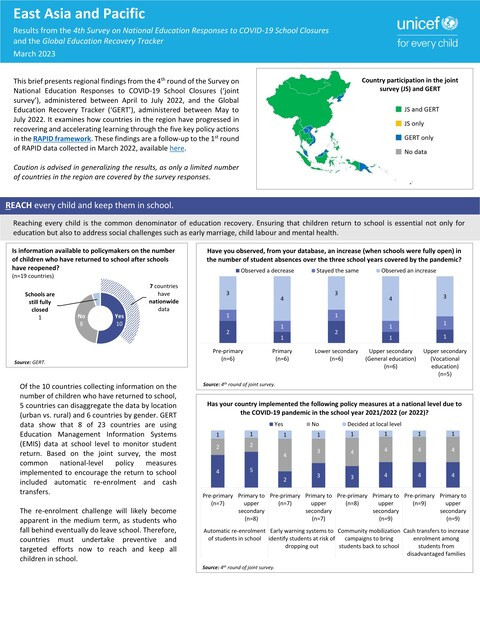 Education in a Post-COVID World: Towards a Rapid Transformation; East Asia and Pacific Regional Brief Year of publication: 2023 Corporate author: United Nations Children's Fund (UNICEF) On March 11, 2020, the World Health Organization declared COVID-19 a global pandemic, resulting in disruptions to education at an unprecedented scale. In response to the urgent need to recover learning losses, countries worldwide have taken RAPID actions to: Reach every child and keep them in school; Assess learning levels regularly; Prioritize teaching the fundamentals; Increase the efficiency of instruction; and Develop psychosocial health and wellbeing. This brief presents regional findings from the 4th round of the Survey on National Education Responses to COVID-19 School Closures (‘joint survey’), administered between April to July 2022, and the Global Education Recovery Tracker (‘GERT’), administered between May to July 2022. It examines how countries in the region have progressed in recovering and accelerating learning through the five key policy actions in the RAPID framework. These findings are a follow-up to the 1st round of RAPID data collected in March 2022.
 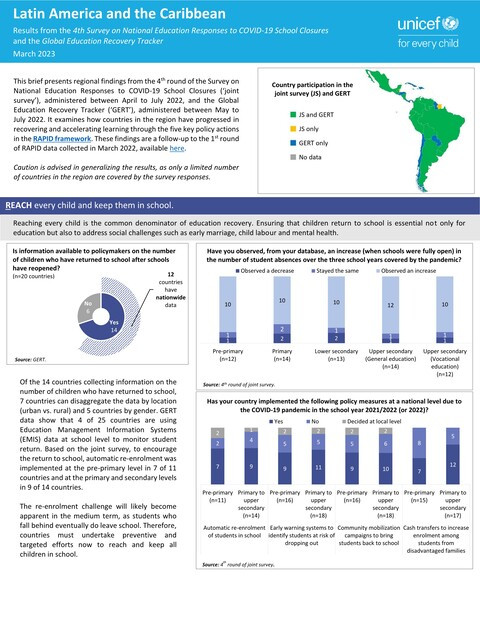 Education in a Post-COVID World: Towards a Rapid Transformation; Latin America and the Caribbean Regional Brief Year of publication: 2023 Corporate author: United Nations Children's Fund (UNICEF) On March 11, 2020, the World Health Organization declared COVID-19 a global pandemic, resulting in disruptions to education at an unprecedented scale. In response to the urgent need to recover learning losses, countries worldwide have taken RAPID actions to: Reach every child and keep them in school; Assess learning levels regularly; Prioritize teaching the fundamentals; Increase the efficiency of instruction; and Develop psychosocial health and wellbeing. This brief presents regional findings from the 4th round of the Survey on National Education Responses to COVID-19 School Closures (‘joint survey’), administered between April to July 2022, and the Global Education Recovery Tracker (‘GERT’), administered between May to July 2022. It examines how countries in the region have progressed in recovering and accelerating learning through the five key policy actions in the RAPID framework. These findings are a follow-up to the 1st round of RAPID data collected in March 2022.
 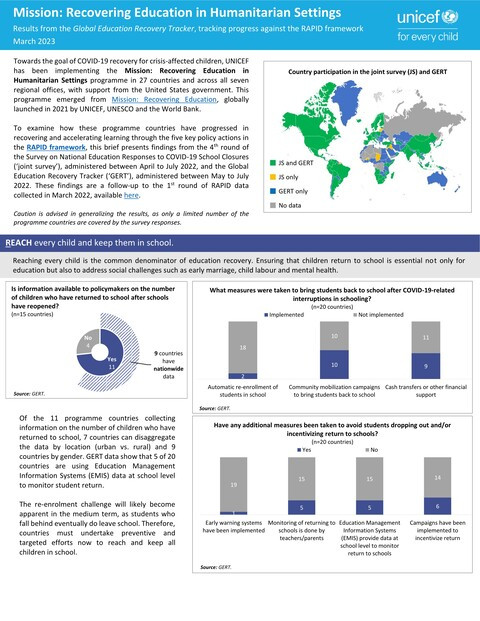 Education in a Post-COVID World: Towards a Rapid Transformation; Mission Recovering Education in Humanitarian Settings Brief Year of publication: 2023 Corporate author: United Nations Children's Fund (UNICEF) Towards the goal of COVID-19 recovery for crisis-affected children, UNICEF has been implementing the Mission: Recovering Education in Humanitarian Settings programme in 27 countries and across all seven regional offices, with support from the United States government. This programme emerged from Mission: Recovering Education, globally launched in 2021 by UNICEF, UNESCO and the World Bank. To examine how these programme countries have progressed in recovering and accelerating learning through the five key policy actions in the RAPID framework, this brief presents findings from the 4th round of the Survey on National Education Responses to COVID-19 School Closures (‘joint survey’), administered between April to July 2022, and the Global Education Recovery Tracker (‘GERT’), administered between May to July 2022. These findings are a follow-up to the 1st round of RAPID data collected in March 2022.