
Resources
Explore a wide range of valuable resources on GCED to deepen your understanding and enhance your research, advocacy, teaching, and learning.
3,229 Results found
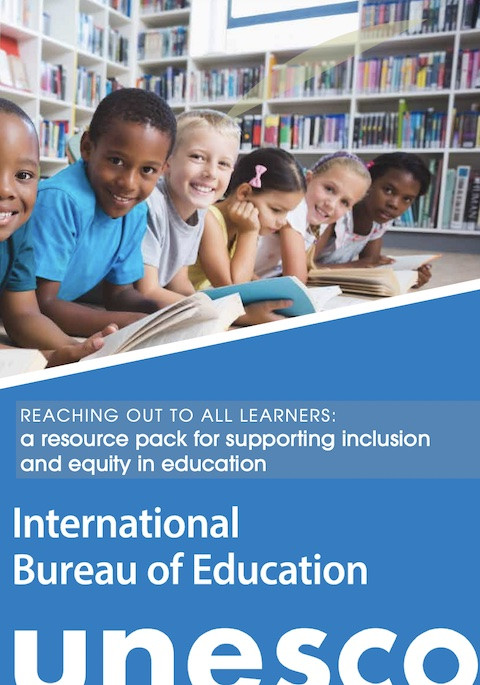 Llegando a todos los estudiantes: Una caja de recursos de la UNESCO-OIE para apoyar la inclusión y la equidad en la educación Year of publication: 2021 Corporate author: UNESCO International Bureau of Education (IBE) El material de recursos LLEGANDO A TODOS LOS ESTUDIANTES aborda los aspectos prácticos de la solución a estos problemas. En concreto, estos recursos se centran en tres cuestiones estratégicas:¿Cómo pueden crecer las escuelas para responder positivamente a la diversidad de los estudiantes?¿Cómo pueden desarrollarse prácticas docentes en el aula que garanticen que las lecciones sean inclusivas?¿Cómo pueden las escuelas involucrar a las familias, a las escuelas asociadas y a la comunidad en general en sus esfuerzos por ser inclusivas y equitativas? Atteindre tous les apprenants: Outils pour soutenir l’inclusion et l’équité dans l’éducation Year of publication: 2021 Corporate author: UNESCO International Bureau of Education (IBE) Les supports de référence du dossier ouvert Atteindre tous les apprenants abordent les aspects pratiques de la résolution de ces problèmes dans les écoles et autres centres d’éducation, et notamment dans l’enseignement préscolaire et supérieur. Ces supports se concentrent plus précisément sur trois questions stratégiques :Comment développer les écoles afin de s’adapter positivement à la diversité des élèves ?Comment développer des pratiques de classe qui garantissent que les cours sont inclusifs ?De quelle manière les écoles peuvent-elles impliquer les familles, les écoles partenaires et la communauté au sens large dans leurs efforts pour devenir inclusives et équitables ?
 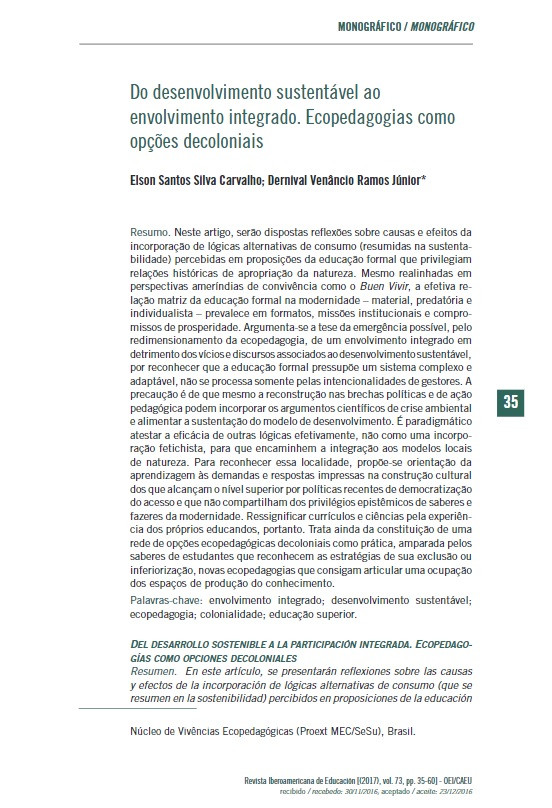 From Sustainable Development to Integrated Participation: Ecopedagogies as Decolonial Options (Revista Iberoamericana De Educación; vol.73) Year of publication: 2017 Author: Elson Santos SilvaCarvalho | Dernival Venâncio Ramos Junior In this article, reflections will be presented on the causes and effects of the incorporation of alternative logics of consumption (which are summarized in sustainability) perceived in propositions of formal education that emphasize the historical relationships of appropriation of nature. Even realigned with an Amerindian perspective of coexistence such as Good Living, the matrix relationship of formal education in modern times - material, predatory and individualistic - prevails in formats, institutional missions and prosperity commitments. The thesis of the possible emergence, through the new dimensions of ecopedagogy, of an integrated participation at the expense of vices and discourses related to sustainable development is sustained, recognizing that formal education requires a complex and adaptive system, not only the intentions of managers for your process. Del desarrollo sostenible a la participación integrada: Ecopedagogías como opciones decoloniales Year of publication: 2017 Author: Elson Santos SilvaCarvalho | Dernival Venâncio Ramos Junior En este artículo, se presentarán reflexiones sobre las causas y efectos de la incorporación de lógicas alternativas de consumo (que se resumen en la sostenibilidad) percibidos en proposiciones de la educación formal que hacen hincapié en las relaciones históricas de apropiación de la naturaleza. Incluso realineada con una perspectiva amerindia de convivencia como el Buen Vivir, la relación matriz de la educación formal en los tiempos modernos - material, depredadora e individualista - prevalece en los formatos, las misiones institucionales y los compromisos de prosperidad. Se sostiene la tesis de la posible emergencia, mediante las nuevas dimensiones de la ecopedagogía, de una participación integrada a expensas de vicios y discursos relacionados con el desarrollo sostenible, reconociendo que la educación formal requiere un sistema complejo y adaptativo, no solo las intencionalidades de gestores para su proceso.
 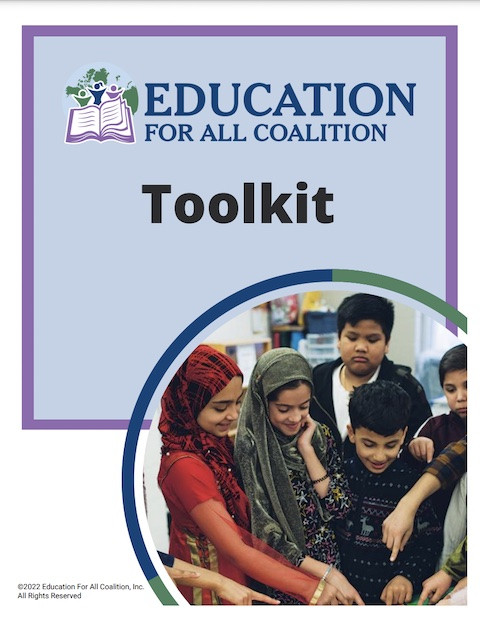 Education for All Coalition: Toolkit Year of publication: 2022 Corporate author: Education for All Coalition (EFAC) Education for All Coalition (EFAC), Inc. is a global organization that is dedicated to creating education opportunities and finding solutions that empower displaced and disadvantaged children in emergency situations, refugee camps and settlements around the world. We focus on advocacy, capacity building, climate education, and social-emotional learning to enhance the overall well-being of children. We promote the physical, social, and cognitive development of all children. Fostering healthy life habits and environmental sustainability are integral parts of our programs to improve conditions for all children so they can become thriving global citizens with global competencies and unlimited potentialThe goal of the “Where Friendship Blooms” resource guide is to foster a fun-filled program for early learners up to age 8 that will result in evidence-based positive outcomes. The package includes: Lesson plans Coping strategies Activities and play Breathing exercises Classroom Growth Chart Tool Classroom Climate Scale Tool Student Goal Setting Chart Measurement & Evaluation
 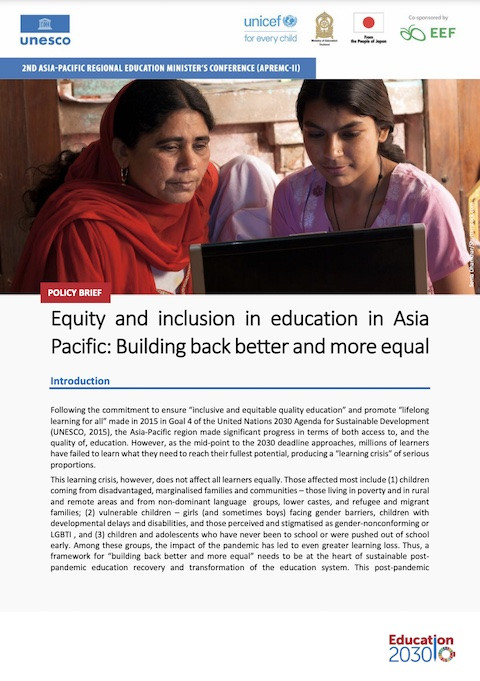 Equity and Inclusion in Education in Asia Pacific: Building Back Better and More Equal; Policy Brief Year of publication: 2022 Corporate author: UNESCO Bangkok Following the commitment to ensure “inclusive and equitable quality education” and promote “lifelong learning for all” made in 2015 in Goal 4 of the United Nations 2030 Agenda for Sustainable Development (UNESCO, 2015), the Asia-Pacific region made significant progress in terms of both access to, and the quality of, education. However, as the mid-point to the 2030 deadline approaches, millions of learners have failed to learn what they need to reach their fullest potential, producing a “learning crisis” of serious proportions. This learning crisis, however, does not affect all learners equally. Those affected most include (1) children coming from disadvantaged, marginalised families and communities – those living in poverty and in rural and remote areas and from non-dominant language groups, lower castes, and refugee and migrant families; (2) vulnerable children – girls (and sometimes boys) facing gender barriers, children with developmental delays and disabilities, and those perceived and stigmatised as gender-nonconforming or LGBTI , and (3) children and adolescents who have never been to school or were pushed out of school early. Among these groups, the impact of the pandemic has led to even greater learning loss. Thus, a framework for “building back better and more equal” needs to be at the heart of sustainable postpandemic education recovery and transformation of the education system. This post-pandemic framework calls for decisive action to protect the right to education of good quality and for measures – as spelled out below – to improve learning outcomes, especially for marginalized children made more vulnerable because of the pandemic.
 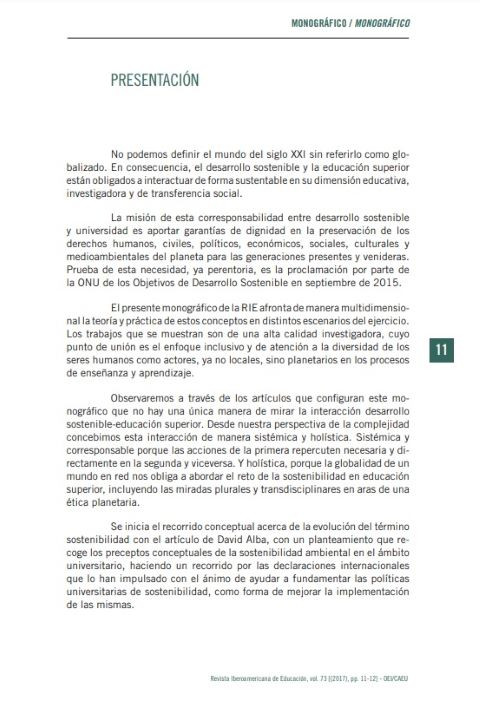 Presentation: Sustainable Development and Higher Education in a Global World (Revista Iberoamericana De Educación; vol.73) Year of publication: 2017 We cannot define the world of the 21st century without referring to it as globalized. Consequently, sustainable development and higher education are obliged to interact sustainably in their educational, research and social transfer dimensions. This document presents a monograph on the RIE in which the theory and practice of these concepts are addressed in a multidimensional way in different scenarios of the exercise. The works that are shown are of a high research quality, whose point of union is the inclusive approach and attention to the diversity of human beings as actors, no longer local, but planetary in the teaching and learning processes. Presentación: Desarrollo sostenible y educación superior en un mundo global (Revista Iberoamericana De Educación; vol.73) Year of publication: 2017 No podemos definir el mundo del siglo XXI sin referirlo como globalizado. En consecuencia, el desarrollo sostenible y la educación superior están obligados a interactuar de forma sustentable en su dimensión educativa, investigadora y de transferencia social. En este documento se presenta un monográfico de la RIE en el que se afronta de manera multidimensional la teoría y práctica de estos conceptos en distintos escenarios del ejercicio. Los trabajos que se muestran son de una alta calidad investigadora, cuyo punto de unión es el enfoque inclusivo y de atención a la diversidad de los seres humanos como actores, ya no locales, sino planetarios en los procesos de enseñanza y aprendizaje.
 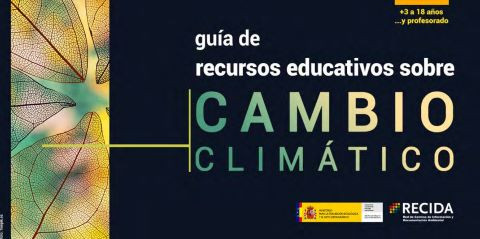 Guide to Educational Resources on Climate Change Year of publication: 2020 Author: Rosario Toril Moreno | Teresa Antolín García | Carmen García Valcárcel | Gema Herranz Aparicio | Isabel Matesanz Miguel y Antonio Moreno Rodríguez Corporate author: Spain. Ministry for Economic Transition and the Demographic Challenge This educational resource guide on climate change is organized according to the educational stages: infant, primary and secondary, a section for environmental educators has also been incorporated. Various resources have been included within each stage: books, magazines, games, websites, apps, videos, etc. When the resource is digital, the download link is provided and the rest can be found at the RECIDA centers and requested on loan, or purchased at bookstores or the corresponding publishers. In general, the documents that are included in the guide are published from 2015 to the present, although some of earlier dates have been maintained, considering that they have not lost their relevance and are of sufficient quality. Guía de recursos educativos sobre cambio climatico Year of publication: 2020 Author: Rosario Toril Moreno | Teresa Antolín García | Carmen García Valcárcel | Gema Herranz Aparicio | Isabel Matesanz Miguel y Antonio Moreno Rodríguez Corporate author: Spain. Ministry for Economic Transition and the Demographic Challenge Esta guía de recursos educativos sobre cambio climático está organizada según las etapas educativas: infantil, primaria y secundaria, también se ha incorporado un apartado para los/las educadoras ambientales. Dentro de cada etapa se ha incluido recursos variados: libros, revistas, juegos, webs, apps, vídeos, etc. Cuando el recurso es digital, se facilita el enlace de descarga y los demás se pueden encontrar en los centros RECIDA y solicitarlos en préstamo, o bien adquirirlos en librerías o en las editoriales correspondientes. En general, los documentos que se incluyen en la guía están publicados desde 2015 hasta la actualidad, aunque se han mantenido algunos de fecha anterior por considerar que no han perdido actualidad y tienen suficiente calidad.