
Resources
Explore a wide range of valuable resources on GCED to deepen your understanding and enhance your research, advocacy, teaching, and learning.
2,199 Results found
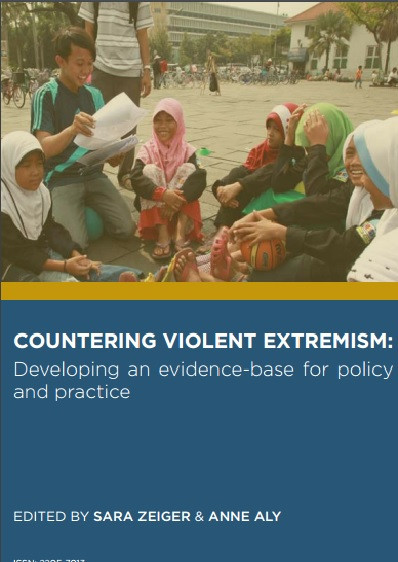 COUNTERING VIOLENT EXTREMISM: Developing an evidence-base for policy and practice Year of publication: 2015 Author: Sara Zeiger | Anne Aly Corporate author: Hedayah | Curtin University Ce rapport présente une gamme des documents présentés à la Conférence annuelle de recherche sur la lutte contre l’extrémisme violent (CVE), qui a eu lieu du 7 au 8 décembre 2014 à Abou Dhabi, aux Emirats Arabes Unis. Il présente deux études de cas sur l’implication des acteurs non étatiques au sein de la communauté, à savoir les familles, les dirigeants communautaires et les jeunes.
  Focus on Global Common Good:The New International Research Trend on World Citizenship Education Year of publication: 2018 Author: Song Qiang | Rao Congman Globalization has posed challenges for national-states to develop traditional citizenship education. To develop the citizenship education in the world needs to regard education and knowledge as global common good, surpass short- term benefit,and promote learners to be world citizens by 2030. Start with the dialectical logic on global benefit and national benefit,the researches of world citizenship education focus on“human rights protection and joint development”,“from national identity to world identity”,“from global governance to world government”, and “western universal mind vs. multi- civilizations intergrowth”. Chinese citizenship education needs to reinforce the national identity in socialism national citizenship education; cultivateing socialism world citizenship and promoteing international discourse power;seek human common good and build community of common destiny for all mankind. 着眼全球共同利益:“世界公民”教育的国际研究新趋势 Year of publication: 2018 Author: Song Qiang | Rao Congman 全球化对民族国家开展的传统公民教育提出了挑战。全球公民教育发展需要将教育和知识视为全球共同利益,超越短期利益,推进学习者成为2030年的“世界公民”。当前“世界公民”教育研究本着全球利益与国家利益的辩证逻辑,聚焦在“人权保护与共同发展”“国家认同到世界认同”“全球治理到世界政府”“西方式普适思想与多元文明共生”四个方面。为此,我国公民教育要加强社会主义“国家公民”教育中的国家认同;培养社会主义“世界公民”,提升国际话语权;寻求人类共同利益,构建“人类命运共同体”。
  Multicultural Citizenship Education In America and Implication for National Minority Education in our Country Year of publication: 2016 Author: Wang wenli | Wang Jian Complex multicultural society background has brought many difficulties to the development of America. The education for children from poor immigrant families has become the focus of the citizenship education with elimination racial prejudice as it score objective. To reconstruct the multicultural citizenship Education in America, the relationship between different races should be improved, and ethnic prejudice And discrimination must be eliminated. Meanwhile, students of different gender, from diverse races, and with varied ethnic and language backgrounds should be helped to acquire knowledge, values and skills. So that they can participate actively in individual, social and civic activities to construct a democratic Society of justice and fair, and to build a system of citizenship education evolving from nationalism to Globalism. China, as a multinational and multicultural country, should also expand the connotation of Citizenship education in terms of its education ideas and methods. Citizenship education in our country should also be reformed from its objectives, contents and methods to fit the needs of China in the context of Globalization. 美国多元文化公民教育及对我国公民教育的启示 Year of publication: 2016 Author: Wang wenli | Wang Jian 复杂的多元文化社会背景给美国的发展带来诸多困境。贫困移民子女的教育成为公民教育的重点,消除种族偏见成为公民教育的核心目标。重构美国多元文化公民教育,应通过改善各族群关系,消除民族偏见与歧视,让所有学生,不分性别、种族、民族及语言背景都有权利获取有效的知识和技能、形成正确的态度和价值观,从而参与到跨文化的个人、社会、公民活动中去,构建公平、公正的民主社会,构建一个从民族主义到国家主义再到世界主义的全球公民教育体系。中国作为多民族多文化的国家,在教育的理念与方法上,也要扩大公民教育的内涵。从民族成员到国家公民再到全球公民,我国的公民教育也要从目标、内容与方法方面进行深入的改革以适应全球化时代中国作为世界主义国家的需求。
  The Lack of Global Citizenship Education in China and Measurements for Improvement Year of publication: 2014 Author: Liu Qihong | Feng Jianjun Education needs to adapt to the needs of globalization and cultivate global citizens of global consciousness. Despite the fact that many countries in the world have attached importance to global citizenship education and China has also carried out related educational activities, there are still many problems in the implementation process according to the survey of middle school teachers. In order to solve these problems, in addition to the effort of front-line teachers, China's global citizenship education also needs the attention of schools, the reform of curriculum, and the policy support from the education administration. 我国世界公民教育的缺失及改善对策 Year of publication: 2014 Author: Liu Qihong | Feng Jianjun 教育作为培养人的活动,需适应全球化需求培养具有世界意识的世界公民。虽然世界上有很多国家开始重视世界公民教育,我国也开展了相关的教育活动,但从对中学教师的调查来看,各学校开展的世界公民教育还存在很多问题。为消解这些问题,我国世界公民教育除了要依靠一线教师在教学中的渗透,还需要学校的重视、课程的改革以及教育行政部门的政策支持。
 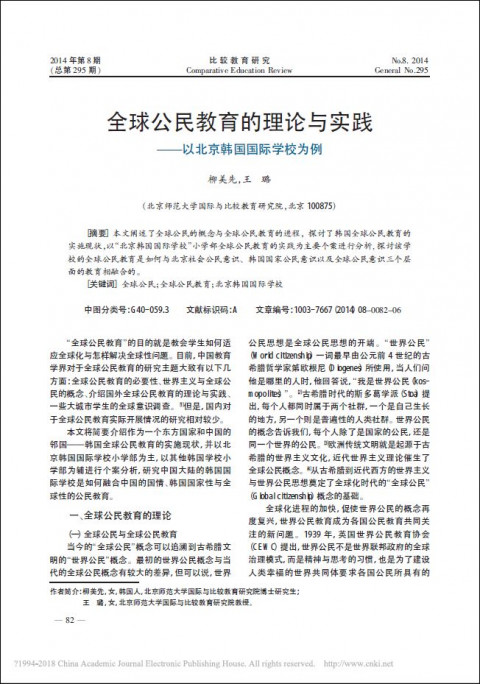 The Theory and Practice of Global Citizenship Education in Korean International School in Beijing Year of publication: 2014 Author: LIU Mei-xian | WANG Lu The purpose of this research is to explore the theory and practice of the global citizenship education of The Korean International School in Beijing. First,I outlined the concept and the theory of the global citizenship education. Second,I inquired the situation of global citizenship education of Korea. Third,I analyzed the curriculum of the elementary course of the Korean International School in Beijing in the viewpoint of global citizenship education. This research comes to the conclusion that the global citizenship education of this school is composed of three dimensions: Beijing citizenship,Korean citizenship and global citizenship in balance. 全球公民教育的理论与实践 —— 以北京韩国国际学校为例 Year of publication: 2014 Author: LIU Mei-xian | WANG Lu 本文阐述了全球公民的概念与全球公民教育的进程,探讨了韩国全球公民教育的实施现状,以“北京韩国国际学校”小学部全球公民教育的实践为主要个案进行分析,探讨该学校的全球公民教育是如何与北京社会公民意识、韩国国家公民意识以及全球公民意识三个层面的教育相融合的。
 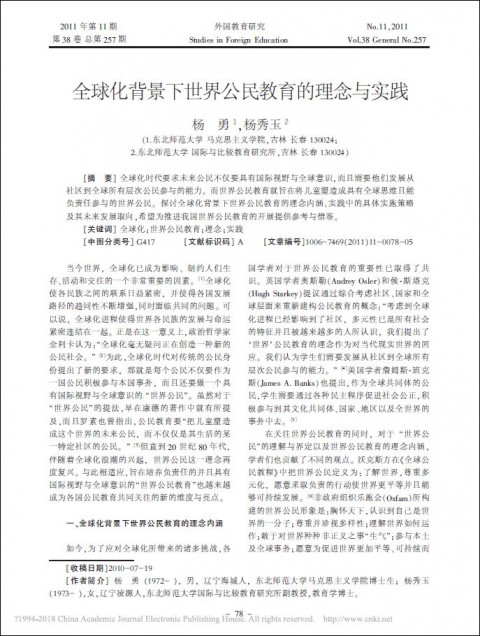 The Concept and Practice of Global Citizenship Education under the Background of Globalization Year of publication: 2011 Author: Yang Yong | Yang Xiuyu The age of globalization requires the future citizens not only have international visual field and global consciousness,but also have the ability of participation as citizens in the affairs at all the levels from communities to global. The global citizenship education aims at cultivating children to be global citizens who have global thinking and ability of responsible participation. The probe into the concept connotation,the specific implementation in practice and future development orientation of global citizenship education under the background of globalization can provide some important reference for promoting the development of global citizenship education in China.