
Resources
Explore a wide range of valuable resources on GCED to deepen your understanding and enhance your research, advocacy, teaching, and learning.
1,180 Results found
 Education 2030: Déclaration d'Incheon et Cadre d'action pour la mise en oeuvre de l'Objectif de développement durable 4: Assurer à tous une éducation équitable, inclusive et de qualité et des possibilités d'apprentissage tout au long de la vie Year of publication: 2016 Corporate author: Organisation des Nations Unies pour l'éducation, la science et la culture (UNESCO) La Déclaration d’Incheon présente la vision collective et l’engagement de la communauté internationale envers l’éducation mondiale. Le Cadre d’action 2030 fournit des directives pour l’attente de l’Objectif de développement durable 4. Educación 2030: Declaración de Incheon y Marco de Acción para la realización del Objetivo de Desarrollo Sostenible 4: Garantizar une aducación inclusiva y equitativa de calidad y promover oportunidades de aprendizaje permanente para todos Year of publication: 2016 Corporate author: UNESCO The Incheon Declaration articulates the collective vision and commitment of the international community on global education. The 2030 Framework for Action provides guidance for the implementation of Sustainable Development Goal 4. 2030年教育:仁川宣言和行动框架实现可持续发展目标4——确保包容和公平的优质教育,让全民终身享有学习机会 Year of publication: 2016 Corporate author: UNESCO 《仁川宣言》阐明了国际社会在全球教育方面的集体愿景和承诺。“2030年行动框架”为可持续发展目标4的实施提供了指导。
  Education for People and Planet: Creating Sustainable Futures for All, Global Education Monitoring Report, 2016 Year of publication: 2016 Corporate author: UNESCO | Global Education Monitoring Report Team Education for People and Planet: Creating Sustainable Futures for All explores the complex relationship between education and the new 2030 Agenda for Sustainable Development, covering six fundamental pillars – Planet, Prosperity, People, Peace, Place and Partnerships. This report shows that education will not deliver its full potential unless participation rates increase dramatically and sustainable development guides education system reform. It also warns of the destructive impact that climate change, conflict, unsustainable consumption and the increasing gap between rich and poor have on education. A huge transformation is needed if we are to create sustainable futures for all.
  [Summary] Education for People and Planet: Creating sustainable Futures for All, Global Education Monitoring Report, 2016; Summary Year of publication: 2016 Corporate author: UNESCO Education for People and Planet: Creating Sustainable Futures for All explores the complex relationship between education and the new 2030 Agenda for Sustainable Development, covering six fundamental pillars – Planet, Prosperity, People, Peace, Place and Partnerships. This report shows that education will not deliver its full potential unless participation rates increase dramatically and sustainable development guides education system reform. It also warns of the destructive impact that climate change, conflict, unsustainable consumption and the increasing gap between rich and poor have on education. A huge transformation is needed if we are to create sustainable futures for all.
  Stratégie du réSEAU pour 2014-2021 Un réseau mondial d’ecoles pour répondre aux défis mondiaux: renforcer la citoyenneté mondiale et promouvoir le développement durable Year of publication: 2014 Corporate author: UNESCO Associated Schools Project Network (ASPnet) Over the next 8 years (2014-2021), ASPnet needs to respond to the needs of education in a rapidly changing and increasingly complex world. The following strategy, therefore, has to remain flexible and requires regular re-evaluation in the light of a changing environment. Globalization and growing interconnectedness ask for increased networking and cooperation. ASPnet has proven to have a great potential for global school networking and educational innovations, which remain largely untapped. UNESCO can make much fuller use of ASPnet in its quest for and implementation of a successful Post-2015 Global Education Agenda.
  Arts Education for the Children of the Arab World as a Mediator for Development and the Axis of International Understanding: The Child's Song Year of publication: 2014 Author: Amal Sadiq Corporate author: Arab Council for Childhood and Development (ACCD) This paper focuses on art education and music in the Arab world and its link to development. The paper goes on critical understanding on how music and art can educate children for international understanding. تعليم الفنون لأطفال العالم العربى وسيط للتنمية ومحور التفاهم الدولى : أغنية الطفل Year of publication: 2014 Author: Amal Sadiq Corporate author: Arab Council for Childhood and Development (ACCD) تركز الورقة على التربية الفنية والموسيقى في الوطن العربي وصلتها بالتنمية. تتناول الورقة فهمًا نقديًا لكيفية تعليم الموسيقى والفن للأطفال من أجل التفاهم الدولي.
 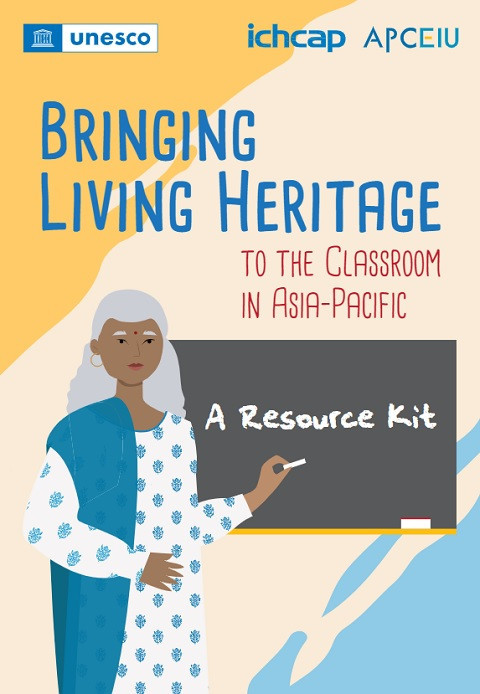 Bringing Living Heritage to the Classroom in Asia-Pacific: A Resource Kit Year of publication: 2022 Corporate author: UNESCO Bangkok | APCEIU | International Information and Networking Centre for Intangible Cultural Heritage in the Asia-Pacific Region (ICHCAP) Integrating living heritage in school teaching and learning can enhance education quality, enliven the experiences of students and teachers, and contribute to keeping this heritage alive for current and future generations. In addition, as the ongoing COVID-19 pandemic has also demonstrated, living heritage can play an important role in ensuring the well-being and resilience of communities. UNESCO encourages countries to safeguard living heritage through formal and non-formal education. From the end of 2019 to early 2022, UNESCO has been working with partners to implement a pilot project “Teaching and Learning with Living Heritage in Schools” in six countries in Asia and the Pacific - including Cambodia, Kazakhstan, Kyrgyzstan, Nepal, Republic of Korea and Thailand. Over 1900 students from 21 schools had the opportunity to participate in these innovative classes. Throughout the process, 86 teachers, with more than two thirds being women, have developed and tested 101 lesson plans and activities. This Resource Kit provides step-by-step guidance and key resources on why and how to integrate living heritage in lessons and extracurricular activities in schools. Whoever you are – policy-maker, school director, teacher, student, parent, heritage practitioner – you have a vital role to play in this process.
  A Pedagogical Guide on Global Citizenship Education in Korean Context Year of publication: 2015 Corporate author: APCEIU APCEIU has published a pedagogical guide on Global Citizenship Education (GCED) for Korean readers, which is the Korean adaptation of the UNESCO pedagogical guide, GCED: Topics and Learning Objectives (a.k.a. TLOs).Following the recently launched Korean translation of the TLOs, this Korean adaptation contextualizes the TLOs in Korean education, aligns its terminologies with Korean curriculum, and provides further explanations for Korean readers. This guide was developed by professors in the field of teacher education, primary and secondary school teachers, and curriculum developers with special expertise in GCED/EIU.It is hoped that this guide will help Korean educators and key stakeholders better understand GCED as a new pedagogy and also reflect on traditional teaching-learning experiences in various respects.