
Resources
Explore a wide range of valuable resources on GCED to deepen your understanding and enhance your research, advocacy, teaching, and learning.
3,451 Results found
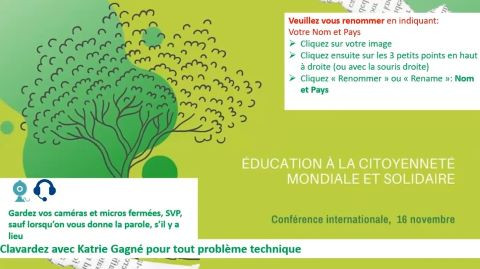 Conférence internationale sur l'Éducation à la citoyenneté mondiale et la solidarité internationale Year of publication: 2022 Corporate author: Association québécoise des organismes de coopération internationale (AQOCI) Partage de pratiques et de réflexions sur l'éducation à la citoyenneté mondiale et solidaire. Conférence initiée par le comité international du Festival des Solidarités (Festisol) et animée par l'AQOCI (Association québécoise des organismes de coopération internationale). Plusieurs intervenants venant de plusieurs pays discutent des enjeux de l’approche décoloniale de l’éducation à la citoyenneté mondiale. L’émancipation possible des gens marginalisés est explorée.
  State of the World's Forests 2022: Green Recovery, Creating Inclusive and Sustainable Economies Year of publication: 2022 Corporate author: Food and Agriculture Organization of the United Nations (FAO) Forests stand as a vital defense against climate change and biodiversity loss, while also providing livelihoods for millions of people across the world. But they are under threat. In the last 30 years, they’ve lost an area larger than Algeria and Libya combined. FAO’s latest State of the World’s Forests (SOFO) report identifies three pathways that can conserve forests while supporting environmental and economic recovery: halting deforestation, restoring degraded forests, and sustainably using forests to build resilient local economies. La Situation des forêts du monde 2022: Relance verte, créer des économies inclusives et durables Year of publication: 2022 Corporate author: Food and Agriculture Organization of the United Nations (FAO) Le rôle des forêts dans les écosystèmes de vie et les menaces actuelles. La perte des terres et le besoin de stopper la déforestation, de restaurer les forêts et d’intensifier l’utilisation durable.
 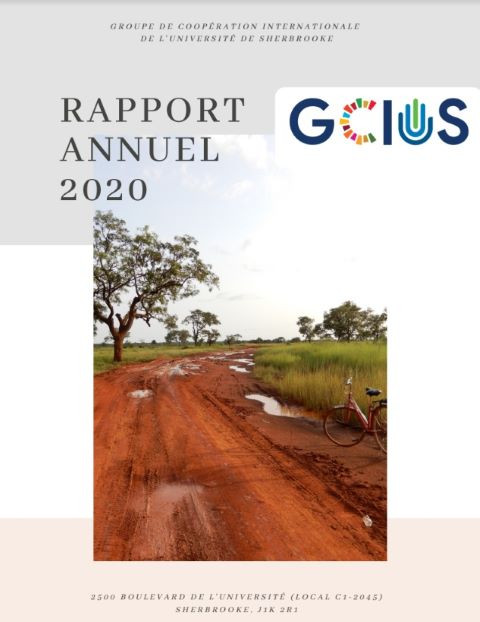 Annual Report 2020 Year of publication: 2020 Corporate author: University of Sherbrooke. International Cooperation Group The GCIUS has set itself the task of encouraging the emergence of sustainable development of local communities in the countries of intervention and UdeS students, through supportive, inclusive, and dynamic networks. The GCIUS supports students and local communities in the co-construction of multidisciplinary sustainable development projects aimed at improving living conditions for communities in need. Rapport annuel 2020 Year of publication: 2020 Corporate author: Université de Sherbrooke. Groupe de Coopération Internationale Le GCIUS s'est donné pour mission de favoriser l'émergence d'initiatives de développement durable des communautés locales dans les pays d'intervention et des étudiant.e.s de l'UdeS, via des réseaux solidaires, inclusifs et dynamiques. Le GCIUS appuie les étudiant.e.s et les communautés locales dans la coconstruction de projets multidisciplinaires de développement durable visant l'amélioration des conditions d'existence auprès des communautés dans le besoin.
  Security, Food and Nutrition in the World Year of publication: 2022 Corporate author: Food and Agriculture Organization of the United Nations (FAO) This report repeatedly highlights the intensification of the main factors of food insecurity and malnutrition: conflicts, climatic phenomena extremes, and economic shocks, the effects of which combine with those of the increase in some inequalities. The issue is not whether more trials are to come or not; it's about rather taking matters into their own hands with more courage and building resilience in the face of future shocks.
  Strengthening Social and Emotional Learning in Hybrid Modes of Education: Building Support for Students, Teachers, Schools and Families Year of publication: 2024 Corporate author: UNESCO International Bureau of Education (IBE) This Discussion Paper focuses on the essential role of social and emotional learning (SEL) in the global movement to transform education and amplify its social, economic, environmental and personal impacts in a rapidly changing world. It explores how the mainstreaming of SEL into educational policies and practices can contribute to realizing future visions of education that are flexible, reflective, innovative, and impactful. Specifically, the Paper focuses on six topics that, as a whole, reflect global experiences in integrating and implementing SEL in its various forms both during and in the wake of the COVID-19 pandemic. Its main objective is to animate discussion on how to integrate a SEL dimension in hybrid modes of teaching and learning. This introductory overview presents the overall purpose and scope of the Paper, defines its underlying concepts and introduces the topics brought to this forum through the lenses of a diverse group of educators from Africa, the Arab States, Asia, Europe, and Latin America.
  Les clichés du gaming, comment chasser le racisme ou le patriarcat des jeux vidéos ? Year of publication: 2024 Corporate author: France Inter Produit phare de l’industrie culturelle, le jeu vidéo a, au même titre que le cinéma, une dimension politique et sociale. Certains titres, ont été jugés comme étant racistes. Alors, comment décoloniser le jeu vidéo ?A flagship product of the cultural industry, video games have, like cinema, a political and social dimension. Some titles, like Resident Evil 5, have been deemed racist. So how do we decolonize video games?
 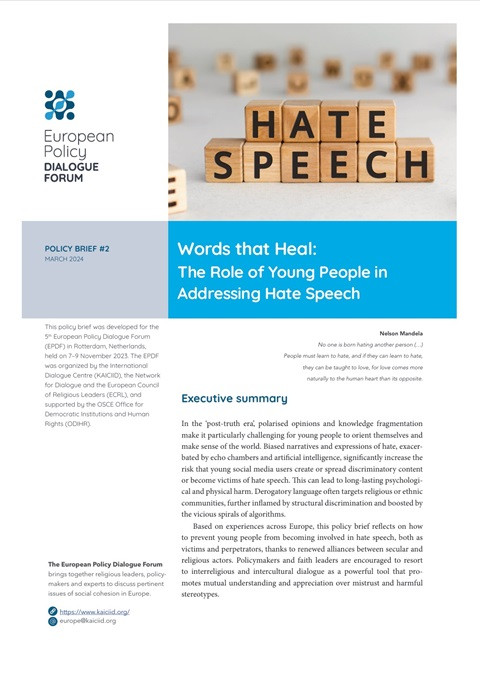 Words that Heal: The Role of Young People in Addressing Hate Speech (EPDF Policy Brief No. 2) Year of publication: 2024 Corporate author: International Dialogue Centre (KAICIID) In the ‘post-truth era’, polarised opinions and knowledge fragmentation make it particularly challenging for young people to orient themselves and make sense of the world. Biased narratives and expressions of hate, exacerbated by echo chambers and artificial intelligence, significantly increase the risk that young social media users create or spread discriminatory content or become victims of hate speech. This can lead to long-lasting psychological and physical harm. Derogatory language often targets religious or ethnic communities, further inflamed by structural discrimination and boosted by the vicious spirals of algorithms. Based on experiences across Europe, this policy brief reflects on how to prevent young people from becoming involved in hate speech, both as victims and perpetrators, thanks to renewed alliances between secular and religious actors. Policymakers and faith leaders are encouraged to resort to interreligious and intercultural dialogue as a powerful tool that promotes mutual understanding and appreciation over mistrust and harmful stereotypes.
  Artificial Intelligence and Democracy Year of publication: 2024 Author: Daniel Innerarity Corporate author: UNESCO Montevideo | Latin American Council of Social Sciences (CLACSO) UNESCO’s Recommendation on the Ethics of Artificial Intelligence, adopted by all Member States in November 2021, is the first global policy framework for artificial intelligence (AI) and outlines different aspects of this technology that directly impact political life. The initial considerations of the Recommendation outline the potential ramifications of AI across diverse domains, notably its implications for democracy. This report builds on these analyses and recommendations, aligning with the core values and principles outlined in the Recommendation. It delves into the current and potential impact of artificial intelligence on democracy and the benefits that both artificial intelligence and digitalization, in general, could bring to enhancing collective decision-making processes. This analysis is structured around four key topics:1. The democratic expectations and disappointments of digitization2. The new digital public space: the democratic conversation3. The democracy of data: the politics of Big Data4. Democracy as a form of political decision-making: algorithmic governance Finally, this report offers recommendations for the democratic governance of artificial intelligence aimed at mitigating neative impacts and fostering a more democratic approach to AI governance.