
Resources
Explore a wide range of valuable resources on GCED to deepen your understanding and enhance your research, advocacy, teaching, and learning.
1,727 Results found
 The Effect of Integration in Kindergarten in Improving Verbal and Non-Verbal Communication among Children with Autism spectrum Disorder Year of publication: 2023 Author: Bin Fatima Maryam Corporate author: University of Blida 2 This study aimed to identify the effect of integration in kindergartens on improving verbal and non-verbal communication among children with autism spectrum disorder by presenting the development of a group of seven children (3-4) years old who were diagnosed with autism spectrum disorder and then integrating them for a full year in kindergartens. The study, based on the Cars scale for estimating childhood autism, the verbal and non-verbal communication test, and the Brunet-Lèzine test, found that there are statistically significant differences between integration in kindergarten and both verbal and non-verbal communication, the degree of estimation of childhood autism, and the coefficient of the growth. أثر الدمج في رياض الأطفال في تحسين التواصل اللفظي و غير اللفظي لدى الأطفال المصابين باضطراب طيف التوحد Year of publication: 2023 Author: Bin Fatima Maryam Corporate author: University of Blida 2 هدفت هذه الدراسة إلى التعرف على أثر الدمج في رياض الأطفال على تحسين التواصل اللفظي وغير اللفظي لدى الأطفال المصابين باضطراب طيف التوحد بتقديم تطوُر لمجموعة من سبعة أطفال( 3- 4) سنوات تم تشخيصهم باضطراب طيف التوحد ثم دمجهم لمدة عام كامل في رياض الأطفال. و توصلت الدراسة بالاعتماد على مقياس كارز لتقدير التوحد الطفولي ، و اختبار التواصل اللفظي وغير اللفظي ، و اختبار بروني ليزين إلى وجود فروق دالة إحصائيا بين الدمج في رياض الأطفال و كل من التواصل اللفظي وغير اللفظي و درجة تقدير التوحد الطفولي و معامل النمو.
  Indicators for evaluating municipal policies aimed at fighting racism and discrimination Year of publication: 2005 Author: Jean Claude Icart | Micheline Labelle | Rachad Antonius Corporate author: Centre de recherche sur l'immigration, l'ethnicité et la citoyenneté (Canada). Observatoire international sur le racisme et les discriminations Ethnocultural diversity increasingly constitutes an important characteristic of major cities around the world. As the primary centres for national, ethnic and cultural intermixing, cities are becoming laboratories for new ways of “living together” (UNESCO, 2004). However, when this diversity is accompanied by inequalities, racism and discrimination, it can increase the social divide. Therefore, in order to benefit from the true advantages of the ethnocultural diversity that makes up the fabric of contemporary societies, it has become increasingly necessary to employ methods to correct social injustices, and to ensure the equality and the full exercise of citizens’ rights. Accordingly, the last few years have seen true efforts to conceptualize interventions by cities to manage ethnocultural diversity. These efforts rely on ideologies controlled by the state and on the values of equality, social justice, and respect for pluralism that are endorsed by different international organizations such as the UN and UNESCO, or by national organizations such as human rights commissions.To promote and reinforce municipal anti-discriminatory policies, UNESCO supported the launching of the International Coalition of Cities Against Racism1. The initial framework for this Coalition was the proposal of the Ten-Point Action Plan, which was adopted in December 2004 in Nuremburg.The present research report relating to the development of a series of indicators for evaluating municipal policies to fight racism and discrimination should be situated in this context. It was carried out with the goal of assisting cities that want to adopt public policies of diversity management and to fight racism and discrimination, and to evaluate the impact of such policies. The goal is to equip cities with tools that make it possible to evaluate, in quantitative and/or qualitative terms, whether their actions produce results that correspond to the major goals of adopted policies. Indicateurs pour l'évaluation des politiques municipales visant à contrer le racisme et la discrimination Year of publication: 2005 Author: Jean Claude Icart | Micheline Labelle | Rachad Antonius Corporate author: Centre de recherche sur l'immigration, l'ethnicité et la citoyenneté (Canada). Observatoire international sur le racisme et les discriminations Ethnocultural diversity increasingly constitutes an important characteristic of major cities around the world. As the primary centres for national, ethnic and cultural intermixing, cities are becoming laboratories for new ways of “living together” (UNESCO, 2004). However, when this diversity is accompanied by inequalities, racism and discrimination, it can increase the social divide. Therefore, in order to benefit from the true advantages of the ethnocultural diversity that makes up the fabric of contemporary societies, it has become increasingly necessary to employ methods to correct social injustices, and to ensure the equality and the full exercise of citizens’ rights. Accordingly, the last few years have seen true efforts to conceptualize interventions by cities to manage ethnocultural diversity. These efforts rely on ideologies controlled by the state and on the values of equality, social justice, and respect for pluralism that are endorsed by different international organizations such as the UN and UNESCO, or by national organizations such as human rights commissions.To promote and reinforce municipal anti-discriminatory policies, UNESCO supported the launching of the International Coalition of Cities Against Racism1. The initial framework for this Coalition was the proposal of the Ten-Point Action Plan, which was adopted in December 2004 in Nuremburg.The present research report relating to the development of a series of indicators for evaluating municipal policies to fight racism and discrimination should be situated in this context. It was carried out with the goal of assisting cities that want to adopt public policies of diversity management and to fight racism and discrimination, and to evaluate the impact of such policies. The goal is to equip cities with tools that make it possible to evaluate, in quantitative and/or qualitative terms, whether their actions produce results that correspond to the major goals of adopted policies.
  Référentiel des compétences développées en éducation à la citoyenneté mondiale et solidaire à l’âge de l’obligation scolaire Year of publication: 2017 Corporate author: Annoncer la Couleur (ALC) | La coopération belge au développement | Centre de Connaissances en Éducation à la Citoyenneté Mondiale (WikiCM) Ce référentiel de compétences ECM(Éducation à la citoyenneté mondiale) a été élaboré par WikiCM, le centre de connaissances en éducation à la citoyenneté mondiale coordonné par Annoncer la Couleur a réuni des professionnels de l’enseignement (administration, réseaux, inspection) et de l’éducation à la citoyenneté mondiale (ONG, ALC). Il présente dans un premier temps les repères sur les stades de développement de l’enfant et, dans un deuxième temps, les 7 compétences de l’ECM en milieu scolaire.
 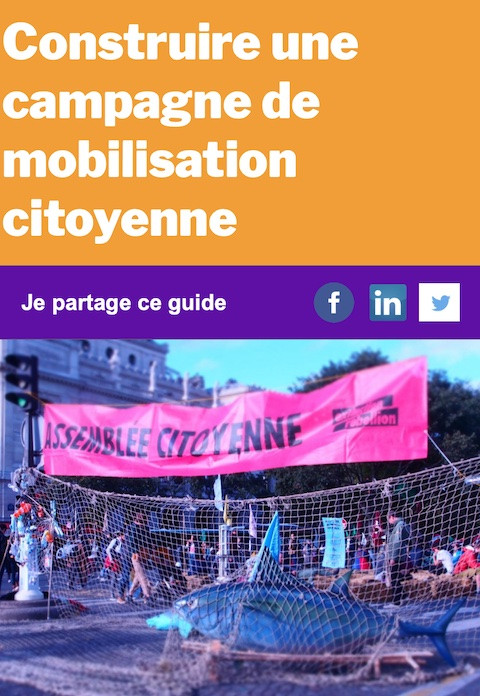 Construire une campagne de mobilisation citoyenne: Je partage ce guide Corporate author: L'accélérateur de la mobilisation (France) Ce kit est pour partager les bases de la création de campagnes de mobilisation citoyenne, générer de l’inspiration et donner l’envie à des groupes de citoyen.ne.s d’aller gagner des victoires concrètes.
  Citoyenneté mondiale: Une définition ignatienne Year of publication: 2019 Corporate author: Educate Magis Sont citoyens du monde ceux qui recherchent en permanence à approfondir leur propre conscience de leur place et de leur responsabilité, localement et globalement, dans un monde de plus en plus interconnecté ; sont citoyens du monde ceux qui sont solidaires des autres dans la poursuite d’une terre durable et d’un monde plus humain, comme véritables compagnons dans la mission de réconciliation et de justice. La Taskforce du Secrétariat sur la Citoyenneté Mondiale offre une définition ignatienne de la citoyenneté mondiale, ainsi que quelques questions directrices et un cadre pour intégrer les PAU et la Charte d’Engagements JESEDU-Rio2017 à les dimensions mondiale dans nos écoles jésuites. Ce travail intègre et s’appuie sur le matériel existant sur la citoyenneté mondiale rassemblé par la communauté mondiale.
 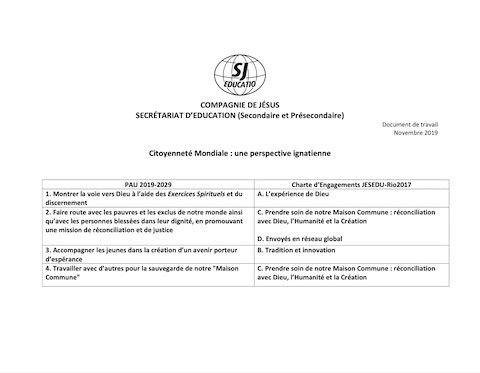 Citoyenneté mondiale: Une perspective ignatienne Year of publication: 2019 Corporate author: Educate Magis Ce tableau suit est un modèle qui présente des suggestions d’activités pour chaque région, province, établissement ou département éducatif, qui peuvent être utilisées comme exemples ou comme guides et qui peuvent être mises en œuvre et développées d’une manière adaptée à chaque situation ou besoin spécifique.
 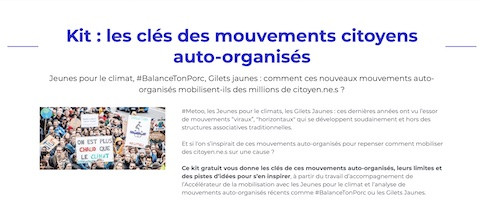 Kit: Les clés des mouvements citoyens auto-organisés Corporate author: L'accélérateur de la mobilisation (France) Ce kit gratuit vous donne les clés de ces mouvements auto-organisés, leurs limites et des pistes d’idées pour s’en inspirer, à partir du travail d’accompagnement de l’Accélérateur de la mobilisation avec les Jeunes pour le climat et l’analyse de mouvements auto-organisés récents comme #BalanceTonPorc ou les Gilets Jaunes.
  Let's Build a Fairer and More United World, with Young People from Here and Elsewhere Year of publication: 2021 Corporate author: Quebec Association of International Cooperation Organizations (AQOCI) Discussion panel organized as part of the Quebec Days of International Solidarity (JQSI) by the Regional Committee for Education for International Development of Lanaudière (CRÉDIL) and the Table de concertation jeunesse en solidarité Internationale (TCJSI) of AQOCI. The event took place on November 25, 2021, and presented the engagement projects of young people from here and elsewhere to highlight the importance of youth involvement for the construction of a fairer and more united world.